Tara O'Neill Hayes July 6, 2018
Earlier this week, the Centers for Medicare and
Medicaid Services (CMS) issued enrollment data for the Affordable
Healthcare Act’s (ACA) individual health insurance Exchanges, as well as trends regarding subsidized and
unsubsidized coverage in the total individual market from 2014-2017. The
biggest takeaways are that while overall enrollment in Exchange-sold plans
remained roughly the same this year as last year, over the past two years enrollment
by non-subsidized individuals in individual market plans (including those
bought off-Exchange) has declined, driving an overall decline in individual
market enrollment. This decline perhaps is not surprising, as premiums have
risen quite substantially.
As of March 2018, 10.6 million people had
enrolled in an individual market Exchange plan and paid their premiums (if they
owed one). This figure represents a 9 percent drop from the number of
individuals who selected a plan during the 2018 open enrollment period last Fall,
but a 3 percent increase from the 10.3 million people with effectuated
enrollment in February of last year. The average premium increased 27 percent from
2017, to $597 per month, but the average premium subsidy increased 39 percent,
to $520, more than offsetting the increased cost for most subsidy-eligible
enrollees. And there are more subsidy-eligible enrollees this year than last:
87 percent of current Exchange enrollees qualify for a subsidy, up from 84
percent last year.
There are a greater share of Exchange enrollees
qualifying for subsidies largely because individuals who do not qualify for a
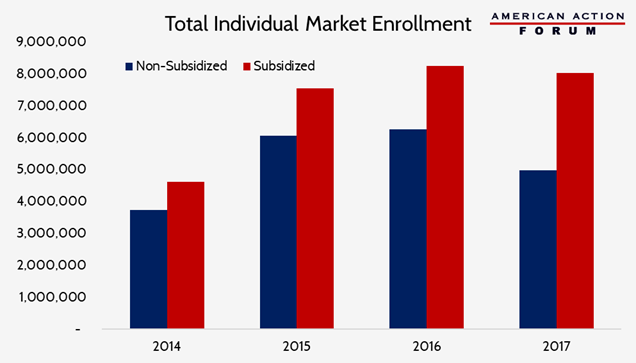
subsidy are simply dropping out of the market, as the chart below shows. In
2014, subsidized enrollees comprised barely more than half of all individual
market purchasers, including those buying plans off-Exchange; in 2017, 62
percent of all individual market enrollees had subsidized coverage. Nearly
three-fourths of individuals who visit the federal Exchange platform and who do
not purchase insurance consistently cite cost as the reason they ultimately
chose not to buy. From 2016 to 2017, enrollment among individuals who were not
eligible for subsidies dropped 20 percent (or 1.3 million people) at the same
time that average premiums increased 21 percent; subsidized enrollment only
decreased by 223,000 people for an overall decline of 10 percent in total
individual market insurance enrollment (including plans bought off-Exchange).
The impact varied across the states: 44 states experienced declines in overall
enrollment, and 20 states lost more than a quarter of their non-subsidized
enrollees, while five states plus the District of Columbia saw an increase in
non-subsidized enrollment.
The upshot here is that the higher prices are
leading to fewer people purchasing insurance, and the data bear this conclusion
out: The overall uninsured rate ticked up in 2017 for the first time
since the ACA was implemented.
https://www.americanactionforum.org/weekly-checkup/rising-insurance-premiums-pushing-out-non-subsidized-buyers/#ixzz5LRprDKO2
Follow: @AAF on Twitter

No comments:
Post a Comment