Dan Goldbeck August 6, 2018
Last week’s rulemakings generally trended in the
cost-reducing and paperwork-cutting direction. While 12 out of the 16 measures
with quantified cost-benefit analysis were merely proposed rules, the
Environmental Protection Agency (EPA) had a final rule that revised aspects of
an Obama-era coal regulation. Between both proposed and final rules, agencies
published roughly $628.9 million in net cost savings, and cut 1,675,822 hours
of paperwork. The per capita regulatory burden for 2018 is negative $16.88.
REGULATORY
TOPLINES
- New Proposed Rules: 51
- New Final Rules: 60
- 2018 Total Pages of Regulation: 38,003
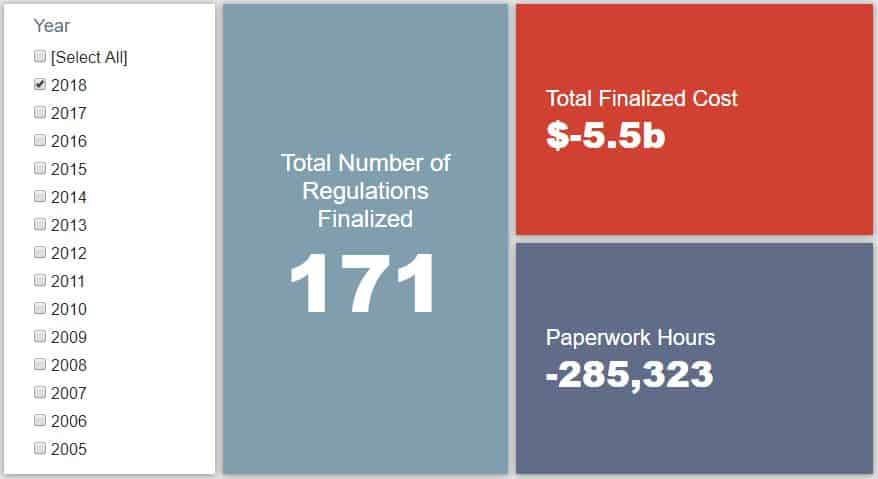
- 2018 Final Rules: -$5.5 Billion
- 2018 Proposed Rules: $12.9 Billion
TRACKING REGULATORY MODERNIZATION
The most significant rulemaking contributing
savings towards the Executive Order (EO) 13,771 regulatory budget for Fiscal
Year (FY) 2018 comes from EPA. This rule regarding “Hazardous and Solid Waste
Management System: Disposal of Coal Combustion Residuals [CCR] From Electric
Utilities; Amendments to the National Minimum Criteria” finalizes particular
revisions to Obama-era CCR regulations. EPA estimates that this action could
bring up to $31.4 million in annualized savings and $605 million over its
lifetime. Affected entities could expect even further cost reductions in the
future as other proposed changes become final.
According to American Action Forum (AAF)
analysis, since the start of FY 2018 (beginning Oct. 1, 2017), executive
agencies have promulgated 47 deregulatory actions with quantified estimates
against 10 regulatory measures, under the rubric created by EO 13,771 and the
administration’s subsequent guidance document on the matter. These
rules combine for net annual savings of roughly $1.3 billion. This means that
agencies have thus far surpassed the administration’s cumulative goal for FY 2018 of $687 million in net
annual savings. In fact, according to the administration’s latest Unified
Agenda, agencies are on track to roughly double that goal.
Click here to view AAF’s examination of
the administration’s progress under the “one-in, two-out” executive order
through the end of Fiscal Year 2017.
STATE OF MAJOR OBAMA-ERA INITIATIVES
There was one notable regulatory action related
to the Affordable Care Act (ACA). The administration’s rulemaking on
“Short-Term, Limited-Duration Insurance” went final last week. The rule would extend the allowable coverage
period for short term, limited duration (STLD) plans from three months to one
year with the option to renew such plans for up to three years. As AAF’s
Christopher Holt notes, “these changes represent a responsibly
measured effort by the administration to help uninsured individuals for whom
the ACA doesn’t provide a particularly viable option.” The agencies involved
provided qualitative analysis of the measure’s
costs and benefits.
Based on total lifetime costs of the
regulations, the ACA has imposed costs of $52.9 billion in final state and
private-sector burdens and 176.9 million annual paperwork hours.
Since passage, the Dodd-Frank financial reform
legislation has produced more than 82.9 million final paperwork burden hours
and imposed $38.9 billion in direct compliance costs.
TOTAL BURDENS
Since January 1, the federal government has
published $7.4 billion in net costs (despite $5.5 billion in net savings from
final rules) and paperwork burden cuts amounting to 748,255 hours (including
285,323 hours of paperwork reduced under final rules). Click
here for the latest Reg Rodeo findings.
https://www.americanactionforum.org/week-in-regulation/a-steady-deregulatory-week/#ixzz5O4VKvTx2
Follow us: @AAF on Twitter

No comments:
Post a Comment