 |
Just Released
|
|
|
List Prices Increased As Much As 9 Times Faster Than Inflation for 20
of the Top 25 Part D Drugs, Suggesting Potential for Savings Under Proposed
Inflation Rebate Policies
A
new KFF analysis finds that the list prices for most of
the top Medicare Part D drugs by total spending increased as much as nine
times the rate of inflation (1.7%) between 2016 and 2017, suggesting recent
Congressional proposals targeting such increases could generate savings for
Medicare and Part D enrollees.
The
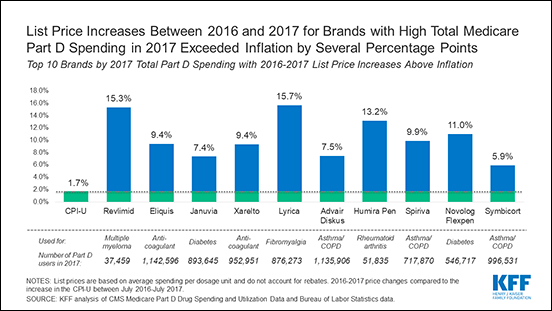
analysis finds 20 of the top 25 drugs, all of which were brand-name
medications, had price increases between three and more than nine times the
inflation rate during that year. In some cases, price increases were in the
double digits, far outstripping the inflation rate. These include 15.7% for
Lyrica, a pain medication used by 900,000 Part D enrollees; 15.3% for
Revlimid, a cancer drug used by 37,000 enrollees; and 13.2% for Humira Pen, a
medication for rheumatoid arthritis taken by 52,000 enrollees.
The
analysis is based on data from the CMS’s most recent Medicare Part D drug
spending dashboard. Of the 2,879 drugs reported in 2017 in the dashboard
(both brand-name and generic), 60 percent had list prices that increased
faster than inflation between 2016 and 2017.
The
analysis suggests the potential for savings to the Medicare program if drug
manufacturers limited price increases to the rate of inflation or paid a
rebate to the federal government. Medicare beneficiaries could also benefit
because Part D cost sharing often comes in the form of coinsurance, which is
calculated as a percentage of the list price. If the policy led to slower
growth in Part D program costs, enrollees could also see lower premiums.
KFF
did not analyze any specific provision in current legislation that would
require drug manufacturers to pay a rebate to the federal government if their
drug prices increase above the rate of inflation. Savings would depend on the
details of legislative proposals, as well as on the response of drug manufacturers,
such as increasing launch prices for drugs or decreasing existing rebates.
The analysis is based on pricing data that does not reflect existing
manufacturer rebates or discounts to plans, which are considered proprietary
and not publicly available.
Filling
the need for trusted information on national health issues, the Kaiser Family Foundation is
a nonprofit organization based in San Francisco, California.
|
||
|
||
|
Connect with us:
    |
||
Friday, October 18, 2019
List Prices Increased As Much As 9 Times Faster Than Inflation for 20 of the Top 25 Part D Drugs, Suggesting Potential for Savings Under Proposed Inflation Rebate Policies

Subscribe to:
Post Comments (Atom)
No comments:
Post a Comment