 |
Just Released
|
|
|
State Budgets for Fiscal Year 2020
Include Total Medicaid Spending Growth of 6.2 Percent on Average, Even As
Enrollment Remains Essentially Flat
Rising
Costs for Prescription Drugs, Provider Rate Increases and Care for the
Elderly and People with Disabilities Are Factors, Annual 50-State Survey
Finds
States
budgeted for total Medicaid spending to increase at a faster pace than
enrollment in fiscal year 2020, driven in part by rising costs for
prescription drugs, provider rate increases and higher costs associated with
caring for the elderly and disabled, according to KFF’s new 50-state Medicaid budget survey.
The
19th annual survey of state Medicaid directors finds that
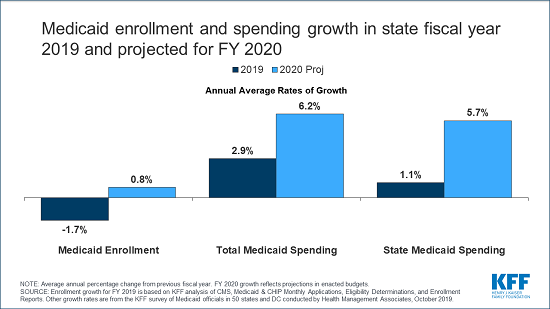
officials expect total Medicaid spending to climb 6.2 percent while
enrollment remains virtually flat, up 0.8 percent. This follows total
Medicaid spending growth of 2.9 percent for fiscal 2019, a year in which
enrollment declined 1.7 percent.
Officials
identified increasing costs for prescription drugs (particularly for
specialty drugs), provider rate increases (most often for managed care
organizations, hospitals, and nursing facilities) and pressures from the
aging population and long-term care costs as key upward drivers of total
Medicaid spending.
States
generally attributed enrollment declines to a stronger economy; however, some
states also pointed to process and systems changes including changes to
renewal processes, upgraded eligibility systems and enhanced data matching
efforts to verify eligibility as putting a downward pressure on enrollment.
Recent Census Bureau data show an increase in the number of uninsured in the
U.S., suggesting that some people losing Medicaid coverage may not gain
access to employer-based health benefits and are not buying their own
insurance.
State
Medicaid spending accounted for 37.5 percent of the $593 billion in overall
Medicaid spending in federal fiscal year 2018. Reported data for this
survey shows that average state Medicaid spending is budgeted to increase by
5.7 percent in state fiscal year 2020, after rising 1.1 percent in 2019.
State
Medicaid spending growth, which typically moves in the same direction and at
a similar rate to total Medicaid spending, was lower than total Medicaid
spending growth in FY 2019 and is expected to be lower again in FY 2020. In
FY 2019, state Medicaid spending grew slower than overall general fund
expenditure growth. The Affordable Care Act requires that expansion
states assume an increasing share of Medicaid expansion costs, with their
share rising from 6 percent in January 2018, to 7 percent in 2019 and 10
percent in 2020, where it will remain.
Thirty-six
states and Washington D.C. have adopted the Medicaid expansion, with
implementation expected in 2020 for Idaho, Nebraska and Utah (although
implementation could be in FY 2021 for Nebraska and Utah). Most expansion
states relied on general funds to finance the expansion, but a number also
reported using provider taxes or other savings from the expansion.
The
annual survey provides an in-depth, state-specific examination of changes and
initiatives taking place in Medicaid programs. Some notable findings
include:
Work requirements.
The most
frequently reported eligibility restrictions implemented in FY 2019 or
planned for FY 2020 are work or community engagement requirements. Six states
(AZ, IN, MI, OH, UT, WI) currently have approved Section 1115 work
requirement waivers. Nine states (AL, ID, MS, MT, OK, SC, SD, TN, VA) have
pending waivers for work requirements. With the exception of Virginia,
Montana, and Idaho, all other pending work requirement waivers are from
non-expansion states. Three states (KY, AR, NH) have had work requirement
waivers set aside by the courts following legal challenges and litigation was
filed challenging the work requirement waiver in Indiana.
Prescription
drug cost containment. Amid rising concerns about the cost of prescription drugs,
24 states in FY 2019 and 26 states in FY 2020 reported newly implementing or
expanding at least one initiative to contain prescription drug spending.
Strategies include value-based contracts linking reimbursement to patient
health outcomes, transparency requirements related to pharmacy benefit
managers and prior authorization requirements for certain high cost drugs.
The opioid
epidemic.
All states reported using pharmacy benefit management strategies to prevent
opioid-related harms. These include adoption of opioid prescribing
guidelines, drug utilization review, prior authorization based on clinical
criteria and state prescription drug monitoring programs. States also
reported a variety of initiatives to expand access to medication assisted
treatment (MAT).
Long-term
services and supports. Nearly all states in FY 2019 (48 states) and in FY 2020 (47
states) are employing one or more strategies to expand the number of people
served in home and community-based settings. Of these states, the vast
majority report using HCBS waivers and/or state plan options
Other
key highlights include state initiatives to address social determinants of
health through managed care contracts and outside of managed care and an
array of efforts (through eligibility, benefits and delivery system changes)
to help reduce maternal mortality and improve infant birth outcomes.
The
survey findings are presented in two reports:
The
50-state survey, conducted by analysts at KFF and Health Management
Associates, is to be discussed today at a public briefing today held jointly by KFF and the
National Association of Medicaid Directors.
Filling
the need for trusted information on national health issues, the Kaiser Family Foundation is
a nonprofit organization based in San Francisco, California.
|
||
|
|
||
|
Connect with us:
    |
||
Friday, October 18, 2019
State Budgets for Fiscal Year 2020 Include Total Medicaid Spending Growth of 6.2 Percent on Average, Even As Enrollment Remains Essentially Flat

Subscribe to:
Post Comments (Atom)
No comments:
Post a Comment