|
About 8 in 10 frontline health care workers say concerns
about being exposed to COVID-19 at work and exposing others in their
household have been sources of stress during the past year, including at
least 4 in 10 who say these concerns were “major sources of stress.” A
smaller majority (63%) say concern about having enough personal
protective equipment has been a source of stress.
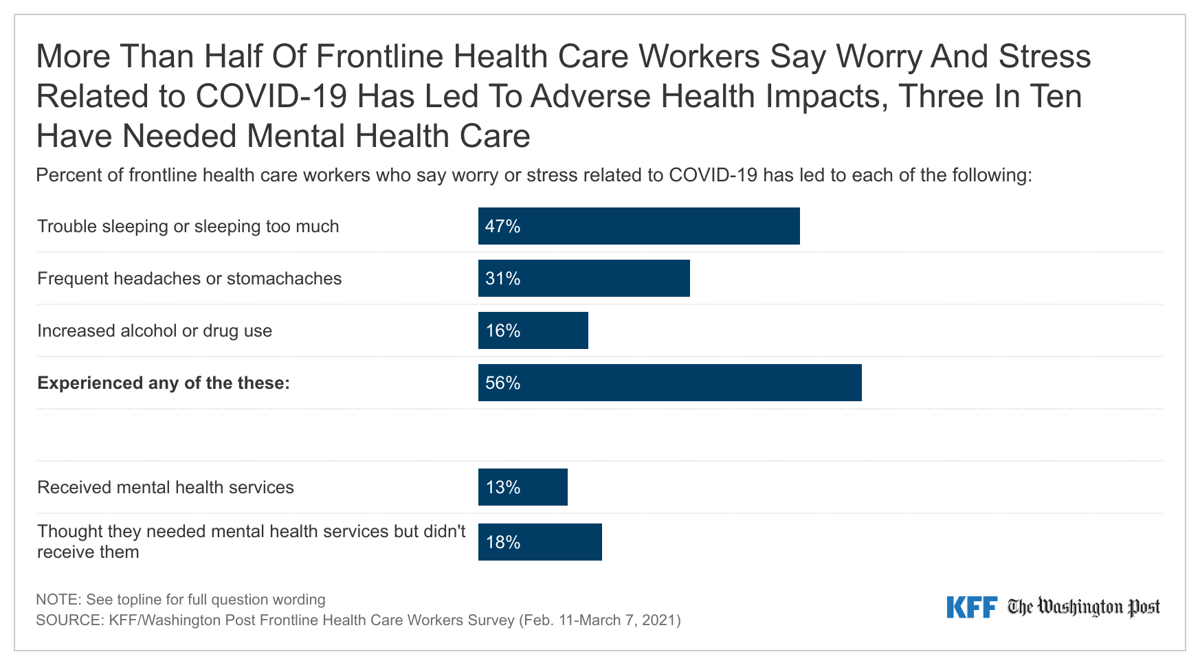
For about 3 in 10 frontline health workers, the mental
health challenges led them to obtain mental health care or medications (13%)
or to think that they needed such services but didn’t get them (18%).
Among those who felt they needed but didn’t get mental health care, the
most commonly cited reasons are because they were too busy (27%), they
were afraid or embarrassed about seeking care (17%), they couldn’t afford
it (16%), or they couldn’t get time off work (14%).
The survey results show that younger frontline health care
workers (those under age 30) seem to be the hardest hit, with three
quarters (75%) reporting that the pandemic has had a negative impact on
their mental health, and nearly as many (69%) saying they feel “burned
out.”
About 1 in 6 frontline health care workers (16%) say they
tested positive for COVID-19 at some point during the pandemic. The share
who contracted COVID-19 was somewhat higher among those working in
nursing homes or assisted care facilities (24%) than in hospitals (18%),
doctor’s offices or clinics (14%), or home health care (8%).
About a quarter of those who tested positive (4% of all
health care workers) say they experienced “major symptoms,” while the
rest reported only minor symptoms or no symptoms at all.
The findings come from the latest KFF/Post partnership
survey, which examines the experiences of frontline health care workers
during the COVID-19 pandemic. Frontline health care workers include those
who come into contact with patients or bodily fluids across many
different aspects of patient care, including diagnosis and treatment,
administrative duties, and assisting with as bathing, eating, cleaning,
exercising, and housekeeping. Findings appear in The
Washington Post and
in a KFF report.
More than half (56%) of those who worked in hospitals say
their intensive-care units were overcapacity at some point during the
pandemic, and a third (34%) of those who worked at hospitals or nursing
homes say that at some point they ran out of personal protective
equipment.
Other findings include:
- A slim majority (56%) of frontline health care
workers who are not self-employed say that their employer is
“falling short” in providing hazard pay for those who work in the
most high-risk situations. Fewer say their employer is “falling short”
in providing adequate paid sick leave (33%) or ensuring employees
can get vaccinated (12%).
- Most frontline health workers (58%) don’t expect
Americans to be able to safely return to normal life until 2022.
Smaller shares expect a return to normal by mid-summer (24%) or
between mid-summer and mid-fall (18%).
- When asked to describe in their own words what
the hardest part of working during the pandemic has been, similar
shares say that it was being worried about getting exposed to and
sick from COVID-19 or exposing family members (21%) and having to
wear masks and other personal protective equipment (16%).
Fewer cited other concerns such as safety protocols and
precautionary measures (8%) and being overworked with long hours and
lack of time off (7%).
The project, the 35th KFF/The Washington Post
partnership survey, includes interviews with a nationally representative
sample of 1,327 frontline health care workers (direct contact with
patients and their bodily fluids), representing hospitals, doctors’ offices,
outpatient clinics, nursing homes and assisted care facilities, and those
working in home health care. The sample includes workers who work in
many, and multiple, different aspects of patient care including patient
diagnosis and treatment, administrative duties, and/or assisting with
patient care such as bathing, eating, cleaning, exercising, and
housekeeping. The survey also included a comparison survey allowing
researchers to compare the group of frontline healthcare workers to the
general population, that included 971 U.S. adults not working as
frontline health care workers. The margin of sampling error for the group
of frontline health care workers is 3 percentage points, national
comparison sample is 4 percentage points. For results based on subgroups,
the margin of sampling error may be higher.
|
.png?width=1200&upscale=true&name=Just%20Released%20Header_1%20(1).png)


No comments:
Post a Comment