February 8, 2022 Thomas Wade
Executive
Summary
- In the past year
at least 16 percent of Americans have traded cryptocurrencies – a $1.7
trillion industry that has grown significantly since 2017.
- Despite this
market’s size and growth, cryptocurrencies fall into a number of
regulatory gaps, and federal regulatory oversight of the market is
severely underdeveloped.
- It is incumbent
upon Congress to define the cryptocurrency industry and lay the
appropriate regulatory groundwork before such decisions are made by
existing regulators.
Introduction
A market
that did not exist prior to 2017 is now causing headaches for regulators and
policymakers in Washington as a growing number of Americans – an
estimated 16 percent – invest in, trade, or use
cryptocurrencies. Wyoming and Arizona are reportedly considering accepting tax
payments in the form of digital currencies. New York’s new mayor took his first paycheck in
cryptocurrencies.
While (or
perhaps because) the broad, long-term economic implications of cryptocurrencies
remain unknown, the market value of cryptocurrencies exceeded $3 trillion in November of last year. Any
market or industry of this size deserves rigorous scrutiny by policymakers and
regulators, forward-looking analysis, and examination—and this is particularly
true for a market in which individual Americans have little in the way of consumer
protections. To date, Congress has not yet performed this review and
analysis, but this may finally be changing. This week will see Commodity
Futures Trading Commission (CFTC) Chair Rostin Behnam testify before Congress
at a hearing examining the risks,
regulation, and innovation of digital assets.
Below are
five fundamental questions that Congress must seek to answer in considering how
to appropriately regulate the cryptocurrency market. If Congress does not take
ownership of this nascent industry, cryptocurrency issuers and users will
likely face a patchwork of conflicting agency-led initiatives, or worse, no regulatory
oversight at all.
What Is a
Cryptocurrency?
A
cryptocurrency is a digital or virtual currency, underpinned by advanced
encryption algorithms that allow cryptocurrency users to obtain
cryptocurrencies without the use of third-party intermediaries – it is
decentralized, and not usually managed by a central authority. The encryption
algorithms and advanced cryptographic processes are held on blockchain, an open
distributed ledger that creates a unified transaction record, promising
real-time transparency to all users.
The most
important problem facing Congress and regulators is that it can be difficult to
know what a cryptocurrency is for. While the primary purpose of a
currency is to exchange it for goods and services, most users of
cryptocurrencies are instead investing in or trading cryptocurrencies. Although
the United States has over 30,000 bitcoin ATMs, it remains difficult to
actually use Bitcoin to pay for goods or services.
This
raises the question of how to best define cryptocurrencies for the purpose of
regulation. Cryptocurrencies, as digital currencies, are unquestionably an
asset, but what kind of asset? If the primary purpose of a cryptocurrency is to
be used to pay for goods and services, it would be appropriate to classify it
as a commodity, like a metal. If instead a cryptocurrency is primarily a
financially tradeable instrument, it would be appropriate to classify it as a
security. Bitcoin, the world’s first cryptocurrency, is regulated as a
commodity, but the Securities Exchange Commission (SEC) has said that in its view most cryptocurrencies are
securities. This distinction matters, because securities are regulated
significantly more stringently than commodities, including, among other
requirements, restrictions on price fixing.
Given the
questions as to both the current role, and future evolution, of cryptocurrencies,
regulating this class of assets is something of a moving target.
How
Should We Think About Regulating Cryptocurrency Issuers?
Most
cryptocurrencies are currently issued by a relatively new class of financial
vehicle, the fintech – so called because they share
the properties of both financial services firms and technology firms. Fintechs
are typically fast, nimble startups seeking to challenge entrenched financial
services providers by providing traditional services better, reaching
underserved markets, or offering brand-new combinations of products and product
offerings. Where this becomes challenging for regulators is where fintechs
provide banking and banking-like services. By issuing cryptocurrencies and
seeking to challenge the supremacy of established banks, most fintechs have
morphed from back-office service providers to increasingly providing
customer-focused finance options. In short, many of these quasi-banks provide quasi-bank
like services, without the exhaustive bank supervision and oversight regulatory
system.
While
relief from a burdensome regulatory regime can be a good thing, particularly
for a new industry, there is significant scope for customer abuses and, at the
extreme end of the scale, the potential for consequences to the economy
broadly. One of the defining characteristics of a bank is that it is required
to purchase insurance from the Federal Deposit Insurance Corporation (FDIC),
which offers consumers and investors a degree of comfort if the bank enters
material financial distress. This same protection is not provided to fintechs,
although the scale of the vast majority of fintechs is not material to the
economy – yet.
Who
Should Regulate Cryptocurrencies and Cryptocurrency Issuers?
The
federal government’s reticence to identify precisely what a cryptocurrency is
makes it difficult to determine which federal agency ought to be responsible.
No administration nor any Congress has yet taken a stand. The necessary result
has been that what regulatory oversight exists has been a turf war between the
financial regulators. This is not to imply that the decision is an easy one:
The currency aspects of cryptocurrency concern the Federal Reserve and
Treasury; the commodity aspects the CFTC; and the securities aspects the SEC.
The responsible regulator may even differ depending on the cryptocurrency
issuer, with parties ranging from the Fed, to the Office of the Comptroller of
the Currency, to even the Small Business Administration. The FDIC is waiting in
the wings if any of these fintechs require bank charters (usually to deny them). Even outside of the federal
financial services regulators, there are broader privacy and security issues
that might concern the National Economic Council or the Financial Stability
Oversight Council.
The
tenor, burden, and characteristics of the regulatory response will differ wildly
depending on the responsible federal agency (or worse, multiple agencies).
Whichever federal agency or agencies is ultimately made responsible will then
face a number of operational challenges, as this new brief will require staff,
time, and expertise to address, even as the new ordinary course of business,
let alone the time it will take to meet the needs of regulating
cryptocurrencies. The relevant body may even need to consider its charter as to
its applicability given these expanded responsibilities.
Even if
the correct agency can be identified and has an abundance of regulatory
resources, it also remains true that cryptocurrency is inherently quite a
tricky beast in and of itself to regulate. One of the key reasons for this is
cryptocurrency’s high volatility (technically a measure of dispersion around the mean value
of a security, but more generally rapid or significant fluctuations in value as
defined by the market). The graphic below shows the daily log return (a
calculation of return on equity) of the first and second most significant
cryptocurrencies, bitcoin and Ethereum, by comparison to the average volatility
of the S&P 500.
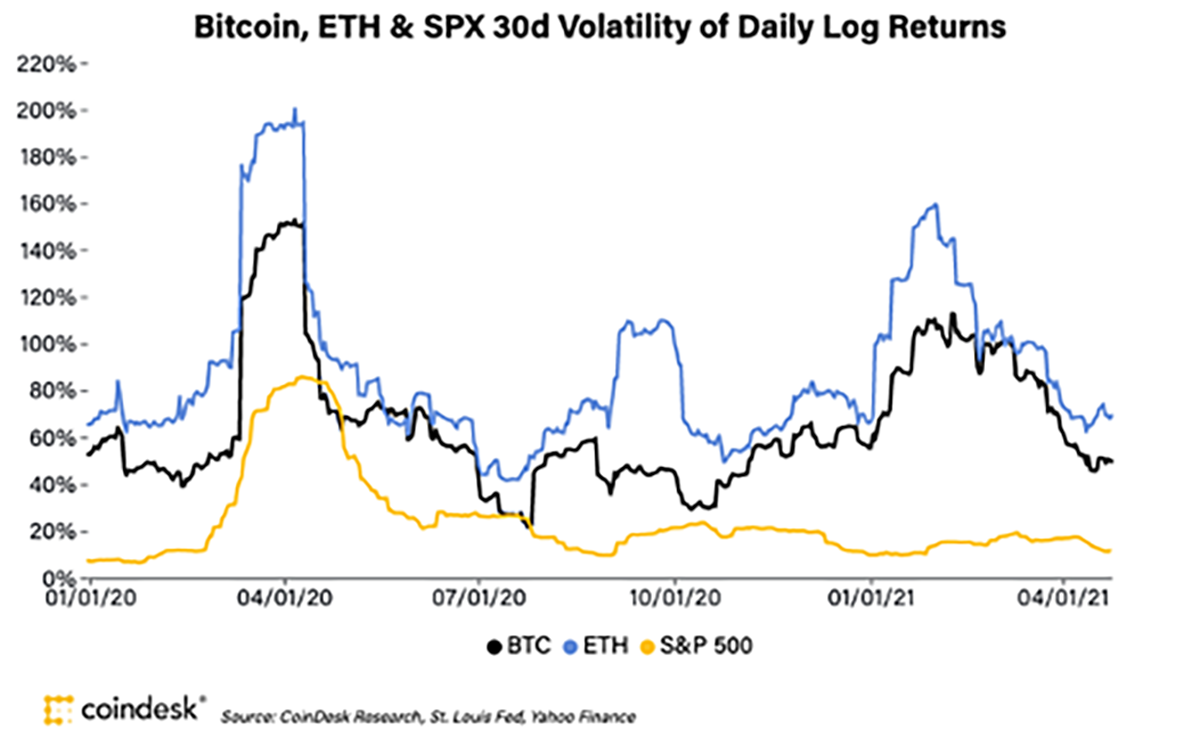
Any asset
class that behaves unpredictably – and so unpredictably – will be a challenge
for any regulator.
Should
the U.S. Government Back a Cryptocurrency?
All these
concerns have so far been pointed at cryptocurrency as represented by private
industry. Congress might also consider, further down the line, the idea of a
federally backed cryptocurrency, or central bank digital currency (CBDC).
Proponents of cryptocurrencies point to the speed and transparency offered to
consumers by crypto and in some cases forecast not just that the traditional
banking sector is in danger, but also eventually the U.S. dollar.
Since the
1944 Bretton Woods agreement, world currencies have been pegged not to gold but
to the U.S. dollar, under the reasoning that it itself was pegged to gold.
Despite President Nixon’s decoupling of the dollar and gold and the subsequent
emergence of the system of fiat money currencies in global use today, the U.S.
dollar remains the global reserve currency, and that is unlikely to change
given the stability and liquidity of U.S. Treasuries supporting the dollar as
the world’s most redeemable currency.
This
situation could of course change if a sufficiently strong digital contender
emerges, with the most obvious contender a CBDC backed by the Chinese
government. Although this risk may still be decades off, one of the most
effective ways to forestall it would be the creation of a U.S. CBDC. A
recent Fed discussion paper considers the
potential benefits and risks of a CBDC and represents the first step taken by
the U.S. government in this direction.
What Is
the Right Balance of Regulation?
Even if
the federal government can address these preliminary, theoretical questions to
determine how it should regulate cryptocurrencies, the
government will also have to strike the correct balance as to how much.
Push the balance too far in one direction, and the federal government will
overly burden cryptocurrency issuers, discourage innovation, and harm U.S.
global market competitiveness. Too far in the other direction, and the federal
government may fail to adequately protect both consumers and investors.
Conclusions
Whether
cryptocurrencies will have the staying power to make a significant long-term
impact on U.S. or global economies is unclear. Even accounting for the
volatility of cryptocurrencies, however, the cryptocurrency market is lurching
from strength (to weakness) to strength. Congress has an opportunity to set
broad industry guardrails, protect consumers and investors, and create a
unified vision for the new market that best employs regulatory resources and
fosters innovation in U.S. financial markets. That opportunity is swiftly
disappearing.
https://www.americanactionforum.org/insight/the-five-things-to-consider-before-regulating-cryptocurrency/#ixzz7KPqXxpFO
Follow @AAF on Twitter

No comments:
Post a Comment