|
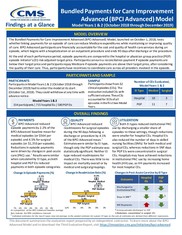
Bundled Payments for Care
Improvement Advanced (BPCI Advanced) Model: Third Evaluation Report
(Model Years 1 & 2)
Third
Evaluation Report - Key Takeaways:
Hospitals
and physician group practices (PGPs) participating in the BPCI Advanced
Model reduced Medicare fee-for-service payments primarily by reducing
post-acute care use. Evidence from the independent evaluation indicates
that for surgical episodes overall, BPCI Advanced achieved net savings
to Medicare and possibly improved quality of care, driven mostly by
orthopedic procedures. Savings from surgical episodes, however, were
fully offset by losses from medical episodes. Evidence indicates that,
generally, target prices were too high for medical episodes but were
more accurate for surgical episodes. CMS made significant design
changes starting in Model Year 4 (2021) to improve the model’s target
pricing, which will be analyzed in future evaluation reports.
|
The Two
Page Overview:
The
Report (includes an Executive Summary):
Additional
Supporting Materials:
|
|
|
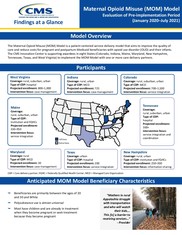
Maternal Opioid Misuse (MOM)
Model: Pre-implementation Period Evaluation Report
Pre-Implementation
Period Evaluation Report - Key Takeaways:
Maternal
Opioid Misuse (MOM) Model awardees and their partners hope to relieve
physical and psychosocial barriers to opioid use disorder treatment for
pregnant and postpartum people. Barriers to treatment include
transportation, childcare issues, and stigma. MOM Model enrollment
began in July 2021 for six of eight awardees.
|
 The Two
Page Overview: The Two
Page Overview:
The
Report (includes an Executive Summary):
Additional
Supporting Materials:
|
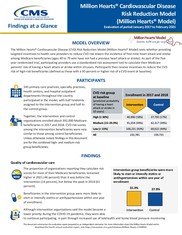
Million Hearts®
Cardiovascular Disease Risk Reduction Model (Million Hearts® Model): Fourth
Annual Evaluation Report
Fourth
Annual Evaluation Report - Key Takeaways:
Through the
end of the fourth year, the Million Hearts® Model has improved
cardiovascular disease (CVD) preventive care, as shown by provider’s
increased use of CVD risk assessment and beneficiaries’ increased use
of statins and antihypertensive medications. These changes have
contributed to reductions in overall predicted risk of having a heart
or attack or stroke in 10 years, primarily driven by reductions in
blood pressure and low-density lipoprotein (LDL) cholesterol. Most
organizations that continued to participate in the model plan to
sustain changes related to using CVD risk assessments.
|
The Two
Page Overview:
The
Report (includes an Executive Summary):
Additional
Supporting Materials:
|
|
|
|




No comments:
Post a Comment