|
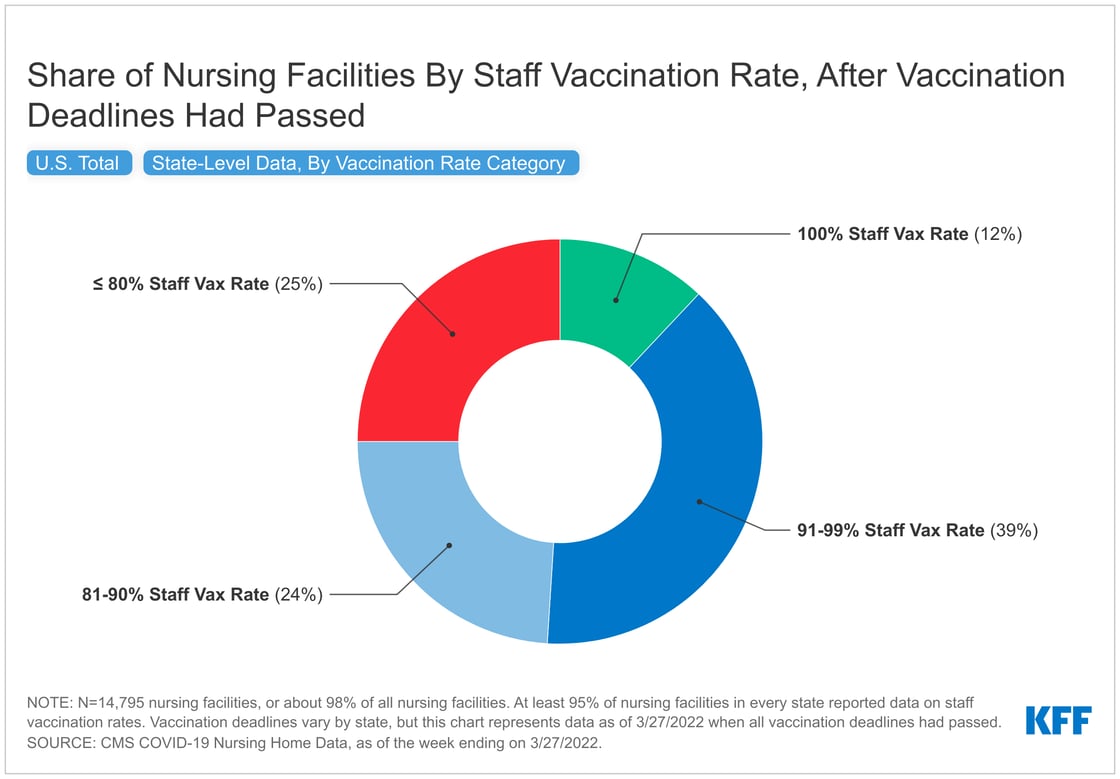
While the federal
mandate does not explicitly require booster shots, the national booster
rate for nursing home staff was 44 percent as of March 2022.
Some nursing home operators warned that requiring health care workers
to be vaccinated against COVID-19 could contribute to staffing
shortages. Data suggest that the vaccine mandate has not exacerbated
such shortages, however.
KFF analysts find that 28 percent of nursing homes in the U.S. reported
staffing shortages as of March 2022, down slightly from the peak in
January 2022 where nearly one in every three nursing homes reported a
shortage.
Staff shortages in nursing homes are a longstanding problem that
predates the pandemic. In a
separate analysis also released today, KFF analysts
summarize federal and state standards related to nursing home staffing
prior to COVID-19 and identify changes that states have made to minimum
staffing requirements during the pandemic. They also examine state
legislative and regulatory actions since the onset of the pandemic that
directly affect worker wages and training requirements.
The Biden administration has announced plans to propose new federal
minimum staffing adequacy regulations in the next year, and the
National Academies of Science, Engineering, and Medicine recently
recommended minimum staffing levels as part of its comprehensive report
on ways to improve nursing home quality.
Conditions and COVID-19 precautions in nursing homes remain a subject
of heightened public interest since over one in five COVID-19 deaths
during the pandemic has been in a long-term care facility. While the
vaccine mandate remains in effect, litigation challenging the new rule
is ongoing. Although cases in Texas and Florida were dismissed after
the Supreme Court allowed the rule to take effect, cases in Missouri
and Louisiana are still pending.
|
.png?width=1200&upscale=true&name=Just%20Released%20Header_1%20(1).png)


No comments:
Post a Comment