Abortion Grows as a
Motivator for Midterm Voters, Particularly for Democrats and in States
Where It Has Become Illegal Since the Supreme Court Overturned Roe v. Wade
Voters, Including Most
Republicans and Most Living in States with Abortion Bans, Oppose
Prohibiting It in Cases of Rape or Incest, or Criminalizing Women and
Doctors
Few Voters Know About the Medicare Drug Provisions in the Inflation
Reduction Act, Though Seniors are More Aware and Would Be Likely to Vote
for Candidates Who Support Them
About a month ahead of
the 2022 midterm election, abortion continues to grow as a motivating
issue for voters, especially among Democrats and those living in states
where abortion is now illegal, the latest
KFF Health Tracking Poll finds.
Half (50%) of voters now say the Supreme Court’s decision overturning Roe v. Wade has made
them more motivated to vote in this year’s elections, up from 43% in July
shortly after the Court’s decision and from 37% in a similar question in
May, prior to the decision. About two thirds of Democrats (69%), and half
of independents (49%), cite the Court’s decision as a motivator, as do a
third of Republicans (32%).
Many races in the midterms will be decided by marginal changes in
turnout, with a few voters making a difference. The new survey reveals
how abortion access and reproductive health is motivating majorities of
Democratic women, women of reproductive age, and Democratic and
Democratic-leaning voters in states where abortion is currently illegal.
Among those who say the Supreme Court decision is making them more
motivated to vote, three-quarters (76%) say they plan to vote for
candidates who want to protect abortion access, compared to 17% who say
they plan to vote for candidates who want to limit access.
With states now determining whether and when abortion is legal for their
residents, four in ten (40%) voters say their state’s abortion laws are
making them more motivated to vote this year.
In states with abortion bans in place following the Supreme Court’s
decision, half (51%) of voters say their state’s abortion laws are making
them more motivated to vote this year. This includes three quarters of
Democratic and Democratic-leaning voters (74%) and a third of Republican
and Republican-leaning voters (35%) in those states.
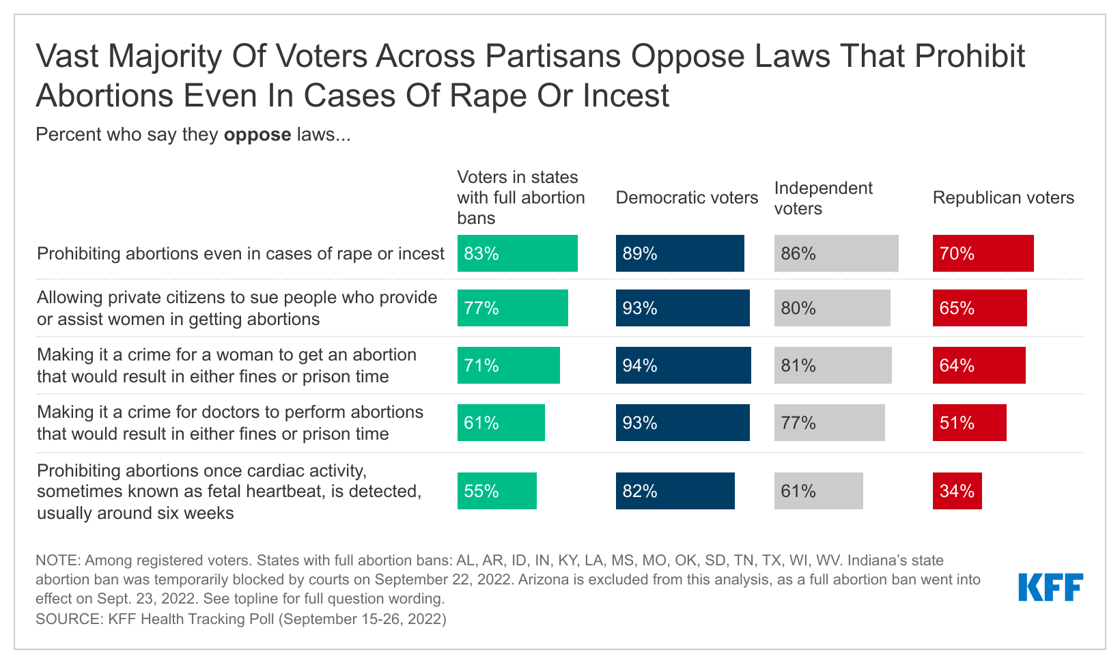
Nationally, 82% of voters oppose laws that would prohibit abortion in
cases of rape and incest, as is now in place in some states such as
Texas, Tennessee, South Dakota, Missouri, Louisiana and Kentucky. About
six in ten (59%) oppose prohibiting abortions after a fetal heartbeat is
detected, which is usually at around six weeks.
In addition, large majorities of voters oppose punitive abortion laws,
such making it a crime for doctors to perform them (74%) or for women to
get them (79%), and allowing private citizens to sue people who provide
or assist in abortions (81%).
Most Democratic and independent voters oppose each of these five laws,
and most Republican voters oppose a prohibition even in cases of rape or
incest
(70%), allowing private citizens to sue those involved in abortions
(65%), or making it a crime for a woman to get one (64%). Half (51%) of
Republican voters oppose making it a crime for a doctor to provide one,
while a third (34%) oppose a prohibition once a fetal heartbeat is
detected.
Most voters living in states with abortion bans oppose each of these
restrictions, often by large margins.
|



No comments:
Post a Comment