|
Medicare Diabetes Prevention
Program (MDPP) Expanded Model - Second Annual Evaluation Report
Second Evaluation Report - Key Takeaways:
The
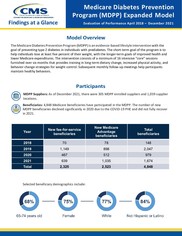
Medicare Diabetes Prevention Program (MDPP) is an evidence-based
lifestyle intervention with the goal of preventing type 2 diabetes in
individuals with prediabetes. The short-term goal of the program is to
help individuals lose at least five percent of their weight, with the
longer-term goals of improved health and lower Medicare expenditures.
The intervention consists of a minimum of 16 intensive “core” sessions
furnished over six months that provides training in long-term dietary
change, increased physical activity, and behavior change strategies for
weight control. Subsequent monthly follow-up meetings help participants
maintain healthy behaviors. MDPP beneficiaries have lost weight and are
largely meeting physical activity goals, thereby meeting the immediate
goals of the program. However, low participation has limited the
program’s impact on the overall population health of Medicare
beneficiaries. At this point, evidence suggests that the program does
not impact Medicare expenditures. It is too early to assess the
program’s impact on diabetes incidence due to the limited number of participants
with long term follow-up periods.
|
The Two Page Overview:
The Report (includes an Executive
Summary):
Additional Supporting Materials:
|
|
|
Next Generation Accountable
Care Organization Model - Fifth Evaluation Report
Fifth Evaluation Report - Key Takeaways:
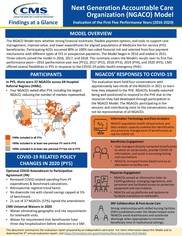
The NGACO
Model tested whether strong financial incentives, flexible payment
options, and tools to support care management, improve value, and lower
expenditures for aligned populations of Medicare fee-for-service (FFS)
beneficiaries. Participating ACOs assumed 80% or 100% two-sided
financial risk and selected from four payment mechanisms with different
types of FFS or prospective payments. The Model began in 2016 and ended
in 2021. Three cohorts joined the model in 2016, 2017, and 2018. The
Evaluation report covers the Model’s results over its first five
performance years—2016 (performance year one [PY1]), 2017 (PY2), 2018
(PY3), 2019 (PY4), and 2020 (PY5). CMS offered several flexibilities in
PY5 in response to the COVID-19 public health emergency (PHE). The
NGACO Model significantly reduced gross spending but increased net
spending in PY5, continuing the pattern observed in earlier years. The
increase in net spending in 2020 relative to net spending in 2019
reflected several factors, including drop out by NGACOs with shared
losses in PY4, continuation of NGACOs with shared savings in PY4, and
model flexibilities to mitigate risks to NGACOs due to the COVID-19
PHE. NGACOs reported being well prepared to address the PHE with
resources and processes developed through participation in the Model.
|
 The Two Page Overview: The Two Page Overview:
The Report (includes an Executive
Summary):
Additional Supporting Materials:
|
Vermont All-Payer Model -
Second Evaluation Report
Second Evaluation Report - Key Takeaways:
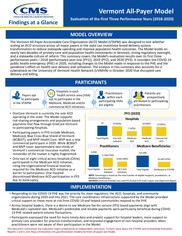
The Vermont
All-Payer Accountable Care Organization (ACO) Model (VTAPM) was
designed to test whether scaling an ACO structure across all major
payers in the state can incentivize broad delivery system
transformation to reduce statewide spending and improve population
health outcomes. The Model builds on nearly two decades of primary care
and population health investments in Vermont, strong regulatory oversight,
and a statewide culture of reform. The Evaluation report covers the
Model’s evaluation results over its first three performance years—2018
(performance year one [PY1]), 2019 (PY2), and 2020 (PY3). It considers
the COVID-19 public health emergency (PHE) in 2020, including changes
to the Model made in response to the PHE and the pandemic’s effect on
health care delivery and utilization. The analysis in this summary also
accounts for a cyberattack on the University of Vermont Health Network
(UVMHN) in October 2020 that disrupted care delivery and billing. In
PY3 (2020), the COVID-19 PHE posed an unprecedented challenge to health
systems and providers across the US. Nonetheless, Vermont’s established
primary care and care management infrastructure helped providers
address residents’ changing needs during the COVID-19 PHE. The
cyberattack on UVMHN caused additional disruptions for many hospitals
and providers in Vermont in 2020. Utilization and spending relative to
the comparison group continued to decrease in PY3, though impacts were
more modest after accounting for the potential effects of the
cyberattack. Excluding the fourth quarter of 2020 decreased the VTAPM’s
gross savings, particularly for Medicare ACO beneficiaries. While
initial findings may not provide strong evidence of the impact of the
VTAPM, the Model is still evolving and may realize benefits in the
long-term provided participants can overcome the challenges noted
above.
|
The Two Page Overview:
The Report (includes an Executive
Summary):
Additional Supporting Materials:
|
|
|
|




No comments:
Post a Comment