Dan Goldbeck May 29, 2018
If crane safety, student aid, or international
arms sales interest you, then there was something for you in the regulatory
world last week. Proposed deregulatory actions affecting each of those areas
led an otherwise forgettable week. Between both proposed and final rules,
agencies published roughly $24.7 million in net cost savings and 137,680 hours
of paperwork cuts. The per capita regulatory burden for
2018 is negative $14.54.
REGULATORY TOPLINES
- New Proposed Rules: 53
- New Final Rules: 68
- 2018 Total Pages of Regulation: 24,174
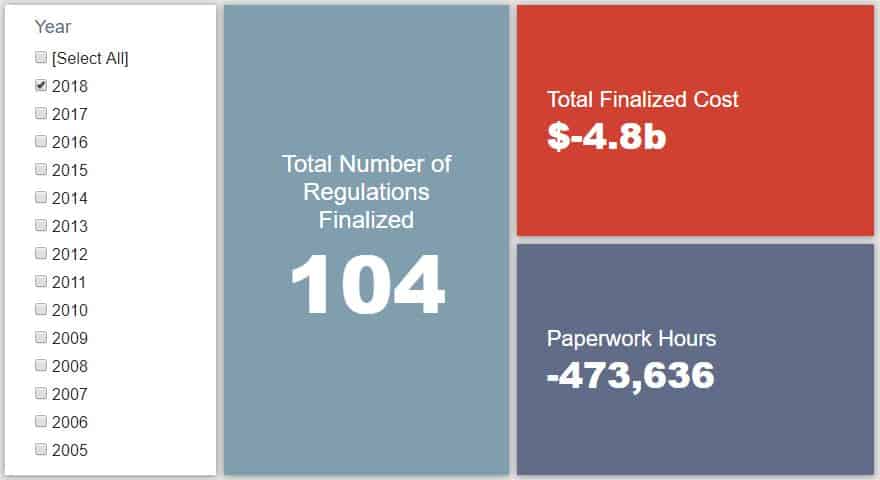
- 2018 Final Rules: -$4.8 Billion
- 2018 Proposed Rules: $9.1 Billion
TRACKING REGULATORY MODERNIZATION
There was a handful of nominal deregulatory
actions this past week. The most notable was an Occupational Health and Safety
Administration proposal to
revise certain crane operator safety measures that results in roughly $2.2
million in net annual savings. The next highest was a pair of linked
rulemakings from the Departments of Commerce and State that
streamline paperwork requirements in international arms sales to produce $2.8
million in cost savings from 5,620 fewer hours of paperwork (that the agencies
split 50/50). And finally, the Department of Education proposed to
delay the effective date of a 2016 rule on “Program Integrity and Improvement”
until July 1, 2020. This would save affected entities roughly $700,000
annually. However, these are all proposed rules and thus do not yet count
towards the regulatory budget established under Executive Order (EO) 13,771.
According to AAF analysis, since the start of FY
2018 (beginning Oct. 1, 2017), executive agencies have promulgated 37 deregulatory
actions with quantified cost savings against five regulatory measures that
impose costs, under the rubric created by EO 13,771 and the administration’s
subsequent guidance document on the matter. These
rules combine for net annual savings of roughly $1.2 billion. This means that
agencies have thus far surpassed the administration’s cumulative goal for FY 2018 of $687 million in net
annual savings. In fact, according to the administration’s latest Unified
Agenda, agencies are on track to roughly double that goal.
Click here to view AAF’s examination of
the administration’s progress under the “one-in, two-out” executive order
through the end of Fiscal Year 2017.
STATE OF MAJOR OBAMA-ERA INITIATIVES
Based on total lifetime costs of the
regulations, the Affordable Care Act has imposed costs of $52.9 billion in
final state and private-sector burdens and 176.9 million annual paperwork
hours.
Since passage, the Dodd-Frank financial reform
legislation has produced more than 82.9 million final paperwork burden hours
and imposed $38.9 billion in direct compliance costs.
TOTAL BURDENS
Since January 1, the federal government has
published $4.3 billion in net costs (despite $4.8 billion in net savings from
final rules) and new paperwork burdens amounting to 2.7 million hours (however,
this includes 473,636 hours cut under final rules). Click
here for the latest Reg Rodeo findings.
https://www.americanactionforum.org/week-in-regulation/modest-deregulatory-proposals-abound/?utm_source=American+Action+Forum+Emails&utm_campaign=04395fc369-EMAIL_CAMPAIGN_2018_05_30_08_14&utm_medium=email&utm_term=0_64783a8335-04395fc369-267125721
Follow us: @AAF on Twitter

No comments:
Post a Comment