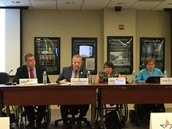
 As chair of the U.S. Access
Board, I had the privilege of participating in an event today celebrating
the anniversary of the Architectural Barriers Act (ABA) of 1968 and the
fifty years of progress it helped spark. As chair of the U.S. Access
Board, I had the privilege of participating in an event today celebrating
the anniversary of the Architectural Barriers Act (ABA) of 1968 and the
fifty years of progress it helped spark.
Before the ABA was passed, accessibility standards were
often inconsistent -- and just as often ignored. The American National
Standards Institute developed the first accessibility standards in 1961
with the help of Easter Seals and the research of the University of
Illinois. Many states used these early standards to develop accessibility
requirements in their building codes. However, other states adopted
access requirements that ranged from lax to nearly nonexistent. This
resulted in great discrepancies in accessible design requirements from state
to state, and in some cases, from city to city.
|
This
had real life impacts. It meant that a wheelchair user could easily go to
the post office in one town but not in a nearby state or community. The
same problem existed with respect to sidewalks, entrances, bathroom stalls,
paths of travel, signage, and everything else that makes a building
accessible.
The Architectural Barriers Act helped solve this problem by
creating a mechanism for developing and setting clear and consistent
nationwide accessibility guidelines for the federal government. It
literally began to open the doors of government to Americans with
disabilities like never before by requiring buildings constructed or
renovated with federal funds, as well as those owned or leased by the
federal government, to be accessible and usable by people with
disabilities. For the first time, schools, housing, offices, courts,
hospitals, stadiums, post offices, and countless other facilities were
available to people with disabilities.
This did far more than eliminate physical barriers. It helped
level the playing field by promoting greater access and equal opportunity
to public education, colleges and universities, community living,
employment, health care, and more. In this way, the ABA helped pave the way
for the last five decades of civil rights advances for Americans of all
ages with disabilities.
One of the law’s lasting legacies is the innovation in design
and technology it helped spur across the private, public, and nonprofit
sectors. Over the years, the National Institute on Disability, Independent
Living, and Rehabilitation Research (NIDILRR) and the Access Board
– together with many other federal agencies – have invested
significant resources, time, ingenuity, and rigor in generating and effectively
sharing new knowledge to improve the opportunity and ability of individuals
with disabilities to access the built environment, technology, and the
digital world. The quest continues and so does the return on
investment.
We at ACL are especially proud of the important role the
Access Board and NIDILRR have played in advancing the science, discipline,
and esthetic of what we now call universal design. Universal design uses a
broad-spectrum of ideas and methods to design and develop buildings,
products, and environments that are inherently accessible to all people of
all ages and abilities.
As he was signing the landmark Americans with Disabilities Act
into law in 1990, President George H.W. Bush said the law would take a
sledgehammer to the shameful wall of exclusion that has prevented far too
many with disabilities from exercising their full rights and
responsibilities. It is important to recognize and celebrate that the first
blow against this wall was struck by the Architectural Barriers Act and
those that made it possible.
We are a better nation and a better people because of it, and
we remain committed to advancing the principles behind it.
|



No comments:
Post a Comment