 |
Just Released
|
|
|
Poll Finds Most Americans Oppose the
Trump Administration’s Changes to Restrict Title X Family Planning Funds from
Clinics that also Provide or Refer for Abortion
Few
Want Funds to Go to Clinics that Only Promote Abstinence or Natural Family
Planning Without Providing Contraception
A new KFF poll of the public’s views on reproductive
health issues finds most Americans, including majorities of women of
reproductive age, are concerned that access to women’s reproductive health
and preventive care services may be limited by the Trump administration’s
changes to Title X, the nation’s federal family planning program.
The poll examines the public’s views of major
regulatory changes to the Title X program, which funds nearly 4,000 clinics
nationally to pay for family planning and other preventive services to
lower-income women. Originally set to take effect today but blocked by
national injunctions issued by multiple federal judges, the new regulations
would prohibit federal funding to any family planning clinic that also
provides abortion services or referrals, even though none of the funds could
be used for abortions.
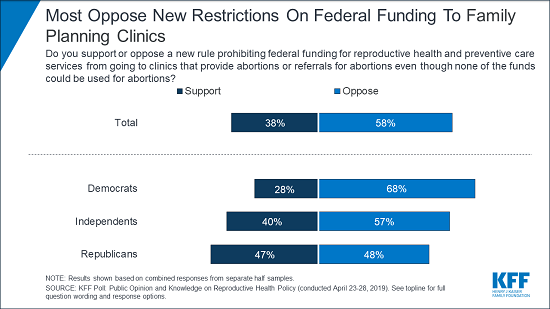
Most of the public (58%) oppose changing the
program to exclude organizations that provide abortions or referrals for abortions
with other resources, while nearly four in 10 (38%) favor such changes. Most
Democrats (68%) and independents (57%) oppose such changes, though
Republicans are divided (47% favoring, 48% opposing).
The new regulation could also channel federal
family planning funds to “non-traditional” organizations that only offer
natural family planning methods or promote abstinence and do not provide
other contraceptive services.
Most of the public – including at least half of
Republicans – oppose allowing federal family planning funds to go to
organizations that either only counsel about natural family planning methods
(68%); don’t counsel pregnant women and girls about all of their options
including prenatal care, adoption and abortion (65%); or do not provide
contraception or birth control (59%). Most women, including most women of
reproductive age, oppose funding such organizations.
KFF polling has consistently found strong support
for federal funding for reproductive health services for lower-income women
with majorities of Democrats, independents, and Republicans saying it is
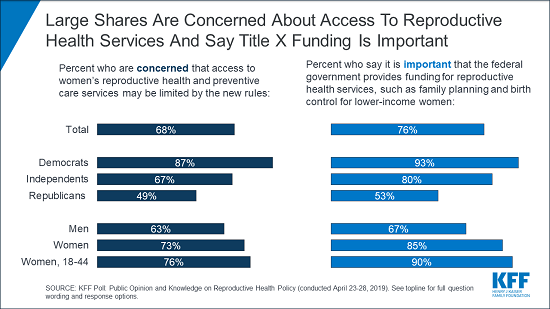
important the government provide this funding. This month’s poll also finds,
in light of the Trump administration’s actions, 68% of Americans, including
three-fourths (76%) of women of reproductive age and nearly half of
Republicans (49%), say they are “very” or “somewhat” concerned that the new
regulations would limit access to women’s reproductive health and preventive
care services.
If implemented, the new regulations would prohibit
Title X funds from going to Planned Parenthood, the nation’s largest family
planning provider and biggest Title X grant recipient. Some states have also
proposed cutting off funding to Planned Parenthood for any services.
When asked about such changes, about seven in 10
(69%) Americans say their state should continue to make payments to Planned
Parenthood, while about three in 10 (29%) say their state should stop
payments. Views split along partisan lines, with a large majority of
Democrats (86%) wanting Planned Parenthood payments to continue and most
Republicans (57%) wanting such payments to stop.
Public Split on Fetal Heartbeat Bills that Ban
Abortions Early in Pregnancy
The poll also assesses the public’s views on other
issues related to reproductive health and abortion, including some states’
efforts to enact new abortion restrictions that could lead the Supreme Court
to revisit the 1973 Roe v. Wade decision that established a women’s
constitutional right to an abortion. These include “fetal heartbeat” bills,
enacted in Ohio and under consideration in other states, that prohibit a
woman from having an abortion once a fetal heartbeat is detected.
The public initially splits on whether their state
should enact a fetal heartbeat ban, with half supporting it and nearly as
many (44%) opposing it. Republican women are most supportive of such a ban,
with about three quarters (77%) favoring it.
However, when supporters are informed that a fetal
heartbeat can be detected around six weeks into pregnancy, before most women
know they are pregnant, enough switch their views to create a more narrow
majority (56%) opposing a fetal heartbeat ban.
Overall, two-thirds of the public (65%) do not
want to see the Supreme Court overturn Roe v. Wade, while about one-third
(32%) would like to see the decision overturned. These views split along
partisan lines, with most Republicans (56%) wanting to see it overturned and
larger majorities of Democrats (80%) and independents (68%) wanting it to
stand.
If Roe v. Wade were to be overturned, 42% of the
public believes that abortion would no longer be legal in their state while
half believe it would still be legal in their state.
Public Unaware of Some ACA Provisions Affecting
Women’s Health Services and Coverage
The poll also examines the public’s knowledge
about key provisions of the 2010 Affordable Care Act that relate to the
availability of reproductive health care services.
While most (62%) know that the ACA requires
insurance plans to include a minimum package of benefits including maternity
care, fewer know that the law eliminates out-of-pocket costs for many
preventive services including mammograms (48%); eliminates out-of-pocket
costs for birth control (38%), and prohibits insurers from charging women
more than men for their health coverage (36%).
Partisans Split on Trump Administration Policy
that Blocks U.S. Foreign Aid to Foreign Organizations that Perform or Promote
Abortion, Even if They Use Their Own Funds to Do So
The poll also examines the public’s views of the
Mexico City Policy, which every Republican administration since President
Reagan has adopted to prevent U.S. global family planning funding from going
to foreign organizations that perform or promote abortion as a method of
family planning, even using their own funds. The Trump administration has
expanded the policy to apply to almost all U.S. global health funding.
While the majority of the public does not support
this restriction, as with other abortion-related issues, views of the Mexico
City Policy diverge along partisan lines.
When asked about the expanded policy, most (55%)
oppose the restrictions, including a large majority of Democrats (73%) and a
smaller majority of independents (53%). In contrast, nearly two-thirds (64%)
of Republicans support the expanded restrictions.
Designed and analyzed by public opinion
researchers at KFF, the poll was conducted April 23-28, 2019 among a
nationally representative random digit dial telephone sample of 1,200 adults.
Interviews were conducted in English and Spanish by landline (305) and cell
phone (895). The margin of sampling error is plus or minus 3 percentage
points for the full sample and 9 percentage points for women ages 18-44. For
results based on subgroups, the margin of sampling error may be higher.
Filling the need for trusted information on
national health issues, the Kaiser Family Foundation is a
nonprofit organization based in San Francisco, California.
|
||
|
||
|
Connect with us:
    |
||
To be a Medicare Agent's source of information on topics affecting the agent and their business, and most importantly, their clientele, is the intention of this site. Sourced from various means rooted in the health insurance industry - insurance carriers, governmental agencies, and industry news agencies, this is aimed as a resource of varying viewpoints to spark critical thought and discussion. We welcome your contributions.
No comments:
Post a Comment