 |
Just Released
|
|
|
Less Than One-Third of New Medicare
Beneficiaries Enrolled in Medicare Advantage During Their First Year on
Medicare
The
Share Varies Considerably Across States and Counties
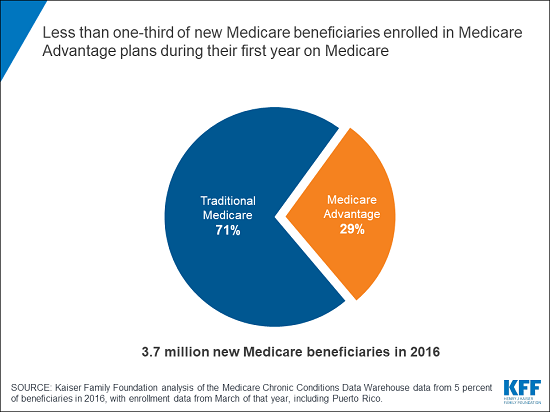
Twenty-nine percent of new beneficiaries chose to
enroll in Medicare Advantage during their first year in Medicare in 2016,
finds a new KFF analysis.
That level generally matches the overall share of
beneficiaries who opted for Medicare Advantage that year, but does not
support the view that the aging Baby Boom generation, having had more
experience with HMOs and PPOs during their working years, would select the
private plans over traditional Medicare at relatively high rates. In
fact, the share of new beneficiaries choosing Medicare Advantage has
increased only modestly over the years.
The share choosing Medicare Advantage in their
first year varies considerably across states and counties, however. Less than
11 percent of new beneficiaries picked Medicare Advantage in Delaware,
Maryland, Nebraska, New Hampshire, Vermont and the District of Columbia, to
cite a few examples, while more than 40 percent selected such plans in Oregon
and Minnesota.
The analysis examines Medicare Advantage
enrollment rates among new beneficiaries over time, by geographic location
and according to age and other characteristics of enrollees.
A second, updated analysis of Medicare Advantage provides 2019
data on enrollment, premiums and out-of-pocket limits. In 2019, 34 percent of
all Medicare beneficiaries, or 22 million people, are enrolled in the private
plans.
Filling the need for trusted information on
national health issues, the Kaiser Family Foundation is a
nonprofit organization based in San Francisco, California.
|
||
|
||
|
Connect with us:
    |
||
To be a Medicare Agent's source of information on topics affecting the agent and their business, and most importantly, their clientele, is the intention of this site. Sourced from various means rooted in the health insurance industry - insurance carriers, governmental agencies, and industry news agencies, this is aimed as a resource of varying viewpoints to spark critical thought and discussion. We welcome your contributions.
No comments:
Post a Comment