 |
Just Released
|
|
|
Analysis: ‘Cadillac Tax’ on High-Cost
Health Plans Could Affect 1 in 5 Employers in 2022
A new KFF analysis estimates that the Affordable Care
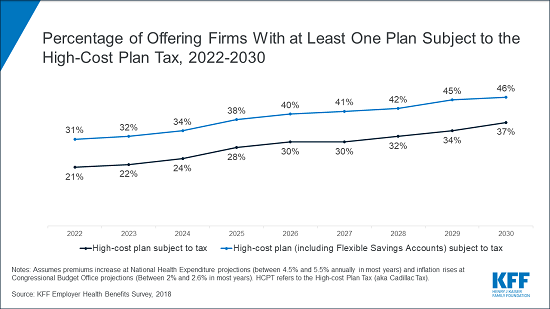
Act’s tax on high-cost health plans would affect one in five (21%) employers
offering health benefits when it takes effect in 2022 unless employers change
their health plans. An even larger share (31%) could be affected when
workers’ voluntary contributions to Flexible Spending Accounts are taken into
account.
The analysis comes as some in Congress are proposing
to repeal the ACA’s tax on high-cost health plans, often called the “Cadillac
tax.” Originally scheduled to take effect in 2018 but delayed by Congress
until 2022, the tax limits the amount of untaxed health benefits employers
can provide to their workers as a tool to slow the growth in overall health
spending.
The provision imposes a 40% tax of each employee’s
health benefits above a certain threshold, adjusted annually for inflation.
In 2022, the thresholds are estimated to reach $11,200 for single coverage
and $30,100 for family coverage.
The analysis relies on data from KFF’s 2018
Employer Health Benefits Survey to estimate the share of employers with at
least one health plan that would exceed the threshold, with and without FSA
contributions since workers could simply stop using those account to avoid
the tax.
The analysis projects that the Cadillac tax would
affect a growing share of employers over time, reaching 37% in 2030 without
including FSA contributions (and 46% with them).
The analysis does not attempt to estimate the
share of employers or employees who would pay the tax, just those whose
current plans would lead them to exceed the thresholds. It is likely many
such employers would modify their plans to avoid the tax – for example,
offering lower-cost plans, raising deductibles or otherwise shifting costs to
workers to avoid the threshold.
Employer-sponsored insurance is the largest source
of coverage for Americans, covering more than 156 million people. In addition
to projections, the new analysis also explains how the high-cost plan tax
works and describes its implications for how employers structure and
administer their health benefits.
Filling the need for trusted information on
national health issues, the Kaiser Family Foundation is a
nonprofit organization based in San Francisco, California.
|
||
|
||
|
Connect with us:
    |
||
To be a Medicare Agent's source of information on topics affecting the agent and their business, and most importantly, their clientele, is the intention of this site. Sourced from various means rooted in the health insurance industry - insurance carriers, governmental agencies, and industry news agencies, this is aimed as a resource of varying viewpoints to spark critical thought and discussion. We welcome your contributions.
No comments:
Post a Comment