 |
Just Released
|
|
Kaiser/UNAIDS Analysis Finds Donor
Governments Spent US$8 Billion for HIV in 2018, Similar to a Decade Ago
U.S. Remains Top Donor, Providing More Than
Half the Total
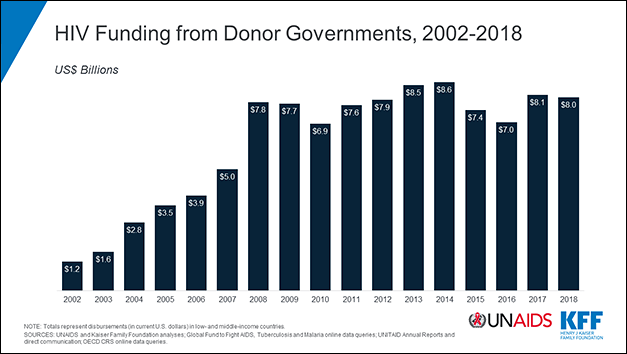
Donor government disbursements to combat HIV in
low- and middle-income countries totaled US$8 billion in 2018, little changed
from the US$8.1 billion total in 2017 and from the levels of a decade ago,
finds a new report from the Kaiser Family Foundation (KFF)
and the Joint United Nations Programme on HIV/AIDS (UNAIDS).
Half of the 14 donor governments analyzed in the
study increased their spending on global HIV efforts from 2017 to 2018; five
decreased their spending; and two held steady. Donor government funding
supports HIV care and treatment, prevention and other services in low- and
middle-income countries.
The United States remains the world’s largest
donor for HIV by far, disbursing US$5.8 billion last year, and also ranks
first in disbursements relative to the size of each donor’s economy. The next
largest donors are the United Kingdom (US$605 million), France (US$302
million), the Netherlands (US$232 million) and Germany (US$162 million).
Since 2010, donor governments, other than the
United States, significantly reduced their funding for HIV, which fell by
more than $1 billion in the aftermath of the global financial crisis, and
with the competing aid demands of a global refugee crisis and other
humanitarian challenges. Most of the decline was in bilateral support.
These donors increased their support for the
Global Fund to Fight AIDS, Tuberculosis and Malaria over this period, but not
by enough to offset a large drop in bilateral support. When factoring how the
Global Fund divides its resources among the three diseases, and reduced
funding for UNITAID, multilateral support for HIV has also fallen since 2010.
The data on donor government funding for HIV feed
into the broader UNAIDS report Communities at the Centre, which
examines all sources of funding for HIV relief, including local governments,
non-governmental organizations and the private sector, and compares it to
need. According to estimates from that report, there was a decline of $1
billion across all sources of funding between 2017 and 2018, leaving a $7
billion gap between resources and need in 2020 after adjusting for inflation.
“Donor contributions are vital for the AIDS
response, particularly in East and South African countries, except South
Africa, where the majority of countries rely on donors for 80% of their HIV
responses," said Gunilla Carlsson, Executive Director a.i., UNAIDS. "It
is disconcerting that in 2018, total available resources for HIV declined by
US$ 1 billion. I call on all countries—domestic and donors to urgently
increase their investments and close the US$ 7 billion funding gap for the
AIDS response.”
“Since the global financial crisis a decade ago,
donor governments’ support for HIV has flattened and funding from donors
other than the U.S., which has held steady, has gone down,” said KFF Senior
Vice President Jen Kates. “Unless this calculus changes, efforts to prevent
and treat HIV globally will need to rely increasingly on other sources of
funding."
The new report, produced as a long-standing
partnership between KFF and UNAIDS, provides the latest data available on
donor government funding based on data provided by governments. It includes
their bilateral assistance to low- and middle-income countries and
contributions to the Global Fund as well as UNITAID. “Donor government
funding” refers to disbursements, or payments, made by donors.
Filling the need for trusted information on
national health issues, the Kaiser Family Foundation is a
nonprofit organization based in San Francisco, California.
|
||
|
||
|
Connect with us:
    |
||
To be a Medicare Agent's source of information on topics affecting the agent and their business, and most importantly, their clientele, is the intention of this site. Sourced from various means rooted in the health insurance industry - insurance carriers, governmental agencies, and industry news agencies, this is aimed as a resource of varying viewpoints to spark critical thought and discussion. We welcome your contributions.
No comments:
Post a Comment