|

|
|
|
Americans prepare to mark Juneteenth against a
backdrop of renewed urgency around the nation’s racial divides. From the
grassroots to the C-suite, the past decade—and the last year in
particular—has seen a growing focus on the stubborn racial disparities that
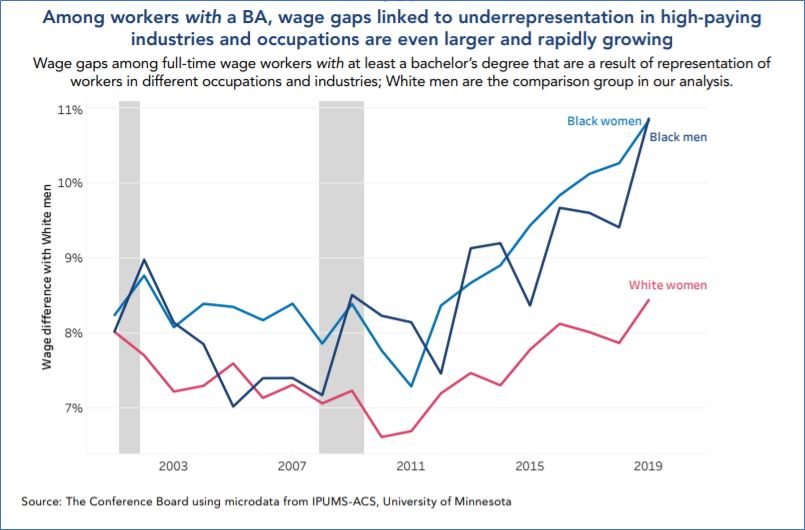
persist in the US economy. · How deeply rooted labor-market segmentation
has constrained the earnings of even highly educated Black workers, who are
underrepresented among high earners in fast-growing industries—and
overrepresented in sectors (government, health, education) that have been
shrinking. · Why the
rise of the tech industry in particular—where Black workers
are especially rare—has been a key driver of racial wage gaps over the past
decade, especially among college graduates. |
|
|
|
· The role of geographic mismatch in this tech divide.
Growth in high-wage technology jobs has been strongest in cities (San
Francisco, Seattle, Austin) where Black workers represent less than 2% of top
earners—and relatively weak in Black population centers like New York,
Philadelphia, Houston, and Washington, DC. · How leaders in high-growth sectors can expand
their access to Black talent—who may be unable or unwilling to relocate to
relatively homogenous tech hubs like Silicon Valley—by opening satellite offices
and embracing remote
work on a permanent basis. I encourage you to read the full report for our exclusive
data, nuanced analysis, and real-world recommendations around this critical
issue. |
|
No comments:
Post a Comment