Published: Aug 12, 2016 Juliette Cubanski Follow @jcubanski on
Twitter , Tricia Neuman Follow @tricia_neuman on
Twitter , and Anthony Damico
Medicare was established in 1965 as the health
insurance program for Americans age 65 and over; since 1973, it has also
covered people under age 65 who receive Social Security Disability Insurance
(SSDI) benefits.1 To
qualify for SSDI, people must be unable to engage in “substantial gainful
activity” because of a medically-determined physical or mental impairment
expected to last at least 12 months or until death. Medicare also covers
certain widows and widowers under age 65 with disabilities, as well as disabled
adult children of retired, deceased, or disabled workers. Today, Medicare
covers 9.1 million people with disabilities who are under age 65,2 or
16% of the Medicare population, up from 7% (1.7 million people with
disabilities under age 65) in 1973.3 When
people under age with disabilities on Medicare turn 65, their coverage from
Medicare continues.4
How do people under
age 65 with disabilities qualify for Medicare?
People under age 65 become eligible for
Medicare if they have received SSDI payments for 24 months. Because people are
required to wait five months before receiving disability benefits, SSDI
recipients must wait a total of 29 months before their Medicare coverage
begins. People under age 65 who are diagnosed with end-stage renal disease
(ESRD) or amyotrophic lateral sclerosis (ALS) automatically qualify for
Medicare upon diagnosis without a waiting period.5 Of
those who were receiving SSDI in 2014, 34% qualified due to mental disorders,
28% due to diseases of the musculoskeletal system and connective tissue, 4% due
to injuries, 3% due to cancer, and 30% due to other diseases and conditions.6
What are the
characteristics of Medicare beneficiaries under age 65 with disabilities
compared to beneficiaries age 65 or older?
Medicare beneficiaries under age 65 with
disabilities differ from beneficiaries age 65 or older in several ways,
including their demographic, socioeconomic, and health status profiles.
Income: In 2012, a much larger share of
beneficiaries under age 65 with disabilities than older beneficiaries had low
annual incomes (Figure 1).
Nearly one quarter (24%) of younger beneficiaries with disabilities had incomes
less than $10,000 per year and two-thirds (67%) had incomes less than $20,000
per year, compared to 13% and 39%, respectively, of older beneficiaries.7
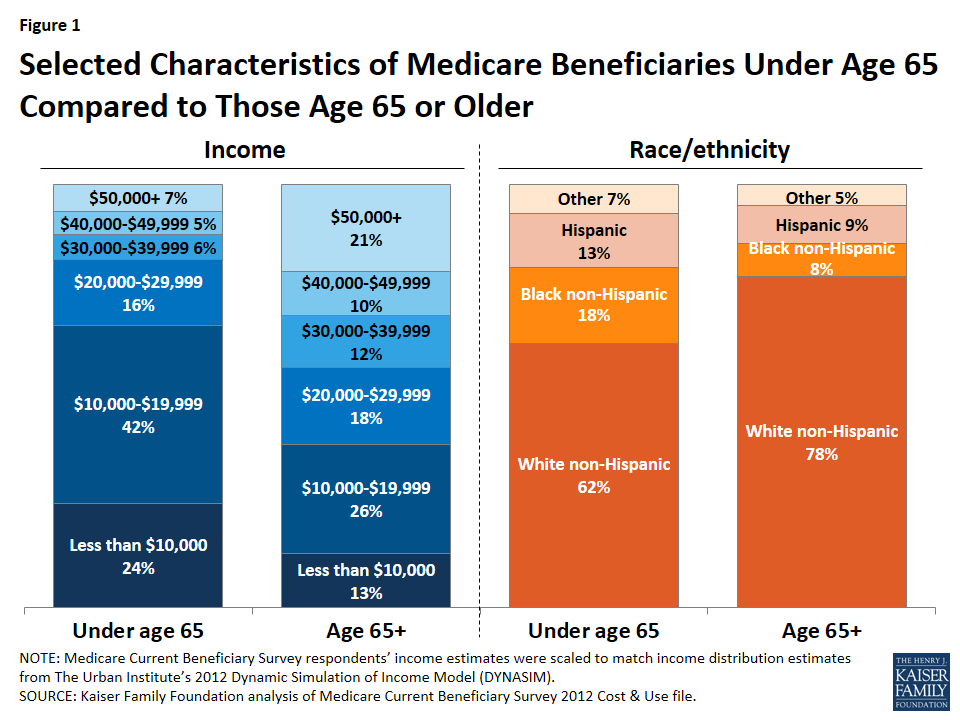
Figure 1: Selected
Characteristics of Medicare Beneficiaries Under Age 65 Compared to Those Age 65
or Older
Race/ethnicity and gender: A larger share of
beneficiaries under age 65 than older beneficiaries are black (18% and 8%,
respectively) and Hispanic (13% and 9%, respectively), and a larger share are
male (53% and 44%, respectively).
Health status: Nearly two-thirds of all
younger Medicare beneficiaries (65%) had a cognitive or mental impairment in
2012, compared to 29% of older beneficiaries (Figure 2). This includes memory loss that interferes
with daily activity, difficulty making decisions, trouble concentrating, and
loss of interest within the past year.8 Nearly
6 in 10 (59%) reported their health status as fair or poor and almost the same
share (58%) reported having one or more limitations in their activities of
daily living, compared to 20% and 34% of beneficiaries age 65 or older,
respectively. But roughly the same share of both younger beneficiaries with
disabilities and older beneficiaries report having five or more chronic
conditions (31% and 28%, respectively).
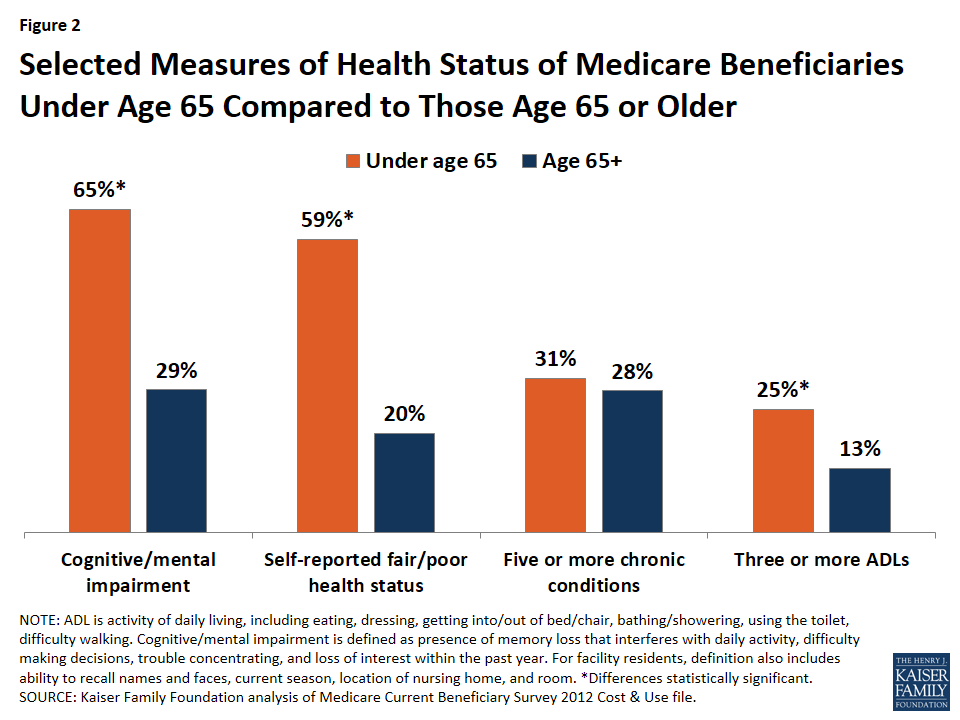
Figure 2: Selected
Measures of Health Status of Medicare Beneficiaries Under Age 65 Compared to
Those Age 65 or Older
How do sources of
supplemental coverage and prescription drug coverage differ for Medicare
beneficiaries under age 65 with disabilities and older beneficiaries?
Supplemental coverage
Most Medicare beneficiaries, including those
under age 65 with disabilities, have public or private supplemental insurance
to help cover Medicare’s cost-sharing requirements.9 A
much larger share of beneficiaries under age 65 with disabilities than older
beneficiaries rely on Medicaid to supplement Medicare (35% versus 10%) because
of their relatively low incomes (Figure 3).10 Medicaid
helps with Medicare premiums and cost-sharing requirements, and covers services
needed by many people with disabilities that are not covered by Medicare,
particularly long-term services and supports.
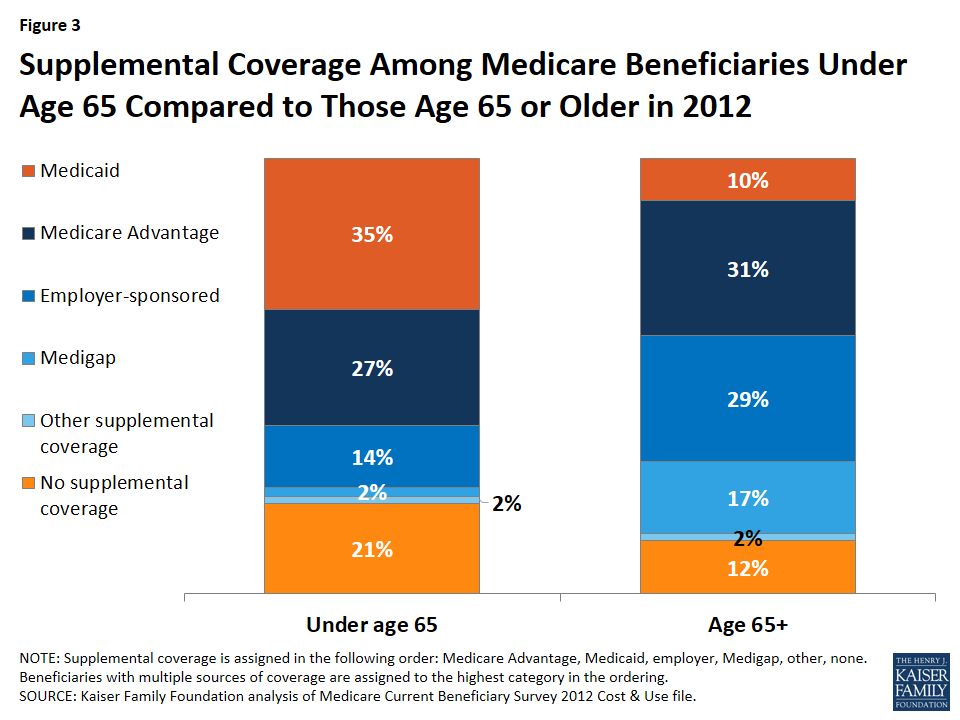
Figure 3: Supplemental
Coverage Among Medicare Beneficiaries Under Age 65 Compared to Those Age 65 or
Older in 2012
A smaller share of beneficiaries under age 65
with disabilities than older beneficiaries have employer-sponsored coverage
(14% and 29%, respectively), Medigap (2% and 17%, respectively), or are
enrolled in a Medicare Advantage plan (27% and 31%, respectively). A larger
share of older beneficiaries have employer-sponsored coverage as a result of
having retiree health benefits from former employers or because they are
currently working and have Medicare as a secondary payer. The small share of
beneficiaries under age 65 with disabilities who report having a supplemental
Medigap policy may be largely due to the fact that federal law does not require
insurance companies to sell Medigap policies to people under age 65, and while
some states do impose this requirement, others do not.11 Insurers
also may use medical underwriting in deciding whether to issue a Medigap policy
to people with disabilities and how much to charge. By contrast, people who
qualify for Medicare when they turn 65 have a six-month open enrollment period
when they can purchase Medigap coverage without medical underwriting and
regardless of what state they live in or their health status, as well as
certain other special enrollment periods.
Just over 1 in 5 (21%) beneficiaries under age
65 has no supplemental coverage, compared with 12% of those age 65 or older.
Lack of supplemental coverage among Medicare beneficiaries is associated with
higher rates of access problems, but rates of access problems are higher among
younger beneficiaries with disabilities who lack supplemental coverage than
among older beneficiaries, including not seeing a doctor for a health problem
when they think they should (31% and 10%, respectively) and having trouble
getting needed health care (17% and 5%, respectively).12 Regardless
of whether or not they have supplemental coverage, however, a larger share of
younger beneficiaries with disabilities than older beneficiaries experience
access and cost-related burdens (see discussion under “Access to Care and
Cost-Related Problems” below).
Prescription drug
coverage
The Medicare Part D drug benefit, which offers
outpatient prescription drug coverage through private stand-alone prescription
drug plans (PDPs) or Medicare Advantage drug plans (MA-PDs), is the primary
source of drug coverage for all Medicare beneficiaries, but covers a larger
share of those under age 65 with disabilities than older beneficiaries.
Three-fourths (75%) of Medicare beneficiaries
under age 65 are enrolled in a Part D drug plan, either a stand-alone
prescription drug plan (PDP) (52%) or a Medicare Advantage drug plan (24%),
compared to roughly two-thirds (63%) of older beneficiaries enrolled in Part
D (Figure 4).
Reflecting their lower incomes and higher rate of Medicaid enrollment, more
than half of all Medicare beneficiaries under age 65 (55%) receive the Part D
Low-Income Subsidy (LIS), compared to just 16% of beneficiaries age 65 or
older.
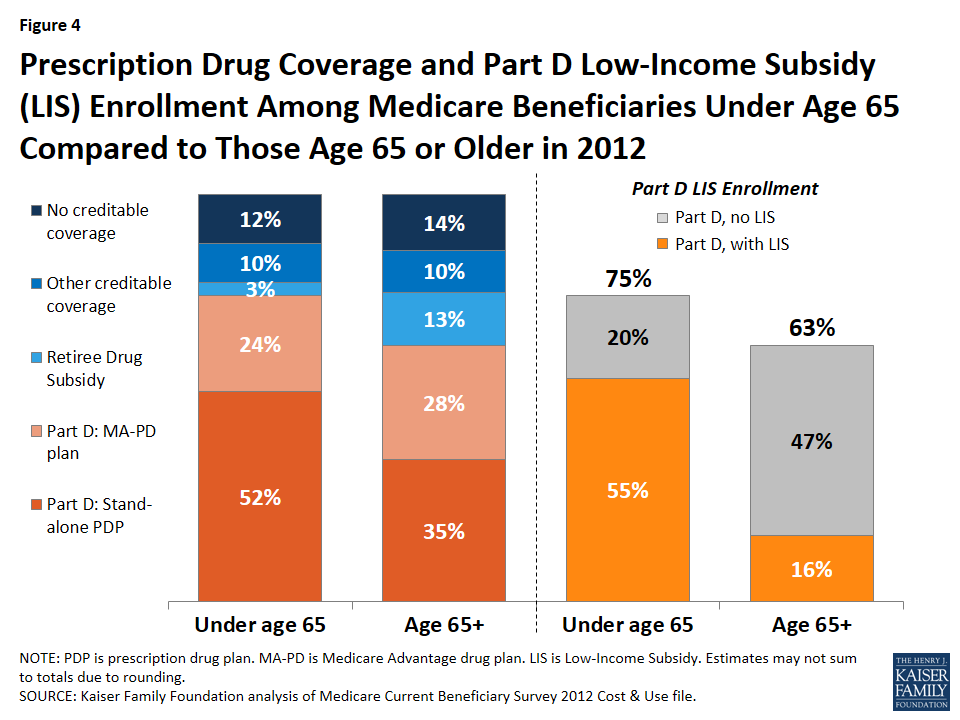
Figure 4: Prescription
Drug Coverage and Part D Low-Income Subsidy (LIS) Enrollment Among Medicare
Beneficiaries Under Age 65 Compared to Those Age 65 or Older in 2012
Roughly the same share of younger
beneficiaries with disabilities and older beneficiaries have no reported source
of creditable drug coverage (12% and 14%, respectively). Creditable coverage is
drug coverage that is at least equal in value to the standard Part D benefit
and can include, for example, coverage from employer-sponsored retiree health
benefits, the Department of Veterans Affairs, and TRICARE.
How do Medicare
spending and use of services differ for beneficiaries under age 65 with
disabilities and older beneficiaries?
Medicare per capita
spending
Average total Medicare spending is higher for
traditional Medicare beneficiaries under age 65, mainly due to higher Part D
prescription drug spending.13 Medicare
per capita spending for beneficiaries younger than age 65 averaged $13,098 in
2014, nearly one third more than average per capita spending for beneficiaries
over age 65 ($9,972).14 Excluding
Part D drug spending, the difference narrows considerably to $9,281 for
beneficiaries under age 65 and $8,814 for those over age 65, on average. On
average, beneficiaries under age 65 have higher per capita spending for drugs
covered under Part D and for inpatient and outpatient services, but lower
spending on post-acute and hospice care than beneficiaries over age 65 (Figure 5; Table 1).
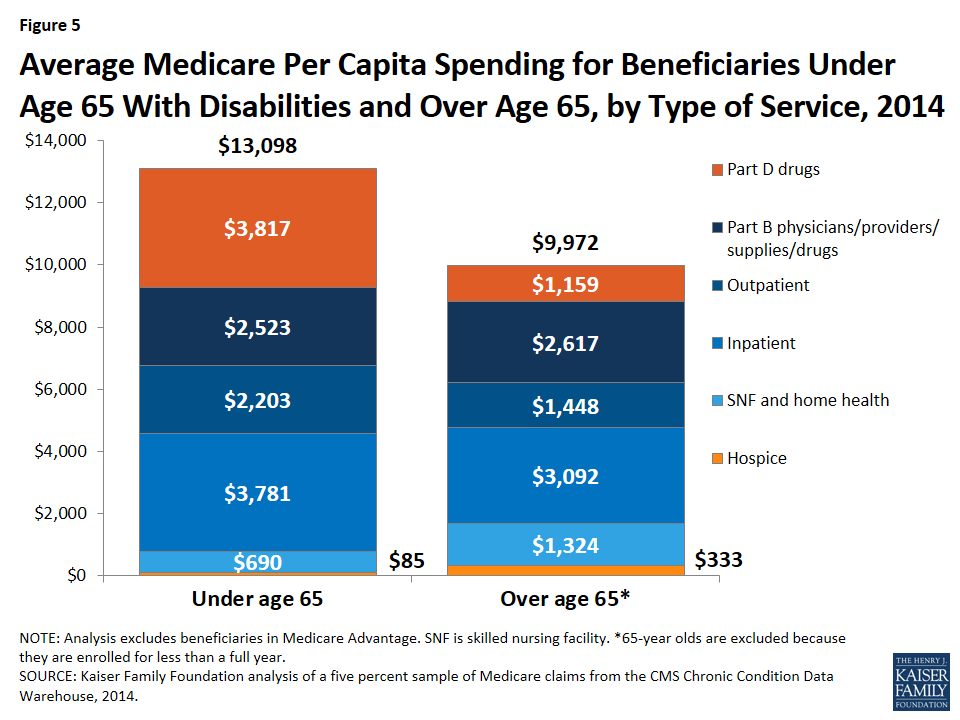
Figure 5: Average
Medicare Per Capita Spending for Beneficiaries Under Age 65 With Disabilities
and Over Age 65, by Type of Service, 2014
Use of medical
services
Among beneficiaries in traditional Medicare in
2012,15 a
somewhat smaller share of younger beneficiaries with disabilities than older
beneficiaries had an office visit (66% and 77%, respectively), but a somewhat
larger share of younger beneficiaries than older beneficiaries had an emergency
department visit (19% and 14%, respectively) (Table 3). A smaller share of younger beneficiaries
with disabilities than older beneficiaries used dental services (35% and 49%,
respectively), and, as might be expected, use of post-acute care services,
including skilled nursing facility stays and home health visits, was also lower
among those with disabilities. But the same share of both groups had a hospital
stay (18%) and the vast majority of both groups used prescription drugs (88%
and 90%, respectively).
How do beneficiaries’
out-of-pocket spending and access to care differ for those under age 65 with
disabilities and those age 65 and older?
Out-of-pocket spending
Although total Medicare per capita spending is
higher for Medicare beneficiaries under age 65 with disabilities than for older
beneficiaries, younger beneficiaries in traditional Medicare spend
significantly less out of pocket, on average. This is likely due to the fact
that a greater share of younger beneficiaries with disabilities than older beneficiaries
have Medicaid coverage (35% and 10%, respectively16), as
well as Part D Low-Income Subsidies (55% and 16%, respectively), that help
cover their premiums and cost sharing. Overall, out-of-pocket spending by
younger beneficiaries with disabilities is 40% less than that of older
beneficiaries (averaging $3,706 and $6,146, respectively) (Table 2). Younger beneficiaries have lower average
out-of-pocket spending than older beneficiaries for insurance premiums ($1,383
and $2,979, respectively) and for medical and long-term care services combined
($2,324 and $3,167, respectively).
On average, in 2012 beneficiaries in
traditional Medicare with disabilities spent the largest share of their total
non-premium out-of-pocket costs on medical providers (29%), followed by
prescription drugs (26%) and long-term care facility costs (20%). These
services also were the top three in terms of out-of-pocket costs for older
beneficiaries, but in a different order: older beneficiaries spent the largest
share of their out-of-pocket costs on facility costs (31%), followed by medical
providers (24%) and prescription drugs (17%).
Access to care and
cost-related problems
Access to care is generally good for a
majority of Medicare beneficiaries overall across a number of standard
measures, but a larger share of younger beneficiaries with disabilities than
older beneficiaries report experiencing a range of access problems, often due
to the cost of care. In 2013, nearly one quarter (23%) of younger beneficiaries
with disabilities reported that they had a health problem they think a doctor
should see but didn’t see a doctor about, compared to 8% of older
beneficiaries. And of those not seeing a doctor, 25% of beneficiaries with
disabilities cited cost as the main reason they didn’t see a doctor, compared
to 14% of older beneficiaries. Also in 2013, 1 in 6 (16%) beneficiaries under
age 65 with disabilities reported that they had trouble getting needed health
care, compared to only 4% of beneficiaries age 65 or older. Among those
reporting trouble getting care, close to half (45%) of younger beneficiaries
with disabilities reported that it was because they did not have enough money
or the cost was too high, compared to 31% of older beneficiaries (Figure 6).
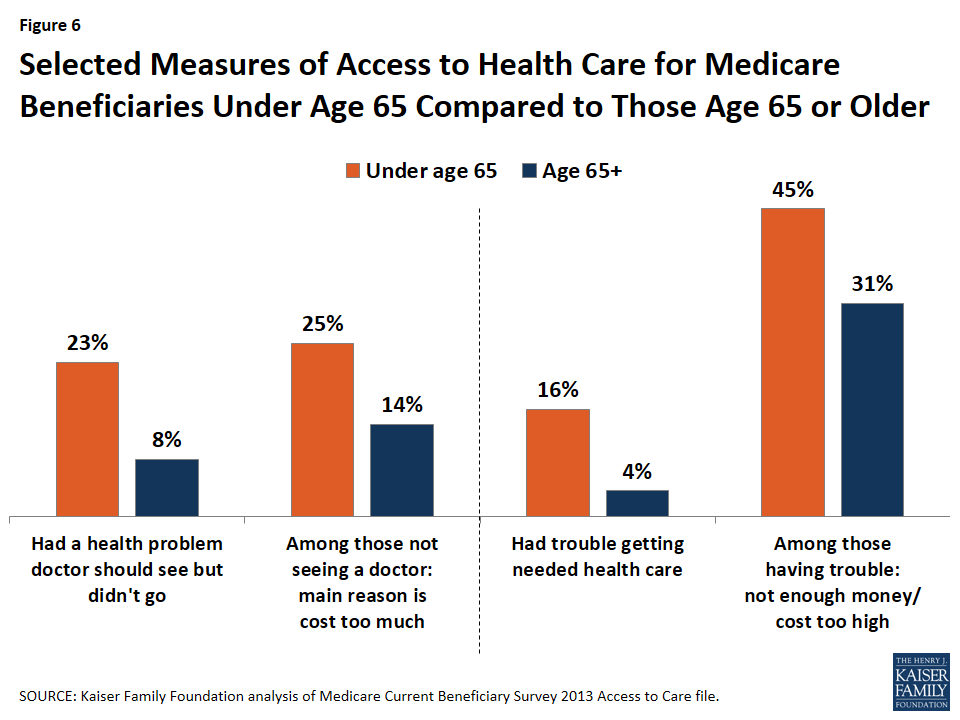
Figure 6: Selected
Measures of Access to Health Care for Medicare Beneficiaries Under Age 65
Compared to Those Age 65 or Older
The fact that a majority of both younger
Medicare beneficiaries with disabilities and older beneficiaries have some
source of drug coverage does not mean that the two groups are alike in the
shares facing access and cost-related problems in obtaining medications. A
larger share of beneficiaries under age 65 than older beneficiaries report that
they often or sometimes: decided not to fill a prescription because of cost
(22% and 7%, respectively); spent less money to save for needed prescriptions
(22% and 5%, respectively); delayed getting a prescription because of cost (21%
and 5%, respectively); took smaller doses of prescriptions (18% and 5%,
respectively); and skipped doses to make prescriptions last longer (15% and 4%,
respectively) (Figure 7).
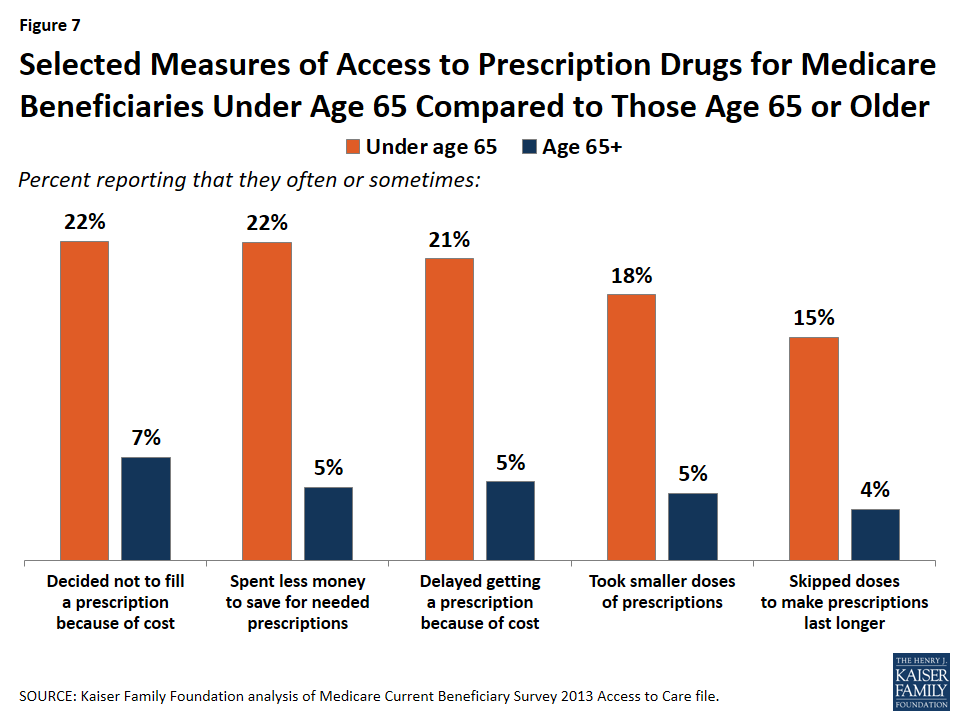
Figure 7: Selected
Measures of Access to Prescription Drugs for Medicare Beneficiaries Under Age
65 Compared to Those Age 65 or Older
Perhaps related to their higher likelihood of
experiencing cost-related access problems, a much larger share of beneficiaries
with disabilities than older beneficiaries report worrying about their health
more than others their age (63% and 18%, respectively), trying to keep their
illnesses to themselves when they get sick (50% and 35%, respectively), and
doing almost anything to avoid going to the doctor (38% and 27%, respectively).
Discussion
Since 1973, Medicare has been an important
source of health insurance for people with disabilities who are under age 65.
More recently, the Affordable Care Act (ACA) of 2010 improved access to health
insurance and coverage of benefits under Medicare, improvements which could be
especially helpful for people with disabilities. Specifically, the law expanded
access to health insurance coverage through expansion Medicaid or Marketplace
plans, which could be especially helpful for SSDI recipients in the 24-month Medicare
waiting period. Prior to the ACA, many people with disabilities in the waiting
period for Medicare faced difficulties obtaining or affording health insurance
in the private market.17
For all people on Medicare, including those
under age 65 with disabilities and older beneficiaries, the ACA also has helped
to alleviate out-of-pocket spending burdens by phasing out the Part D coverage
gap and by eliminating cost sharing for certain preventive services. Filling
the coverage gap could be especially helpful for younger beneficiaries with
disabilities due to their higher prescription drug costs than older
beneficiaries. And for those beneficiaries who are dually eligible for Medicare
and Medicaid, which includes a disproportionate share of younger beneficiaries
with disabilities, the law expanded coverage of home- and community-based care,
and created a new federal office to help coordinate benefits and coverage under
the two programs.
Yet despite broader access to public and
private coverage and improvements in Medicare benefits brought about by the
ACA, people with disabilities are likely to face ongoing challenges if their
coverage, including Medicare, does not provide the services and supports they
need to live as independently and productively as possible. Evidence points to
a consistent pattern of differences in the health care experiences of younger
beneficiaries with disabilities and those of older Medicare beneficiaries, with
younger beneficiaries encountering significantly more cost-related barriers to
care than older beneficiaries. Given high rates of health problems and
relatively low incomes among Medicare’s beneficiaries under age 65 with
disabilities, the needs of this relatively vulnerable population require
careful attention in ongoing Medicare policy discussions.
Juliette Cubanski and Tricia Neuman are with the Kaiser Family
Foundation.
Anthony Damico is an independent consultant.
https://www.kff.org/medicare/issue-brief/medicares-role-for-people-under-age-65-with-disabilities/
No comments:
Post a Comment