|
“Without
adequate paid sick leave and needing a paycheck, it’s not surprising that
some workers – especially those with lower incomes – went to work with
COVID-19 symptoms or after being exposed because they couldn’t afford not
to,” KFF President and CEO Drew Altman said. “The unfortunate result is
that they could help to spread the virus to others while on the job.”
Overall,
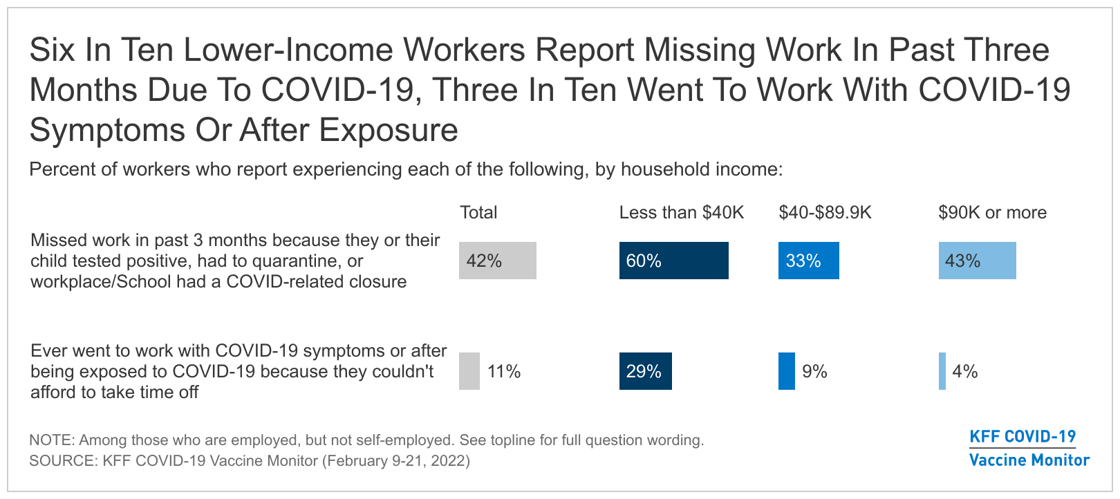
about 1 in 10 (11%) workers say they went to work with COVID-19 symptoms
or after being exposed to someone with the virus because they couldn’t
afford to take time off work. Among lower-income workers, the share rises
to 3 in 10 (29%).
Among workers whose
employer does not offer paid time off if they get sick, 15% say they have
gone into work when they had COVID-19 symptoms or had been exposed
because they couldn’t afford to take the time off.
In
addition, a small share (5%) of working parents say they sent a child to
school or daycare when they had symptoms or had been exposed to the virus
because they couldn’t take time off work.
Among
those workers who had to miss work due to COVID-19 or had to keep their
child home from school, most (62%) say that it impacted their family’s
stress level and 4 in 10 (44%) say it impacted their family’s finances.
This includes about 1 in 5 who say that missing work had a “major impact”
on their family’s stress level (22%) or finances (19%).
The
report also shows that about 3 in 10 adults (29%) report difficulties
paying their household and health care bills over the past three months.
That’s a somewhat smaller share than in February 2021 (37%) or in July
2020 (38%), when many businesses remained closed and the unemployment
rate was higher.
Larger
shares of Black (48%) and Hispanic (34%) adults, as well as people in
low-income households earning less than $40,000 annually (47%), continue
to report recent financial struggles.
Designed and analyzed by
public opinion researchers at KFF, the Vaccine Monitor survey was
conducted from February 9-21, 2022 among a nationally representative
random digit dial telephone sample of 1,502 adults. Interviews were
conducted in English and Spanish by landline (172) and cell phone
(1,330). The margin of sampling error is plus or minus 3 percentage
points for the full sample. For results based on subgroups, the margin of
sampling error may be higher.
The KFF
COVID-19 Vaccine Monitor is an ongoing research project
tracking the public’s attitudes and experiences with COVID-19
vaccinations. Using a combination of surveys and qualitative research,
this project tracks the dynamic nature of public opinion as vaccine
development and distribution unfold, including vaccine confidence and
hesitancy, trusted messengers, and messages, as well as the public’s
experiences with vaccination.
|



No comments:
Post a Comment