|
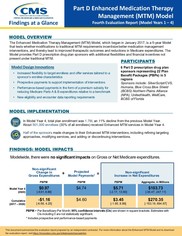
Part D Enhanced Medication
Therapy Management (MTM) Model
Fourth Evaluation Report - Key Takeaways:
The
Enhanced Medication Therapy Management (MTM) Model, which began in
January 2017, is a 5-year Model that tests whether modifications to
traditional MTM requirements incentivize better medication management
interventions, and thereby lead to improved therapeutic outcomes and
reductions in Medicare expenditures. There continue to be no
statistically significant impacts on Medicare Parts A & B
expenditures for the overall enrollee population in Model-participating
plans. In addition, Medicare’s prospective and performance-based
payments to sponsors for the Model continue to be larger than the
non-significant decreases in Medicare Parts A & B expenditures.
Findings from subgroup analyses suggest that enrollees eligible for the
low-income subsidy and enrollees with medically complex profiles did
not benefit more from the Model compared to the overall enrollee
population. Despite high eligibility and service receipt rates for
medically complex enrollees, there were no significant impacts on
Medicare Part’s A & B expenditures for this subgroup.
Setting-specific impacts were generally similar for the enrollee
subgroups and all-enrollee cohort. There were decreases in inpatient
expenditures and admissions related to Ambulatory Care Sensitive
Conditions for both the medically complex subgroup and the all-enrollee
cohort.
|
The Two Page Overview:
The Report (includes an Executive
Summary):
Additional Supporting Materials:
|
|
|
Medicare Care Choices Model
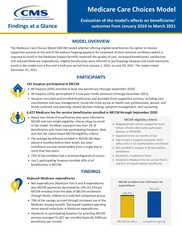
Fourth Annual Report - Key Takeaways:
The
Medicare Care Choices Model (MCCM) tested whether offering eligible
beneficiaries the option to receive supportive services at the end of
life without forgoing payment for treatment of their terminal
conditions (which is required to enroll in the Medicare hospice
benefit) improved the quality of care, increased beneficiaries’
satisfaction, and reduced Medicare expenditures. Outcomes generally
aligned with the expectations of the model. Specifically, MCCM
beneficiaries were more likely to enroll in the Medicare hospice
benefit than matched comparison beneficiaries, less likely to use
hospital services and other health care services, and more likely to
receive better-quality end-of-life care in the period between
enrollment in MCCM and death. Decreased use of resource-intensive
services, driven by earlier enrollment in the hospice benefit, resulted
in lower Medicare expenditures. These findings might not generalize to
other settings, however, given the small number of hospices that
participated in MCCM and the small percentage of eligible beneficiaries
that enrolled.
|
 The Two Page Overview: The Two Page Overview:
The Report (includes an Executive
Summary):
Additional Supporting Materials:
|
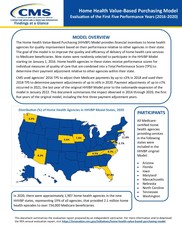
Home Health Value-Based
Purchasing Model
First Five Performance Years (2016-2020) Evaluation Report -
Key Takeaways:
The Home
Health Value‐Based Purchasing (HHVBP)
Model provides financial incentives to home health agencies for quality
improvement based on their performance relative to other agencies in
their state. The first five years of the implementation of the original
HHVBP Model have resulted in cumulative Medicare savings of $949.2
million, a 1.6% decline relative to the 41 non-HHVBP states, as well as
improvements in quality. These impacts were observed during 2020, the
third year for quality-based payment adjustments, as well as the first
four years of the model.
|
The Two Page Overview:
The Report (includes an Executive
Summary):
Additional Supporting Materials:
|
|
|
|




No comments:
Post a Comment