|
Key insights from
Anger: Wisdom for Cooling the Flames
By
Thích Nhất Hạnh
|
|
|
What you’ll learn
The Trappist monk Thomas Merton once said of the Vietnamese
Buddhist Thich Nhat Hanh “[he] is more my brother than many who are nearer
to me in race and nationality, because he and I see things the exact same
way.” Martin Luther King Jr. described the monk as “a holy man, for he is
humble and devout…a scholar of immense intellectual capacity.” So strongly
did King believe in Hanh’s program for peace that he nominated Hanh for the
Nobel Peace Prize in 1967. Hanh died in 2022, but his teachings continue to
captivate and challenge people around the world. In Anger, Hanh
explores the nature of anger and offers practical suggestions for how to
tend to our anger and the anger of others. He submits that an angry person
is a suffering person, in need of compassion.
Read on for key insights from Anger.
|
|
1. When someone
makes you angry, your top priority is cooling the fire inside—not hunting
down the person who ignited it.
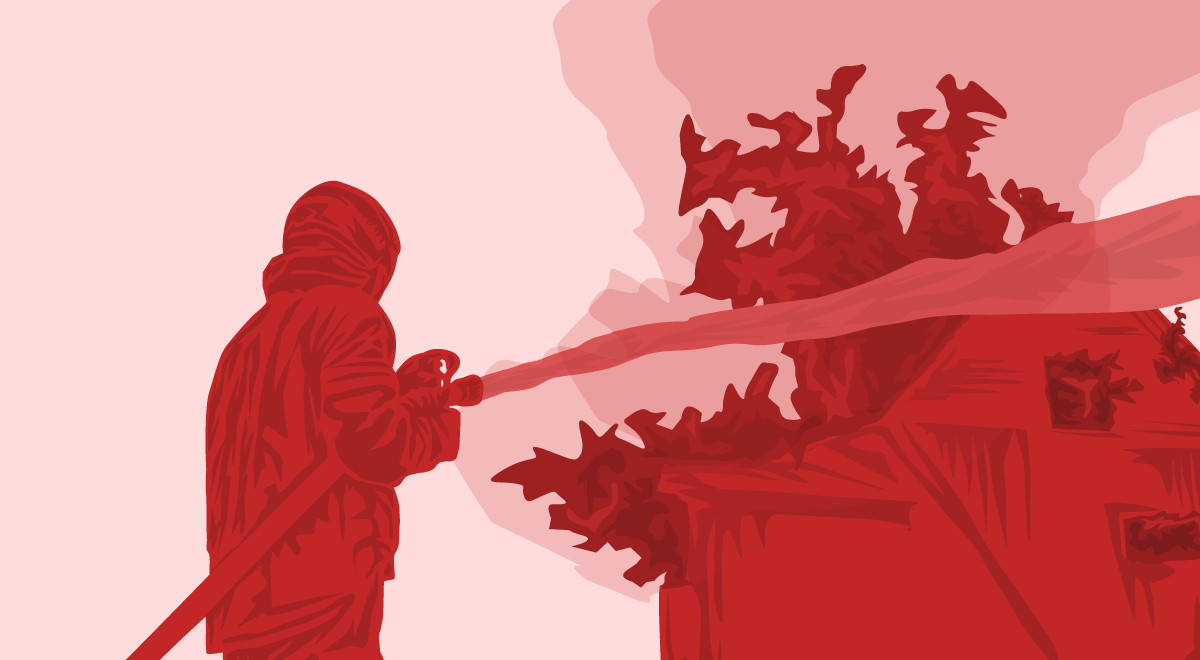
If someone sets your house on fire, do you put the fire out
or chase after the person who started it? If you chase after the culprit, your
house will burn to the ground, but if you tend to the flames quickly, you
can save your house. So often we are out for blood, looking for the people
who have wronged us, but we neglect the fire in our hearts.
With no home to return to, we live an emotionally homeless
existence and set fire to other people’s homes. When someone wrongs us, we
seem to believe that punishing them and watching them suffer will alleviate
our own suffering, but all we do is create more suffering for ourselves and
others. Think about it: When we take it upon ourselves to punish someone,
that person will then look for an opportunity to create suffering for us.
These vicious circles of suffering only end when people decide to tend to
the flames inside them rather than inciting flames in others.
Always remember that another person is only the secondary
cause of your anger. They did not put anger into your heart. To one degree
or another, the seeds of anger are already in each of us. It is unpleasant
when someone waters those seeds and makes them grow, but we must ultimately
release that person from primary responsibility for our anger. It is up to
us to assume responsibility for our own anger, and to pay attention to
anger’s seeds and roots in our life.
Nothing will change in ourselves, in others, or in our
relationships if we insist on punishing each other. We must learn to deal
with the fire before it destroys everything in our lives and in the lives
of those we touch.
|
|
2. Comfort your
anger like it’s your needy child.
If you are a parent and you hear your baby crying, do you
wait till your show is over to find out what is wrong? Do you finish
cooking dinner before checking in? No, you find your child and find out
what she needs, whether that’s a diaper change, to be fed, to be held, or
something else entirely.
Think of your anger as this crying baby that needs a parent
to soothe it. Give that anger the same priority and tenderness that a
distressed infant deserves.
Mindfulness is the key to soothing that angry baby in you.
Anger locks us up, but mindfulness opens us back up to life, much like
sunshine gently coaxes flowers to open their petals to the sun after night
closes them. Mindful energy is emotional sunshine.
So how do we become more mindful and start putting out the
fires in our lives? There are a number of practices from the Buddha himself
that help us cool the flames. Two of Thich Nhat Hahn’s favorites are mindful
breathing and mindful walking. He describes these practices
as two friends who are always with him, who water the seeds of positivity
in his life.
Mindful breathing is tracing the flow of air moving in and
out of your body. As you attend to your breath, your body will be in touch
with your mind. Having mind and body connected keeps us in the present
moment and will help us stay connected to ourselves, to others, and to what
surrounds us. It only takes one deep conscious breath to reconnect with
yourself, and just three to hold that connection.
Mindful walking adds a locomotive dimension to mindfulness
practice. Whether you’re walking across the street, across a field, or
across a room, pay attention to each footfall and to the earth underfoot.
As you walk, say “in” on the inhale and “out” on the exhale. Feel the air
entering and exiting your lungs. This might sound insignificant because
walking is something simple that we do every day, but this is precisely
what makes these practices so powerful. We always have opportunities to
practice as long as we can walk and breathe. Every mindful step will bring
you closer to the present moment. It is when we inhabit the present moment
that we come into “the Pure Land” or “the Kingdom of God.”
Be patient with your anger. Patience is the sign of
authentic love. Love is impossible without patience, and without patience,
you will not be able to bring yourself or anyone else relief. Learning how
to embrace your anger is not a once-and-for-all act. It takes repetition to
become skillful. Start with just five minutes of breathing, walking, and
embracing. If you need 10 minutes, that’s fine. If you need more than that
to cool the flames, there’s nothing wrong with that. But whatever you do,
and however long you need, dedicate yourself to that task of caring for
your anger. Don’t divide your attention by turning on music, grabbing a
book, or starting a show.
|
|
3. Happiness is
not a private concern.
Our emotional states impact others, especially when we are
in an intimate relationship. In moments of anger, practice using these
three lines:
1. “Darling, I am angry. I suffer.”
2. “I’m doing my best.”
3. “Please help me.”
When your beloved sets off your anger, you might be tempted
to hide or deny your feelings. But it is your responsibility to tell your
beloved. When you tell your beloved, “I am angry at you, I suffer, and it’s
important that you know that,” you are finding a middle way between frosty
silence and fiery rage. Try not to wait more than 24 hours if you can help
it, and tell your partner as peacefully as you can. If sadness surfaces,
that’s fine, but rage can’t enter the conversation. It will only cause more
damage. The goal is not to punish or score points.
Letting your partner know, “I am doing my best” communicates
that you are taking the practices of mindful breathing and mindful walking
seriously, that you are earnestly tending to the inner flames. Don’t say
“I’m doing my best” unless you are really practicing it. Saying that you’re
doing your best means you are embracing your anger like you would a wounded
child, and that you are not rejecting your emotions. It’s a part of you
whether you like it or not. Saying “Get away from me, anger!” when you feel
your rage rising is like saying “Get away from me, stomach!” when you feel
nauseous. Your anger belongs to you as much as your organs.
“Please help me” is the third and vital piece of working
through anger. When we are angry, we tend to tell those around us, “Get
away from me!” or “I’ll be just fine without you.” But speaking the
language of true love means acknowledging your neediness even when you are
upset—your need for help—even from the very person who has made you angry.
Peace begins with you. These three sentences will grow trust
and respect in the relationship, and in yourself.
|
|
|
|
4. If your anger
is so intense that you can’t confront someone compassionately, then wait.
Compassion is the antidote to anger, but it’s hard to access
that compassion in moments of frustration. When you turn off a fan, the fan
continues to rotate for a few minutes before it stops altogether. Make sure
you give yourself or your partner that cool-down time when either of you is
angry. And when your partner expresses frustration, compassionately listen
instead of jumping in to correct a perception.
Ideally, you want to let your anger be known within 24 hours
of the event that upset you. If 24 hours is up and you’re still seething
and can’t start the conversation with love in your heart, write it all out
for your beloved. If it happens during the weekday, set Friday as the day
to talk so you’ll be able to enjoy the weekend together.
In that interim time before Friday, remember that you are
partially responsible for the other’s suffering. There are ways you haven’t
been tending to your garden, there are ways you’ve neglected to water the
seeds of what is positive in your life, and instead watered the seeds of
anger in your beloved’s garden. With that in mind, think less
about what you want your beloved to own, and look deeply at
your own actions and how those are contributing to your beloved’s
suffering. We become cruel when we believe that we are the only person
suffering.
As a general practice, it is healthy and humbling to ask
yourself, “Am I sure?” Write it down on a slip of paper and place it
somewhere you can revisit, maybe on your dashboard or in your wallet. It
will keep you humble and curious. You may think you “know” why you’re so
angry, but by asking yourself, “Are you sure?” a fuller story can
emerge—details you might have forgotten or ways you might have provoked
your beloved’s anger.
Some people have found it helpful to carry a pebble in their
pocket wherever they go. Every time anger arises, they hold the pebble
(gently). It serves as a simple, beautiful, tangible reminder of the
present moment and an invitation to return to it. It might sound juvenile,
but give it a try: Pull out the pebble whenever you feel anger rising up in
you, gently cradle it, smile, and breathe slowly. Remember those three
lines:
Darling, I am angry. I
suffer.
I’m doing my best.
Please help me.
Just like the bells at a temple, the practices of using a
slip of paper and the pebble help you pause and slow down enough to see
your own anger and where you are contributing suffering to your partner
instead of love.
|
|
5. Once you learn
to cool your own flames, you can lend a hand in helping other people cool
their flames.
As you continue your practices, you will be able to listen
compassionately to others in suffering without activating your own
suffering. Your practices will reduce your suffering to such a degree that
you can stay protected as you go with people to their dark places. The act
of fully, attentively listening to someone’s suffering without jumping in
or correcting can unravel a great deal of pain in his life.
It can’t be emphasized enough that you cannot effectively
help others with their anger if you have not tended to yours. Imagine being
a psychotherapist, where your job is to listen attentively and
compassionately. In a single session, you will encounter tremendous
suffering, and this suffering will set off yours if you do not practice
mindfulness.
If someone’s suffering has led to you drowning in your own
suffering, you will not be able to listen deeply. Moreover, they will sense
that you are not fully present to them, that your suffering has taken you
somewhere else other than the present.
Firefighters are trained to put other people’s fires out,
but they don’t go without their equipment: They bring ladders and water and
flame-retardant attire so the fires of others don’t singe them. Compassion
is your equipment that helps you go into a home full of suffering and cool
the flames. Like a firefighter, your goal is to help others, not to punish
them. A person with a house on fire is a distressed and suffering person.
Punishing someone for having a house on fire will not save anyone from the
flames.
|
|
6. Our anger is
intimately tied to our consumption patterns.
It's important to understand that anger is not a purely
psychological process. We make a mistake when we divide up body and mind,
and treat them like separate entities. In Buddhism, there is a concept of namarupa,
which roughly translates “body-mind.” It gets at the idea that they belong
together and are a single entity. Body is mind and mind is body.
This might sound nonsensical, but recent discoveries in
quantum mechanics help make this connection clearer. Scientists noticed
while trying to observe the most basic elements of life that sometimes they
behave like particles, other times like waves. So is it a particle, or is
it a wave? Or is it both? Some scientists, uneasy with the
dualistic division, have started calling these elements “wavicles.”
Similarly, the body-mind defies the tidy dualisms we create.
What does all this have to do with anger? It is tempting to
view anger as psychological, without considering our body and how we treat
it. The truth is that our patterns of consumption can exacerbate our anger.
Give a little thought to what you put into your body and your mind.
Some of the systems that supply our food are full of pain
and they proliferate pain and anger. For example, think about where your
eggs come from. More and more frequently, we get our eggs from chickens
housed under inhumane conditions. They are jammed into cramped cages with
other chickens, and held in giant warehouses. These birds have no time
outdoors—no opportunity to spread their wings or even walk. In that fear
and stress, they claw and peck at each other—sometimes to death. To prevent
this, some companies cut off chickens’ breaks. What is more, the lighting
is intended to imitate a day-night rhythm to stimulate egg production—but
the cycle is expedited, so chickens can churn out eggs even faster. This
puts stress and strain on their bodies that is unnatural.
With all this involved in the production of eggs, what kind
of eggs are you getting? You are getting eggs that are full of suffering.
It would be naïve to believe that all that rage from such an exploitative
system would not be transferred to the eggs the chickens produce. You’re
putting angry eggs in your body. As you ingest this kind of energy, it will
come out of and create more suffering for you and for others.
Be mindful of where your food comes from. Be mindful of how
you eat it, too. Chew your food thoroughly—at least 50 times a bite. In
addition to slowing you down, becoming a mindfulness practice, and allowing
you to enjoy your food, eating your food this way will ease your digestion
and allow your body to access more energy, rather than expending extra
energy breaking down mindlessly half-chewed food.
Be conscious of what you put in your mind, too. From
attention-grabbing headlines or violent shows, there’s plenty of content
that will rob you of peace and fuel your anger.
|
|
7. You are far
more attractive when you smile.
Think about how you feel when you are around an angry
person. Think about that person’s face, twisted into a frown. Reflect on
the fear it evokes. Even if you have the insight that an angry person is a
suffering person, such interactions can still be frightening experiences.
It is worth pondering what you must look like when you’re angry, about how
your face looks when it’s contorted into a scowl. People will treat you
like a bomb that could explode at any moment and keep their distance. Go to
a mirror and greet your frustrated visage with deep breaths and a smile.
You are far more attractive when you smile.
This practice might seem artificial or cloying, but don’t underestimate the
link between the mind and the body. Body influences mind as much as mind
influences body. A lifetime of smiling (or scowling) alters a person’s
physiology and psychology, so be mindful of the links you want to develop,
of the countenance you want to bring to the world.
|
|
Endnotes
These insights are
just an introduction. If you're ready to dive deeper, pick up a copy of Anger here. And since we get a commission on
every sale, your purchase will help keep this newsletter free.
*
This is sponsored content
|
|
|
This newsletter is powered by Thinkr, a smart reading app for the
busy-but-curious. For full access to hundreds of titles — including audio —
go premium and download the app today.

|
|


No comments:
Post a Comment