Tara O'Neill Hayes October 12, 2018
The Medicaid actuaries recently released
their annual status update on the program. The
top-line numbers reveal no surprises: Expenditures and enrollment continued to
rise, with total outlays in FY2017 estimated to have increased to $592.2
billion, up 2.6 percent from the year prior. Enrollment grew at a slightly
slower pace of 2.1 percent, reaching 73.8 million beneficiaries. Federal
expenditures held steady as a share of overall spending at 63 percent, where
it’s been since 2015 following the Medicaid eligibility expansion.
When you look at the trends since 2010, however,
more interesting data points are revealed. Total expenditures have increased an
estimated 57 percent since 2010, and by next year it is estimated expenditures
will be 66 percent higher than they were at the start of the decade. What may
be the biggest surprise to some, though, is that state expenditures since 2010
have increased much more rapidly than federal expenditures: 79 percent versus
46 percent. Next year, those percentages are expected to reach 88 percent and
56 percent, respectively. So much attention has been paid over the past several
years to the Medicaid expansion—which has been almost completely financed by
the federal government—that some may have expected federal expenditures to have
grown much more quickly than state expenditures. Yet the expansion
population still represents only 16.5 percent of Medicaid enrollees.
Breaking down the data even further shows that
states’ primary cost growth is due to increased benefit expenditures, whereas
the federal government has seen dramatic increases in administrative expenses.
The states’ benefit expenditures have increased 83 percent since 2010 while
their administrative expenditures have only increased 27 percent. The federal
government, on the other hand, is now spending 88 percent more on
administrative expenses in Medicaid but only 44 percent more directly on
benefits.
Also surprising is how much expenditures have
increased given that enrollment has increased only 37 percent.
I say “only” 37 percent because it is dramatically less than the expenditure
growth of 57 percent, but 37 percent enrollment growth in 8 years is quite significant.
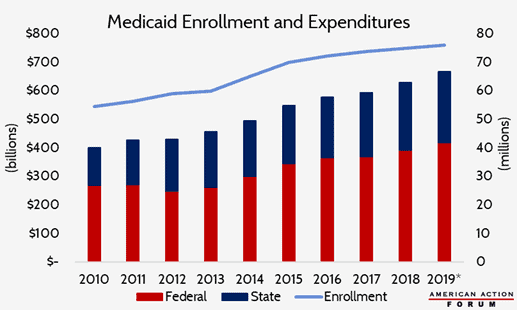
What this disconnect really shows is a more startling reality: Expenditures are
rising much more quickly than enrollment, which really becomes apparent when
both are put on the same scale, as shown in the chart below. Put more simply,
the cost per enrollee is rising substantially each year. In fact, the average
cost per Medicaid enrollee has risen 14.2 percent since 2010, from $7,367 to
$8,413; by next year, it is expected the nine-year growth rate will be 19.2
percent.

These figures will obviously continue to climb
going forward. While the 2.6 percent expenditure growth rate in 2017 was much
slower than the 5.1 percent growth rate seen in 2016, the growth rate is
projected to pick right back up next year. Enrollment will continue to climb,
particularly among the elderly as a result of the Baby Boomers reaching
retirement, and since the elderly typically require more care, spending per
person will likely increase more quickly. Expenditures are expected to grow at
an average annual rate of 5.7 percent between 2017 and 2026, at which time
total Medicaid expenditures will surpass $1 trillion.
https://www.americanactionforum.org/weekly-checkup/medicaid-growth-past-and-future/#ixzz5U6mEOkzW
Follow: @AAF on Twitter

No comments:
Post a Comment