Christopher
Holt January 11, 2019
The ongoing partial
shutdown of the federal government doesn’t affect most federal health programs, because the bulk of
the government’s health care activities are covered by appropriation bills that
were signed into law last year. In fact, only about a third of the government
is actually shut down.
The shutdown is, however,
having an impact on a few important government functions in the health care
space. First, the Indian Health Service (IHS) is funded not through
appropriations for the Department of Health and Human Services (HHS) but
through the Department of the Interior, which is caught up in the shutdown.
That means American Indians and Alaska Natives, who depend on these
facilities, will be going without health services in the very near future.
So far the IHS has been able to continue operations using carry-over funding,
but those resources will begin to run out shortly.
Second, the Food and
Drug Administration (FDA)—though part of HHS—receives its appropriated funding
through the Agriculture, Rural Development, Food and Drug Administration, and
Related Agencies appropriations bill, and that funding package is part of the
one-third of federal spending that hasn’t been provided. As a result, much
of the FDA’s domestic food-safety inspections, though not all, have halted.
On the other hand, inspections of foreign food imports have been deemed
essential and are continuing. Like the IHS, the FDA can also continue
nonessential operations using remaining 2018 funds while they last.
Unlike other federal
agencies, however, most of the FDA’s funding doesn’t come from federal appropriations.
Instead, the FDA’s brand-name and generic pharmaceutical, medical device, and
biologic and biosimilar review and approval processes are funded through
industry user fees (read AAF’s primer on the
user fees for more detail). It gets even more
complicated: The FDA can’t accept new user-fee payments during the
shutdown, but it can continue operations for which user fees have already been
paid. Additionally, the FDA is shifting around existing user-fee monies to
prioritize post-market drug safety surveillance over new drug approvals. All
told about 59 percent of FDA’s workforce is still going about its business as
the agency juggles available funding and critical responsibilities to try to
maintain food and drug safety.
The shutdown could also
have long-term implications for both the FDA and IHS. The longer the
shutdown continues, the more likely it is that the IHS fails to meet critical
health needs or that contaminated food slips past the FDA’s reduced
inspections. And the FDA already faces backlogs in its device and drug
approvals. To the degree new applications pile up, or work is slowed or stopped
on existing applications, the backlog will only worsen.
CHART REVIEW
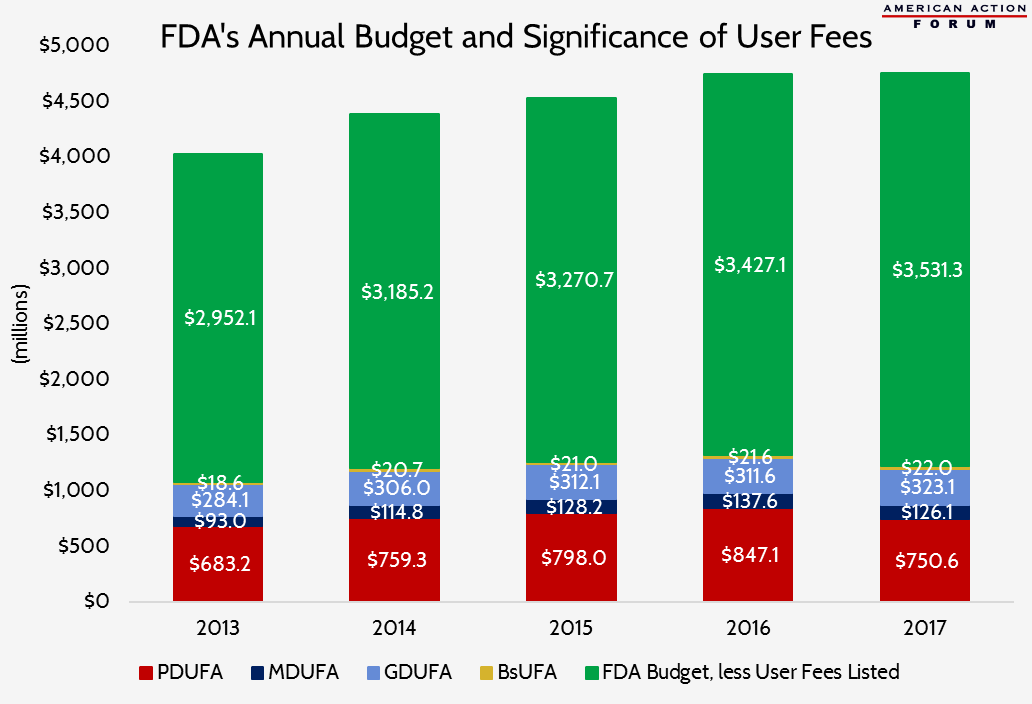
In 2017, AAF examined the Food and Drug Administration’s user
fees. The following chart shows the significance the prescription drug and
medical device user fees play in FDA’s annual budget. These four user fees
alone accounted for 27 percent of the FDA’s budget from 2013 to 2017.
https://www.americanactionforum.org/weekly-checkup/the-shutdown-federal-health-programs/#ixzz5cbsJih00
Follow @AAF on Twitter

No comments:
Post a Comment