|
Key insights from
Principles for Dealing with the Changing
World Order: Why Nations Succeed and Fail
By
Ray Dalio
|

|
|
What you’ll learn
Bridgewater Associates is among the largest and most
successful hedge funds in the world. Bridgewater’s founder, Ray Dalio,
wrote this book after noticing the simultaneous convergence of factors that
we haven’t seen in our lifetime, a convergence that will produce outcomes
we’ve never encountered. Most investors move assets based on what they’ve
experienced in their lifetime. Very few will glance backward to the
mid-20th century. To Dalio’s knowledge, he’s the only investor who ventures
back into history far enough to discern the overarching cycles that have
defined nations and economic systems over the centuries. After researching
the rise and fall of empires across history, Dalio locates the world’s
current empires in the empire life cycle, and describes how to plan and
invest accordingly.
Read on for key insights from Principles for Dealing with the Changing World Order.
|
|
1. The Big Cycle
is a once-in-a-lifetime upheaval that every empire succumbs to sooner or
later.
The rise-and-fall pattern of dynasties and empires follows
“the Big Cycle.” The Big Cycle involves the overlap of numerous smaller
cycles, most significantly:
-“long-term debt and capital market cycles” (century-long
debt cycles coinciding with short-term debt cycles and the decline and
replacement of the globally accepted reserve currency)
-“internal order and disorder cycle” (fissures in values,
wealth, and politics wider than ever, and exacerbated by economic
instability)
-“external order and disorder” (the rise of a global rival
that challenges the world’s reigning superpower)
Two other highly influential factors that could also be
added to this list are acts of nature (plagues, famines, and floods), which
tend to destabilize and shift existing power dynamics, and technological
innovations that change the world.
Cycles of long-term debt, capital market, internal and
external order and disorder are normal, but they are usually scattered
across an empire’s lifespan. Every once in a while they happen
simultaneously, and when they do, it signals the coming of era-defining,
seismic shifts that will irrevocably change the course of history.
All these smaller cycles are present in our world right now.
In our own time, the Big Cycle is showing up in the form of huge debts and
super low interest rates catalyzing the printing of enormous amounts of the
world’s reserve currency (USD, for now). This has devalued and destabilized
the USD and signals that the USD might not be the world’s reserve currency
much longer. We also see the Big Cycle in major upheavals within nations
(especially in the United States), and the growing rivalry between the
reigning superpower (USA) and a rising superpower (China). There haven’t
been overlapping cycles like this since the Third Reich tried to take over
the world in the 1930s and 40s. We’ve even experienced a world-rattling
plague recently.
The Big Cycle creates a back-and-forth between periods of
peace, prosperity, and creativity; and periods of revolution, war, and
decline. The halcyon periods are always significantly longer than the
periods of upheaval, but as one empire begins to decline and another rises
to replace it, the shifts between periods of peace and turmoil become
increasingly dramatic: ever bigger booms and busts. This is normal. Violent
fluctuations are expected when the Big Cycle begins.
At a conceptual level, people understand that the sun
eventually sets on any state or economy, but most are still shocked when
the sun sets on theirs. When people don’t look at the big picture patterns
that emerge over the course of generations, they end up blindsided by the
once-in-a-lifetime upheavals that shift virtually everything. An empire’s
average lifespan is about 250 years, which is about how old the United
States is at the moment.
|
|
|
Sponsored
by Gold River Trading Co.
Read Great Books,
Drink Fine Tea.
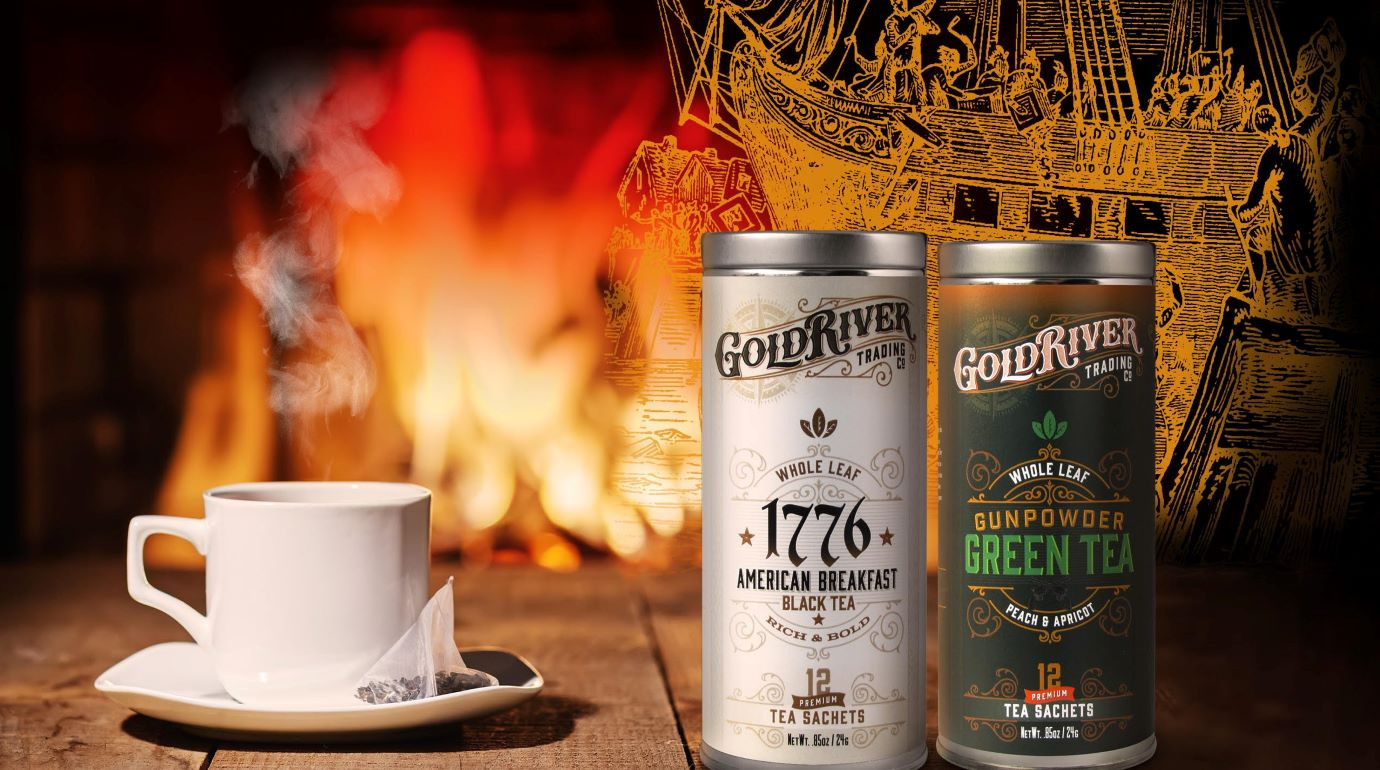
Gold River Trading
Co. is an American tea and hot chocolate company that serves modern
pioneers forging new frontiers and charting new paths. Gold River's
specialty blends pair well with great books, gold rushes, and
interplanetary space travel. Skip the coffee crash and the carbonated
sugar-water and start your day with a healthy, flavorful cup of 1776
American Breakfast or Gunpowder Green Tea.
Shop now and receive 10% off using discount code
“THINKR” at checkout.
|
|
2. World monetary
standards (reserve currency) rise and fall with their empire, and the USD
might be on its way out soon.
At the 1944 Bretton Woods Conference in New Hampshire, the
USD became the world's reserve currency. It was the end of World War II,
the United States was enjoying peace, prosperity, and global influence—a
classic signal of a Big Cycle beginning.
The tide started to turn against the United States and USD
as other nations became increasingly competitive and the dollar began to
drop. No one saw this as a Big Cycle, or the beginning of the unraveling.
It was just an economic hiccup that market forces would sort out, as far as
most people were concerned.
But between astronomical costs of the space race, the
Vietnam War, and the War on Poverty, the dollar was struggling. In 1971,
under President Nixon, the USD was decoupled from gold, and it fell
relative to gold—and then relative to just about everything else, from
stocks to bonds.
Going off gold meant market fluctuations that rippled across
the globe. Since the collapse of the Soviet Union in 1991, there was a
period of prosperity in many parts of the world. But amidst the optimism
and globalization, there were three flies in the ointment: the dot-com bust
in 1999, the housing bust in 2008, and the COVID-19 pandemic that began in
2019. These events are tremors that foreshadow tectonic shifts to come. The
USSR fell, but China has been on the rise since that time too. Tech
continues to replace human labor, and the income gap in the United States
has not been this wide for a century.
Where are we now? The United States is approximately 70
percent of the way through the Big Cycle, give or take. At the moment, the
United States checks a lot of the Big Cycle boxes, but not all of them. For
example, there is certainly high and rising internal conflict in the United
States: There have been frequent protests and the past several elections
have been tight and fiercely contested. The country is not yet, however, on
the verge of civil war.
|
|
3. Growing
tensions within the United States and with China show us that the United
States won’t have center stage forever.
When internal fighting is respectful and the gloves stay on,
the order can be strengthened through productive conflict. But when the
gloves come off and people en masse begin caring more about the
success of their causes over the continuation of the system, the system’s
position becomes precarious. In the United States, the chance of civil war
in the next 10 years is about 30 percent (according to Dalio’s metrics).
Thirty percent is an unsettlingly high probability, and it
points toward extremely polarized politics. A revealing 2010 study found
that half of Republicans and a third of Democrats would be upset if their
children married someone from the opposite party. Now consider that in
1960, that figure was just five percent for both Democrats and Republicans
polled.
On the other hand, while the United States is polarized, its
internal order is especially strong. Many people believe very strongly in a
constitutional form of government. This bodes well for internal resilience,
but it will also be highly disorienting and damaging for the country if
internal order does collapse.
Can these Big Cycle phases be stopped or slowed? History
reveals it is extremely hard to reverse the Big Cycle’s turnings that have
already occurred. As much as we might want to go back to an earlier time,
the best we can do is face the challenges that are before us, adjust, and
innovatively confront difficulties arising now instead of wishing for a
return to yesterday’s.
Can these cycles be reversed? Reversing small cycles of
widening wealth and value gaps might sound appealing, but even these small
cycles are hard to alter. Even if a society manages to do so (a high
improbability), the small cycles are also turning within a Big Cycle, which
has huge amounts of cultural and historical inertia. Big debt plus loss of
international clout plus inner polarization equals a big concern for
Americans and anyone else whose ship rises or falls with the US tide.
Another factor to consider in anticipating the future is
that the declining and rising superpowers (the United States and China,
respectively) possess nuclear weapons. This has created a de facto
mutually assured destruction (MAD) that has ensured an uneasy peace. This
peace defies the average recess between superpower clashes. During the past
500 years, major regimes have fought, on average, every 10 years. But there
has not been a major blowup between superpowers since WWII. In the event
that the United States and China fight, the loser will be wiped from the
map and the winner’s victory will be pyrrhic. The status quo of
mutually assured destruction will probably only lift when one side gains an
outsized technological advantage that revolutionizes warfare.
|
|
|
|
4. You always bet
on the upside, and a knowledge of general and specific trends can help you
identify it.
There is no crystal ball that allows us to divine the future
and plan accordingly. That being said, there is a pattern that consistently
repeats itself (or at least “rhymes”) across history, and by understanding
that pattern, we can at least peek around the corner.
Here are your touchstones for decision making and
anticipating the future as much as you can:
-Evolution
-Cycles
-Indicators
Evolution
isn’t just a theory for biologists. The idea of evolution is central to
understanding our current moment, and the economic, political, and social
trends that have brought us to now. Looking at broad, big picture trends
in, for example, life expectancy, per capita wealth creation, standards of
living, and population, we get a sense of what could be expected in the
future—at least in general terms. For example, if the population rate has
been growing throughout our history, and even exponentially in the last century,
we could reasonably extrapolate that the population will continue to trend
upward. Even in years where there was tremendous loss of life (e.g., the
Spanish Influenza, World War II), global population increased. That being
said, extrapolation only gets us so far. The occasional paradigm shift can
forever change the face of the world. The Digital Revolution was probably
one of the most significant and difficult-to-anticipate evolutionary
lurches forward, but it has forever altered life on our planet.
Cycles,
as already discussed, play a huge role in prosperity and loss. Knowing
where a nation is in its big and small cycles will help guide your
investing. Your best bet is putting money where things appear to be
improving, evolving toward greater productivity and higher income. But
don’t do it so aggressively that your future depends on it. To help
determine which bets are likely to succeed or fail, you need quality
indicators.
Indicators
are the factors that determine the ebbs and flows of power and wealth in a
country and between countries. As mentioned above, the Big Five indicators
are the debt/money/market capital cycle, the internal order-disorder cycle,
the external order-disorder cycle, innovation, and acts of nature. There
are however, a dozen others that deserve consideration, like geography,
geology, levels of self-interest, drive to create and hang onto wealth,
culture, openness to global norms, leadership, the political left-right
swings, and so on.
By understanding the cycles that fuel the rise and fall of
nations, you will be able to anticipate what changes are on the horizon and
position yourself accordingly, shielding yourself from the worst of it and
capitalizing on the best of it.
|
|
Endnotes
These insights are
just an introduction. If you're ready to dive deeper, pick up a copy of
Principles for Dealing with the Changing World Order here. And since we get a commission on
every sale, your purchase will help keep this newsletter free.
*
This is sponsored content
|
|
|
This newsletter is powered by Thinkr, a smart reading app for the
busy-but-curious. For full access to hundreds of titles — including audio —
go premium and download the app today.

|
|


No comments:
Post a Comment