|
Key insights from
The Knowledge Gap: The Hidden Cause of
America’s Broken Education System—and How to Fix It
By
Natalie Wexler
|

|
|
What you’ll learn
Skills, skills, skills! This is the modern day educational
emphasis that teachers take for granted, but according to researcher and
journalist Natalie Wexler, it is letting young kids down. The rest of the
world is moving ahead while US literacy lags behind, and an increasing
proportion of US kids fall short of proficiency standards across
subjects—especially students from low-income families. The growing gap in
achievement between the low-income students and higher-income students and
overall decline in educated high school graduates prompts the question,
“Are we missing something?” Wexler submits the problem and solution are
straightforward, but whether or not educators embrace this alternative
remains to be seen.
Read on for key insights from The Knowledge Gap.
|
|
1. The educational
establishment emphasizes skills and rarely gets around to knowledge.
The Knowledge Gap refers to the glaring and widening
differences in academic achievement between children from lower and higher
socioeconomic backgrounds. The gap is also referred to as the achievement
gap, the opportunity gap, and the test score gap, but at its heart, the
issue is one of knowledge—knowledge of not just reading and math, but
science and history.
A major problem with education today is the pervasive but
misguided idea that teaching science and history before reading and math is
developmentally inappropriate. Children need reading skills before they can
delve into those topics, so the logic goes.
There are a few problems with this. One is that the research
simply does not bear out this conclusion—neither do the standardized test
scores, despite a heavy, heavy emphasis on skills. Another issue is that
focusing on the skills of reading without any content leaves students
learning reading in abstraction. As a result, “informational texts” and
“main ideas” and “comprehension” don’t mean much to elementary school
students. Moreover, science and history provide content and context that
make learning possible and activate the skills, allowing them to “click.”
What students don’t enjoy learning about Egyptian mummies and watching an
explosive chemical reaction?
Without emphasizing content, students have no conceptual
hooks on which to hang the lessons from even the most attentive,
well-meaning teachers. With engaging science or history content, students
learn to read faster and can comprehend better (in a word, acquire all the
skills teachers are trying to instill), rather than just regurgitating
abstractions related to reading. Unfortunately, the latter is standard fare
for American reading education. This approach impedes reading and education
because it waits to deliver content until students learn to read—an
achievement that comes later and later, and, for many from low-income
backgrounds, never. When these students haven’t learned to read, extra
funding goes to doubling down on a defunct skills-heavy method of teaching,
instead of giving them knowledge that would make learning possible, even
enjoyable and relatable.
|
|
|
Sponsored
by The Pour Over
Neutral news is
hard to find.

The Pour Over
provides concise, politically neutral, and entertaining summaries of the
world’s biggest news paired with reminders to stay focused on eternity, and
delivers it straight to your inbox. It's free, too.
Check it out.
|
|
2. Quality
education is the last best hope for disrupting the cycle of
intergenerational poverty.
Standardized testing is on the rise, but there is no
compelling evidence that it is actually helping kids learn. Despite
astronomical spending, extensive testing, and a heavy emphasis on reading,
large proportions of students score below proficiency benchmarks at
elementary, middle, and high school levels. The vast majority of students
are clueless about the world, too. History, geography, and politics—general
knowledge in these topics is totally lacking. The lack is especially
noticeable in low-income areas, where home life does not supplement
classroom learning.
Schools educating low-income students tend to focus on
narrow technical skills in math and reading until they “get it”—after which
science, history, and civics can be introduced. But what if students never
get to learn about those subjects because they never learn skills? And what
if the best way for students to learn the skills is to provide pieces of context
in which abstractions like “main ideas” and “inferences” can nest?
Curricula that use content-rich texts to inform students about the world
are vital for them to gain those skills.
This gap is a glaring and growing problem. Low test scores
correlate to lower likelihood of pursuing higher education, of gaining
employment and keeping it, of hope for the future. Inequality continues to
soar and many low-income students enter universities only to be blindsided
by their unpreparedness. They get stuck in supplemental courses for math
and reading because their K-12 education let them down, and most of these
students never get that coveted bachelor's degree.
What if the best way to teach kids to read is to introduce
them to history and science earlier? What if reading comes naturally just
through having a context, instead of assuming that students can’t learn
history or anything abstract until they learn to read. Education is the
last hope for alleviating intergenerational poverty.
The gap between middle class and the poor is a problem of
knowledge—not skills. The hope that more reading instruction and
skills emphasis will raise test scores is a chimera, and there’s no data to
support it. Adjusting the emphasis from skills to knowledge will give kids
from low-income homes the best shot at a bright future.
|
|
3. The Common Core
drew out the tension between skills and knowledge, but it is also the
United States’ best shot at bringing both together.
The Common Core is a set of benchmarks developed and adopted
around 2010 to redress the lack of cohesion between state standards and the
shortcomings of the No Child Left Behind Act of 2001. Educators began to
realize that students were scoring far higher on state tests than national
tests and began drafting unified common (though not “national”) standards.
By 2017, 46 states had signed up, but the backlash from segments on the
right and left was so severe that 21 states backed out of the initiative
entirely or at least tweaked it to make it their own.
Contrary to popular belief, however, these standards don’t
form a national K-12 curriculum. It’s more of a skeleton than the meat.
Teachers and districts can adopt specific curriculum that align with Common
Core benchmarks. What makes the Common Core unique is that it offers a
different vision of education, one that includes skills but also gives more
space for knowledge of the world. Civics, science, and history benchmarks
are introduced earlier in elementary school. The language that the Common
Core’s architects use to justify this shift is the need for “content-rich”
texts.
The main difficulty with the Common Core is that the
standards require students (many of whom do not have an adequate knowledge
base) to handle complex texts. Under Common Core, students are expected to
understand these texts without the background that makes that understanding
possible in the first place. This is a fair criticism, but for this and all
the other issues with Common Core literacy benchmarks, they are slowly
facilitating a paradigm shift away from skills-heavy curricula and toward a
framework that makes expanding the student knowledge base a real
possibility.
A small-but-growing minority of teachers see the need for skills and
knowledge, embracing the tension. By emphasizing content-rich texts, Common
Core’s standards have helped awaken this awareness that will challenge
students and become not only an opportunity to test their comprehension of
the text, but to increase their knowledge base through the text itself.
|
|
|
|
4. Low-income
students and students with disabilities are exceeding teacher expectations
when assigned challenging, content-rich texts to explore.
What does Common Core’s knowledge emphasis look like in
practice? Let’s look at Nevada as a case study.
Before Nevada adopted Common Core in 2011, their teachers
organized lessons around state standards. One researcher and administrator
named Aaron Grossman discovered that less than 20 percent of the standards
showed up in the actual tests and that it was the same standards every
year. So administrators and teachers learned to zero in on those “power
standards,” as they are often called.
Adoption of Common Core threw Nevada’s education into
confusion. Top administrators and politicians assured teachers that little
would change, but Grossman discovered there were significant differences
between state standards and the newly adopted Common Core. As he did more
research, he found that one of the chief architects of CCS (David Coleman)
was offering a different vision of education, particularly with his
emphasis on putting challenging, complex texts in front of students—and not
just with the purpose of getting the main idea or drawing inferences, but
learning about the world from the text itself.
In a pilot project called the Core Task Project, Grossman
and several others asked 18 teachers from various Nevada schools to give a
complex text to students and see how they handled it. The piece was an
essay by famed physicist Richard Feynman about his father’s influence on his
life and career. Many teachers resisted at first, arguing that the text
would be difficult to the point of demoralizing for their young students,
especially those from low-income backgrounds and those without English
spoken at home. Grossman asked that the teachers simply give it a try and
report back.
Much to the teachers’ surprise, students struggled with the
text, but loved the challenge and offered insightful responses. In some
classrooms, students requested more assignments like it. Even English language
learners (ELLs) were engaged with the text and enjoyed the assignment. This
left many of the teachers to conclude they had sorely underestimated their
students.
Word got around of David Coleman’s ideas and the Core Task
Project. The same teachers came back for another session and with them
scores of other teachers and principals. This time, they tried another
experiment, focused on the poem “The New Colossus,” about the Statue of
Liberty, penned in 1883. Teachers were asked to give the poem to the students.
It was far more complex even than the Feynman piece, with vocabulary and
allusions that even many adults would miss. Again, teachers thought
Grossman and the Core pilot group were crazy, and once again, students
struggled but embraced and enjoyed the challenge the text
presented—including students still learning English and those with learning
disabilities. In fact, many teachers reported that students struggling with
English and disabilities were the most engaged and working the
hardest to grasp the meaning of the texts.
As the Core Task Project grew and gained traction, more and
more of these stories of teachers and students excited about learning kept
popping up.
Coleman has become a controversial figure for his Common
Core Standards, but stories like these corroborate his intuition that close
readings of complex texts bridge the knowledge gap between low-income and
high-income students. And more than that, they show that children getting
excited about learning is not an idea reserved for starry-eyed,
first-year teachers. It is a real possibility.
|
|
5. Scaling up
content-rich curricula across the nation is not a pipe dream—it’s beginning
to happen.
Nevada’s experiments with content-rich materials are not a
one-off. Neither are the excited students who are far more engaged and
beginning to enjoy reading instead of struggling with it.
There is a modest but growing movement of districts across
the United States adopting new, content-rich curricula aligned with the
Common Core, including cities like Detroit and Baltimore. Following the
adoption of Common Core standards, New York created its own K-12 curricula
from scratch, called EngageNY. It was an enormous undertaking, but EngageNY
curricula became a nationwide sensation. The EngageNY website garnered millions
of visits and then millions of curricula downloads. Within a few years, the
number of downloads reached 20 million. States and districts would use
EngageNY material as a template and adapt it for their own purposes. Nearly
a third of math teachers were using it and a quarter of English language
arts teachers. Textbook titans were scrambling as small grassroots
movements began disrupting their market share.
These are all very encouraging signs, but even if districts
embrace content-rich material that promotes close readings of texts,
teacher buy-in will likely be a slower process. Teaching for knowledge as
well as skills is a different approach to educating, and many teachers are
undoubtedly comfortable sticking to what they have known. Even those instructors
who do buy in are fighting a great deal of pedagogical conditioning.
Convincing teachers will require reorienting their gut-level
intuitions through new experiences. This will entail a hands-on,
trial-and-error approach to professional development, much like Grossman
and Nevada’s Core Task Project accomplished by introducing texts to
students and seeing if they stick.
The biggest immediate challenge to this end is the dearth of
informed trainers who could instruct millions of teachers nationwide. The
move away from reading comprehension toward content-rich material is not
just an abstract dream, but a grassroots movement beginning to gain both
traction and credibility. This is exciting news for all students,
especially for low-income students who want to learn but have been hindered
by misguided pedagogy.
Ironically, the best way to improve student skills like
reading comprehension is to emphasize knowledge. Making space in the
curricula for close readings of challenging, content-rich texts that expose
kids to the broader world effectively teaches kids to read and gives them
the opportunity to enjoy reading. If the content movement grows, it could
prove the most revolutionary way to bridge the knowledge gap.
|
|
Endnotes
Read Great Books,
Drink Fine Tea. Gold River
Trading Co. is an American tea and hot chocolate company that serves modern
pioneers forging new frontiers and charting new paths. Blended and packed
in the USA, Gold River's specialty blends pair well with great books, gold
rushes, and interplanetary space travel. Shop now and receive 10% off using
discount code “THINKR” at checkout.
These insights are
just an introduction. If you're ready to dive deeper, pick up a copy of The
Knowledge Gap here. And since we get a commission on
every sale, your purchase will help keep this newsletter free.
*
This is sponsored content
|
|
|
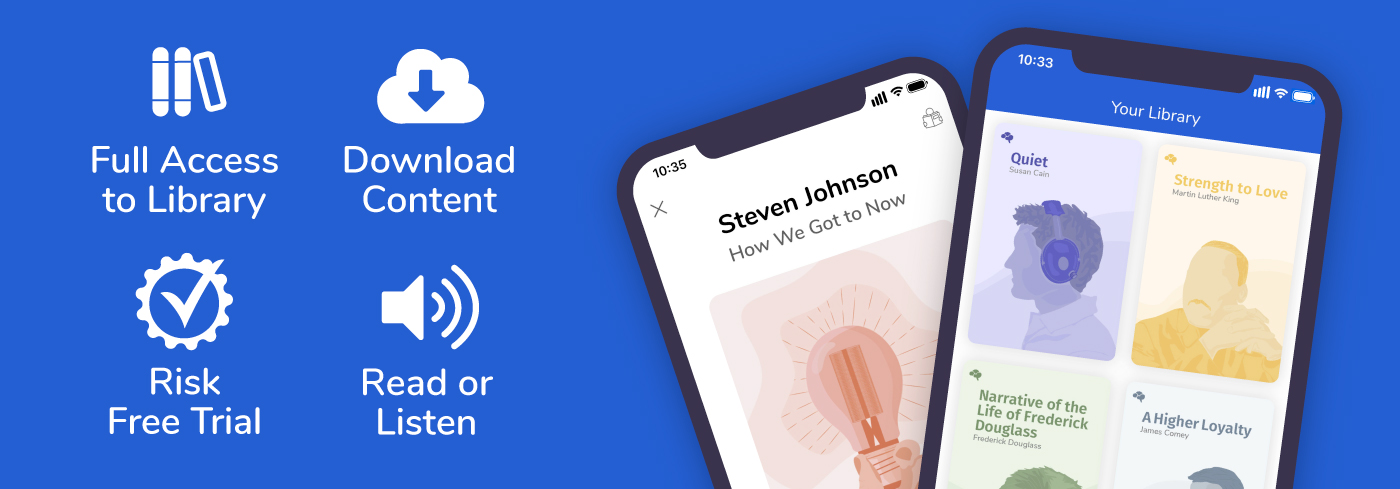
This newsletter is powered by Thinkr, a smart reading app for the
busy-but-curious. For full access to hundreds of titles — including audio —
go premium and download the app today.
|
|

No comments:
Post a Comment