|
Key insights from
The Power of Now: A Guide to Spiritual
Enlightenment
By
Eckhart Tolle
|

|
|
What you’ll learn
Many people are haunted by memories and paralyzed by
worries. But between the past and future, there is the present, where, as
Eckhart Tolle argues, we were meant to stay, where life is truly happening.
Here in the Now we find the light-hearted, joy-filled existence that so
many are striving for, but few seem to find. Accepting each moment as it
comes and all it contains, instead of fighting it or withdrawing from it,
is the key. In The Power of Now, Tolle shows us the benefits of
moving into the Now and the obstacles that hinder many from living mindful,
fulfilling lives.
Read on for key insights from The Power of Now.
|
|
1. Enlightenment
does not come through superhuman effort—it is within you waiting to be
discovered.
There’s an old parable about a beggar on a street corner
looking for a handout. One day someone tells him to look inside the box
he’s been sitting on. The beggar thinks this a strange request but opens
the box and discovers that the box he has been sitting on for years is full
of gold!
Such is the human condition—the truth is far nearer to us
than we would guess. Many are sitting on treasures, even as they live in
existential rags. The treasure of joy and peace that comes from
enlightenment is near. It is, in fact, within us.
But what is enlightenment? The Buddha understood it as the
end of suffering. There’s a beautiful simplicity to this definition, but it
is described in negative terms, in terms of what enlightenment is not
(i.e., not suffering). But when suffering has been vanquished, what is it
that one should be striving for? The Buddha doesn’t tell us, perhaps
because our egos would cry out for something to achieve and then be crushed
by the enormity of the task. This could be why many Buddhists who have
described enlightenment in positive terms have concluded that enlightenment
is for the Buddha but not feasible for the rest of us.
|
|
2. The main
obstacle to enlightenment is the mind.
The main obstacle to enlightenment is an over-identification
with your mind. Most people cannot stop thinking. It’s a compulsive cycle
of tangentially related anxieties, fears, doubts, and hopes that never
ceases. And because it’s pandemic, people are left with the impression that
it’s normal. Like the hum of the refrigerator, so incessant that we forget
it’s there, we have grown accustomed to the climate of inner noise that
interferes with the peace that could be ours.
This causes us to live out of a false self, shaped by the
environment around us, which is full of anxiety and pain. Enlightenment
doesn’t just end suffering but also our slave-like servitude to a mind that
whirs and whirs and cannot bear to be still.
Let’s be clear: the mind isn’t categorically “bad.” It can
be useful, but it cannot serve you until you learn to “watch the
thinker," pausing long enough to realize that you are, in fact,
thinking. This ability to detach from your mind is part of developing a
higher consciousness. As long as you believe that you and your mind are the
same thing, you will not be free, because you will operate in a narrow
realm of intelligence, unable to access the joys of creativity, beauty, and
love that come through this higher tier of consciousness.
An awakening is essential in order to overcome your mind’s
enslavement of you.
|
|
3. The human ego
desires wholeness—but it’s a bottomless pit, so stop feeding it.
There’s an emotional suffering that arises from the ego’s
sense of fundamental lack. It always feels incomplete, which is why it is
always grasping, justifying, lashing out. It is trying to maintain what it
believes it has and desperately grabbing for what it feels it is missing.
When you fail to satisfy your ego, it tells you that you are deficient,
that you’re not enough.
If you do manage to gain the money, admiration, and status
that your ego told you would make you happy, the standards will shift. Your
ego is a bottomless pit that will never be satisfied. Serving it is a
thankless, exhausting, unfulfilling job. It will rob you of peace and joy.
You’ll experience positive emotions occasionally, but they’ll be fleeting
and leave you devastated and empty when they subside.
|
|
|
|
4. Unhealthy
romantic relationships—like any other addiction—arise from pain and end in
pain.
Love is powerful and universally desired. For the person who
has not yet experienced the freedom that enlightenment brings, romance
offers a temporary reprieve from fears and insecurities.
As long as you over-identify with the mind, you will operate
from the false self, a collection of outside sources of identity:
popularity, money, success, a value system. Your ego is just as vulnerable
when inflated as it is when it’s deflated. In a blossoming romance,
however, this neediness appears to subside—but really, it is just getting
off on a new, external source of significance in a lover. It gives a
unified sense of purpose and significance to a splintered existence. This
is, however, very different from love.
Addictive love relationships start from a painful perception
of lack. Like alcohol, drugs, or food, however, romance will only cover up
the pain. And, as with any addiction, when the fix no longer fixes, it will
leave a person in even more pain.
When the initial glow of infatuation fades, what do you do?
The person who met your needs so fully is now falling hopelessly short of
your expectations for how they should be making you feel. The pain you felt
before will resurface and your partner will likely become the prime
scapegoat for your pain and discomfort. You will likely try to change that
person, to align them with your expectations, either through
confrontational aggressive methods or more subtle, manipulative tactics.
When these approaches fail, many people resort to withdrawing from the
present. Addiction is ultimately a coping mechanism that allows someone to
experience the present. To stay in the present is to risk encountering your
pain. So some people medicate instead of confronting it.
The good news is that addictive, unhealthy relationships can
become enlightened relationships. The key is to delve ever more deeply into
the Now. Dysfunction arises from the belief that you lack wholeness, either
because of the past memories or feelings of inadequacy. It’s all
ego-driven.
As discussed earlier, learning to observe the thinker helps
us enter into the Now. By observing the mind, you can disentangle yourself
from its grasp and the noise and pain it perpetuates. Through this process
of submerging yourself in the radiant splendor of the Now, the pain can be
transformed into love and peace, because you will accept what is instead of
greedily grasping for more.
This ends codependency in a relationship because you accept
what is, as it is, instead of seeking to change it or greedily grasping for
more. It brings a contentment and creates distance from the greedy ego
which is tempted to look for significance in another person. And suddenly
the person whom you were crushing with your expectations is now free to
simply be; you are able to accept the them for who they are.
|
|
5. It is
impossible to solve problems of the mind by thinking your way out of them.
You cannot solve your problems by thinking them into
oblivion. This is trying to beat the mind by using the mind. It’s fighting
fire with fire. There’s only so much you can learn by delving into the past
and figuring out what your afraid of or worried about. Your dysfunction
will continue even if you’re cognizant of it.
The root of unconscious—which we ideally replace with
consciousness—is staying at the level of the mind. By disentangling
yourself from your mind, you can step into the present. In order to do
this, you must learn to end the tyranny of time. The mind operates within
time, tugged in every direction by past experiences and hopes and fears
about the future. What would happen if you acknowledged the present moment
and accepted it for what it is? Regardless of the things that brought you
to this moment or will come after it, this moment is here. Time is not what
is valuable, as many suppose. It is the Now.
In fact, the Now is all there is. To operate outside the Now
is to live a life disconnected from Reality, or Being, like a branch
disconnected from the vine.
|
|
6. Your mind will
keep you shifting between past and future—never the present.
To keep your ego or self intact, the mind avoids the Now.
When your mind wanders unconsciously, it usually goes to past memories or
future hopes and worries. The mind will not guide you to the present. You
must choose to live in the Now.
For some people, living in the Now happens immediately and
permanently, but in most cases it takes diligence and practice. As you
begin to focus on the present, you will become aware of how fleeting those
moments are, how quickly you default to past and future orientations of the
mind. But this realization itself is a victory. With practice, the Now
becomes not just a rare encounter but a regular state of being, to be
enjoyed and reveled in.
The litmus test for living in the Now is whether there is an
easy-going, light-hearted joyfulness with which you do things. If you feel
anxious and burdened as you go about your day, it is likely that time is
encroaching and ensnaring you again. Doing is not the end, but the means to
an end. It is hard to be fully present if you are resisting what is
happening. It is also hard to be present when you are preoccupied with the
outcomes of your actions rather than the actions themselves. The fruit of
your labors is external and thus cannot rattle your inner peace. There is a
joy and peace that cannot be taken from you because you have everything you
need now, in the present. You lack nothing.
|
|
7. Surrender is a
powerful approach to keeping the ego from grasping.
True surrender is victory—not defeat. The word “surrender”
connotes a range of meanings and images, some that seem negative, cowardly,
and passive. That is not the surrender spoken of here. Surrender does not
mean that we stop making plans or seeing them through to completion.
Surrender means accepting life’s ebb and flow instead of fighting it. It’s
an unconditional embrace of what is. When we fight what is, we have exited
reality, and this will only leave us angry and hurting. It is not passive,
but active, because we are choosing to accept the Now without the buffers
and caveats.
Refusal to surrender is the ego rearing its head. Giving in
to the ego will separate you from the world, from people, from experiences.
You’ll become suspicious of others because they will be threats to the
unrealities with which you have chosen to align your thoughts through your
refusal to accept what is.
Surrender is not easy, but it is better than the
alternative. To surrender is to accept pain and suffering. It is a kind of
death. Really, all that dies is the ego; so the ego, eager to be preserved
and inflated, will violently resist surrender.
The Christian notion of “the way of the cross” is an example
of the power of surrender. Christ exhorted his disciples to put the false
self to death by way of total surrender. Christians throughout the
centuries have experienced deep suffering and persecution, but they
accepted it as part of “the way of the cross.” In doing so, the false self
that the mind perpetuates does not stand a chance. This practice is an
ancient path to enlightenment, but it is an effective one.
|
|
Endnotes
These insights are
just an introduction. If you're ready to dive deeper, pick up a copy of The Power
of Now here. And since we get a commission on
every sale, your purchase will help keep this newsletter free.
Read Great Books,
Drink Fine Tea. Gold River
Trading Co. is an American tea and hot chocolate company that serves modern
pioneers forging new frontiers and charting new paths. Blended and packed
in the USA, Gold River's specialty blends pair well with great books, gold
rushes, and interplanetary space travel. Shop now and receive 10% off using
discount code “THINKR” at checkout.
*
This is sponsored content
|
|
|
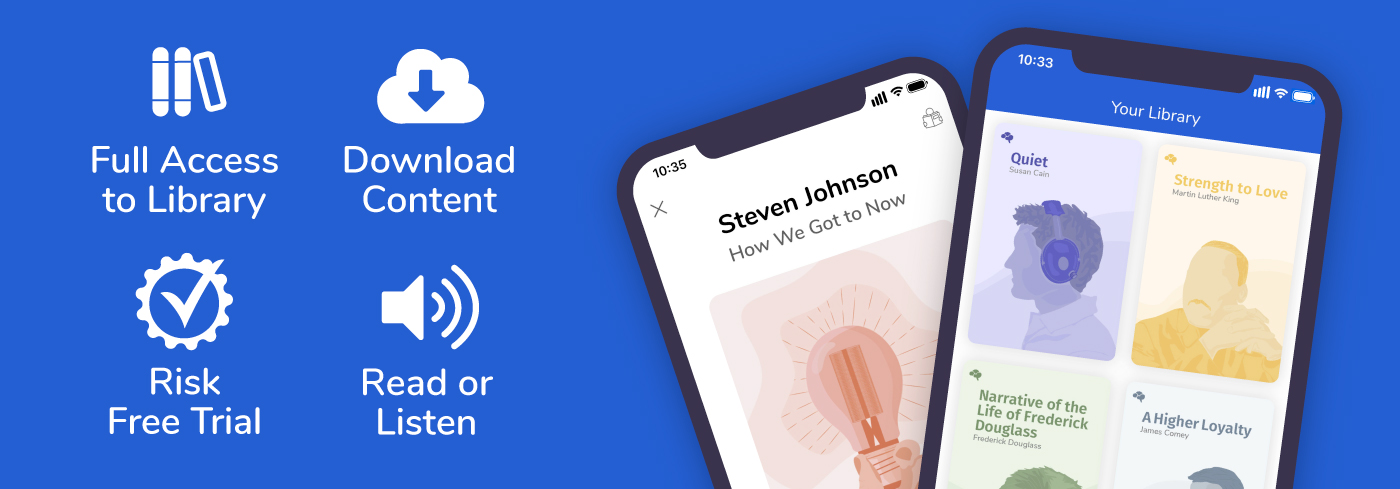
This newsletter is powered by Thinkr, a smart reading app for the
busy-but-curious. For full access to hundreds of titles — including audio —
go premium and download the app today.
|
|


No comments:
Post a Comment