|
The increase in
enrollment is concentrated in a small number of states with large
populations and, consequently, large Medicaid programs. Our analysis
shows that California, New York, Texas, Florida, and Illinois account for
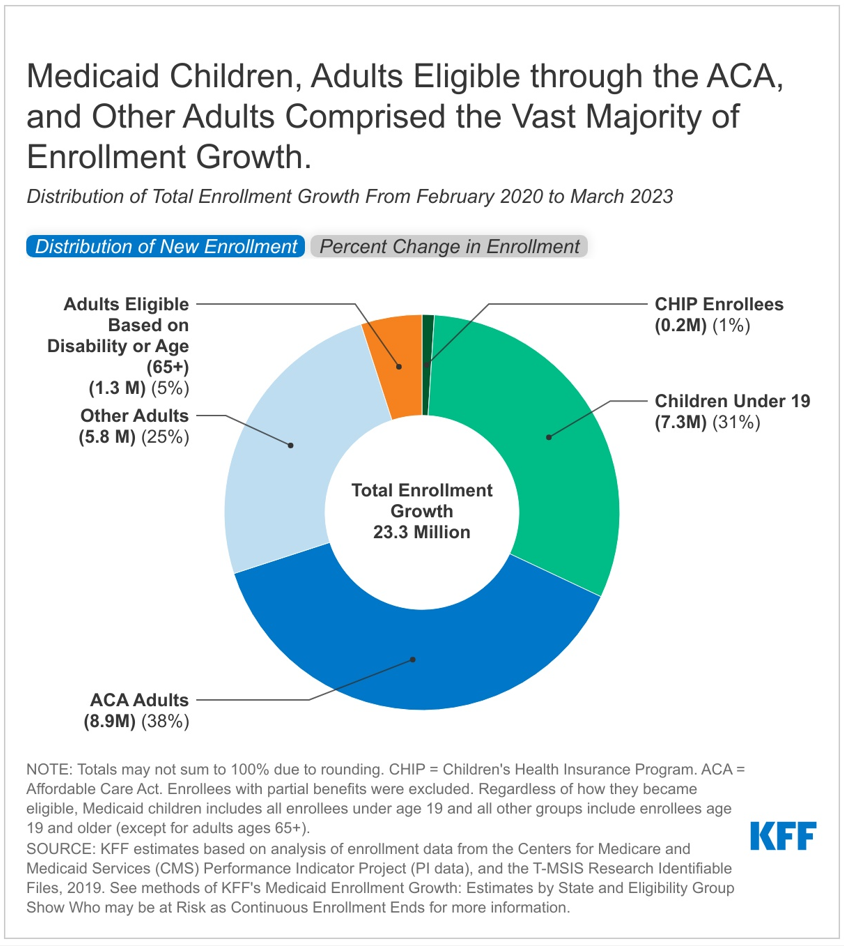
over one-third of the increase in Medicaid/CHIP enrollment. Because Texas
and Florida have not adopted the ACA Medicaid expansion, children and
other adults account for higher percentages of enrollment gains in those
states.
Growth rates in Medicaid/CHIP enrollment vary considerably by state,
ranging from 22 percent in Connecticut to 81 percent in Oklahoma. States
that implemented Medicaid expansion after 2020 (Oklahoma, Missouri,
Nebraska, Utah, and Idaho) have particularly high enrollment growth.
The number and share of individuals who will be disenrolled across states
is expected to vary, but studies estimate that between 5 percent and 17
percent of current enrollees might lose Medicaid coverage. (A previous
KFF analysis estimates that between 5.3 million and 14.2
million people will lose Medicaid coverage during the unwinding of the
continuous enrollment provision.)
As states start to resume renewal procedures for all current Medicaid
enrollees, there is substantial uncertainty as to how much of the
Medicaid enrollment growth during the pandemic will be sustained, how
many people will transition to other coverage, and how many people could
end up uninsured. Our recent
analysis of coverage outcomes after disenrolling from Medicaid
or CHIP found that nearly two-thirds of people experienced a period of
uninsurance. Policies to smooth the transition from Medicaid to other
coverage sources could reduce that rate as the Medicaid continuous
enrollment period unwinds.
The analysis uses a combination of enrollment data from the Centers for
Medicare and Medicaid Services (CMS) Performance Indicator Project (PI
data), Medicaid claims data (T-MSIS data), and some state-specific data.
(A detailed explanation of the methods is available in the paper.) While
our estimates are based on the best available public data on states’
Medicaid and CHIP enrollment, they will likely differ somewhat from data
maintained by individual states because we use modeling and assumptions
to project enrollment through March 2023 and to allocate states’ adult enrollment
across eligibility groups.
|
.png?width=1200&upscale=true&name=Just%20Released%20Header_1%20(1).png)


No comments:
Post a Comment