 |
||
|
Poll: 7 in 10 Black Americans Say They Have Experienced Incidents of
Discrimination or Police Mistreatment in Their Lifetime, Including Nearly
Half Who Felt Their Lives Were in Danger
Most Democrats See Racism and Police
Violence as a Big Problem Nationally, While Most Republicans Instead View
Violence by Protesters as a Big Problem
Most of the Public Favor a Range of
Police Reforms to Curb Excessive Force, though Partisan Gaps Exist on Some
Key Proposals
Amid
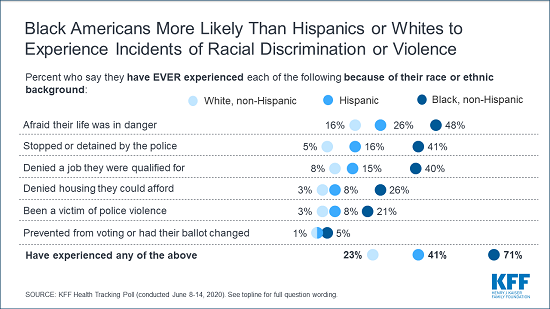
nationwide protests against racial bias in law enforcement and beyond, a new KFF poll finds that the vast majority (71%) of
Black Americans say they’ve experienced some form of racial discrimination or
mistreatment during their lifetimes – including nearly half (48%) who say at
one point that they felt their life was in danger because of their race.
When
asked about interactions with law enforcement during their lifetimes, 4 in 10
(41%) Black Americans say they have been stopped or detained by police
because of their race, and 1 in 5 Black adults (21%), including 3 in 10 Black
men, say they have been a victim of police violence. A third as many
Hispanics (8%) and relatively few Whites (3%) report such negative
interactions with police over their lifetimes.
Blacks
are also much more likely than Hispanics or Whites to say they have been
denied a job for which they were qualified (40%, 15%, and 8%, respectively)
or denied housing they could afford due to their race (26%, 8%, and 3%, respectively).
When
asked about incidents just in the past year, 3 in 10 (30%) Black Americans
say they personally experienced unfair treatment by police during traffic
stops and other encounters. That is nearly three times the share of Hispanic
Americans (11%) and ten times the share of White Americans (3%) who report
such unfair treatment by police in the past year.
Fielded
June 8-14, the poll probes into issues of racial and ethnic bias and
discrimination and the national conversation about race sparked by recent
deaths of Black Americans at the hands of police, as well as the subsequent
protests, clashes, and in some cases, looting and vandalism.
The
poll finds large shares of Americans view racism, police violence and
violence caused by protesters as at least somewhat of a problem in the
country today, though there are deep partisan divisions on these
issues.
For
example, most Democrats (82%) and independents (59%) say racism is a big
problem nationally, while only a quarter (25%) of Republicans say so.
Democrats
also are much more likely to say police violence is a big problem (65%) than
to say violence caused by protesters is (24%). The opposite is true for
Republicans, who are far more likely to say protester violence is a big
problem (62%) than to say police violence is (14%).
Partisans
also differ in their awareness about the COVID-19 epidemic’s disproportionate
impact on Black and Hispanic communities and broader disparities in health
care. For example, Democrats are twice as likely as Republicans to know that
Black Americans are more likely than White Americans to get sick or die from
coronavirus (69% vs. 34%).
Most of the Public Support Banning
Chokeholds and No-Knock Warrants, Though Partisan Gaps Remain
The
poll finds two key potential reforms that seek to reduce the excessive use of
force by police officers are favored by a majority of the public, though
Republicans are less supportive: banning police from using chokeholds and
strangleholds (68% of the public, including 82% of Democrats, 70% of
independents, and 52% of Republicans) and banning no-knock warrants that
allow police to enter a person’s residence unannounced (52% of the public,
including 65% of Democrats, 56% of independents and 34% of Republicans).
Bipartisan
majorities support a range of other proposed reforms, including:
Two Thirds of Public Supports Recent
Protests against Police Violence
The
poll finds two thirds of the public (64%) support the recent protests against
police violence across the country, while three in ten oppose the protests
(30%). Majorities across racial and ethnic groups support the protests, as do
most Democrats (86%) and independents (67%), though most Republicans (57%)
oppose them.
At
the same time, a slight majority (56%) of the public say they are very or
somewhat worried that protests may lead to an increase in coronavirus cases
in their area. Democrats and Black Americans – groups that are most likely to
support the protests – are also among the most likely to say they are worried
about the protests leading to an increase in coronavirus cases (73% and 68%
respectively).
Overall,
1 in 10 adults say they recently attended an event to protest police violence
or in support of Black Lives Matter or other racial justice issues. About
half (52%) of those who report attending a protest are under 30 years old,
and a similar share (53%) are college graduates. Most identify as Democrats
(46%) or independents (42%), with just 6% identifying as Republicans.
Designed
and analyzed by public opinion researchers at KFF, the poll was conducted
June 8-14 among a nationally representative random digit dial telephone
sample of 1,296 adults. Interviews were conducted in English and Spanish by
landline (297) and cell phone (999). The margin of sampling error is plus or
minus 3 percentage points for the full sample. For results based on
subgroups, the margin of sampling error may be higher. The margin of sampling
error is plus or minus 4 percentage points for the sample of 811 White
adults, plus or minus 9 percentage points for the sample of 211 Black adults,
and plus or minus 8 percentage points for the sample of 177 Hispanic adults.
Filling the need for trusted
information on national health issues, KFF (Kaiser Family Foundation) is a
nonprofit organization based in San Francisco, California.
|
||
|
||
|
Connect with us:
    |
||
|
To be a Medicare Agent's source of information on topics affecting the agent and their business, and most importantly, their clientele, is the intention of this site. Sourced from various means rooted in the health insurance industry - insurance carriers, governmental agencies, and industry news agencies, this is aimed as a resource of varying viewpoints to spark critical thought and discussion. We welcome your contributions.


No comments:
Post a Comment