Wyatt Koma Follow @KomaWyatt on
Twitter , Meredith Freed , Juliette Cubanski Follow @jcubanski on
Twitter , and Tricia Neuman Follow @tricia_neuman on
Twitter Published: Oct 13, 2021
Each year, people with Medicare can review
their coverage options and change plans during the open enrollment period
(October 15 to December 7). Medicare beneficiaries with traditional Medicare
can compare and switch Medicare Part D stand-alone drug plans or join a
Medicare Advantage plan, while enrollees in Medicare Advantage can compare and
switch Medicare Advantage plans or elect coverage under traditional Medicare
with or without a stand-alone drug plan. Beneficiaries have no shortage of
plans to choose from: in 2021, the average Medicare beneficiaries can choose
among 33 Medicare Advantage plans and 30 Part D stand-alone
prescription drug plans (PDPs).
Coverage and costs vary widely among both
Medicare Advantage plans and Part D prescription drug plans. Plans can change
from one year to the next, which could lead to unexpected and avoidable costs,
and disruptions in care for beneficiaries who do not review their options
annually. For example, provider network changes could mean beneficiaries lose
access to their preferred doctors, while changes in the list of covered drugs
and cost-sharing requirements could result in higher out-of-pocket drug costs.
Further, beneficiaries’ health care needs can change from one year to the next,
making it even more important to compare coverage options annually. Even
without a change made by their plan or a change in health status, beneficiaries
may be able to find a plan that better meets their individual needs. The Centers for Medicare &
Medicaid Services (CMS) recommends that beneficiaries review
and compare Medicare plans each year.
This analysis builds on our prior KFF work to
examine the share of Medicare beneficiaries who compared plans during the 2018
open enrollment period for coverage in 2019, the share who compared drug
coverage in Medicare Advantage and stand-alone drug plans, and variation by
demographic characteristics, based on an analysis of the 2019 Medicare Current
Beneficiary Survey (the most recent year available). All reported results are
statistically significant.
Findings
7 in 10 (71%) Medicare
Beneficiaries Did Not Compare Medicare Plans During the 2018 Open Enrollment
Period
With the large number of Medicare private
plans – Medicare Advantage and stand-alone Medicare prescription drug plans –
offered each year in addition to traditional Medicare, beneficiaries have the
opportunity to reassess their coverage each year during the Medicare open
enrollment period. Traditional Medicare beneficiaries can compare and switch
Medicare Part D stand-alone drug plans or decide to enroll in a Medicare
Advantage plan, and can also evaluate Medigap supplemental insurance
plans, known as Medigap.
Enrollees in Medicare Advantage can similarly compare and switch Medicare
Advantage plans or decide to receive coverage under traditional Medicare with
or without a stand-alone drug plan and with or without Medigap.
In 2019, 71% of all Medicare beneficiaries
reported that they did not compare their plan to other Medicare plans that were
available during the 2018 open enrollment period, while 29% of all Medicare
beneficiaries reported that they compared Medicare plans (Figure 1; Table 1). Among beneficiaries in Medicare Advantage plans, 68% reported
that they did not compare Medicare plans during the 2018 open enrollment
period, compared to 73% of those in traditional Medicare (Table 1).
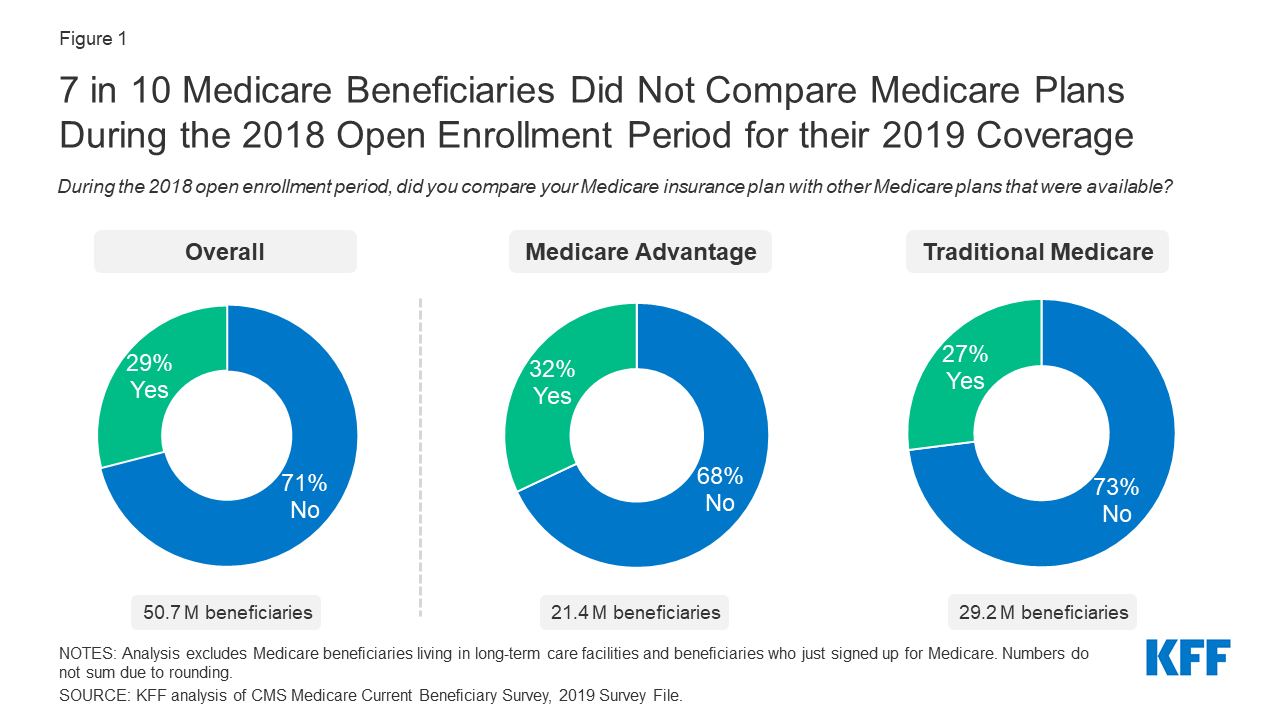
Figure 1: 7 in 10 Medicare Beneficiaries Did
Not Compare Medicare Plans During the 2018 Open Enrollment Period for their
2019 Coverage
The share of all Medicare beneficiaries who
said they did not compare Medicare plans during the 2018 open enrollment period
was higher among Black (74%) and Hispanic (79%) beneficiaries, beneficiaries
ages 85 and older (84%) and under age 65 with disabilities (77%), and
beneficiaries with lower incomes (85%), fewer years of education (e.g., 82% for
those with less than a high school education), living in rural areas (73%),
those in relatively poor health (74%), and those enrolled in both Medicaid and
Medicare (e.g., 87% for full-dual eligibles) (Figure 2).
Most Beneficiaries in
Medicare Advantage Drug Plans and Stand-alone Drug Plans Did Not Compare Drug
Coverage in 2019
In 2019, 8 in 10 (81%) beneficiaries in
Medicare Advantage drug plans (MA-PDs) said they did not compare the drug
coverage offered by their current MA-PD plan to any other MA-PD in their area (Figure 3; Table 2). Among stand-alone drug plan (PDP) enrollees, more than 7 in
10 (72%) said they did not compare drug coverage offered by their current PDP
to other PDPs.

Figure 3: Most Enrollees in Medicare Advantage
Drug Plans and Stand-alone Drug Plans Did Not Compare Plans in 2019
The share of beneficiaries in both types of
drug plans who did not compare drug coverage in 2019 was higher among those who
are Hispanic (88% of MA-PD and 85% of PDP enrollees), ages 85 and older (90% of
MA-PD and 80% of PDP enrollees), with incomes under $10,000 (87% of MA-PD and
81% of PDP enrollees), and those enrolled in both Medicaid and Medicare (e.g.,
91% of MA-PD and 87% of PDP full-dual eligibles) (Table 2).
Medicare’s Website, Toll-Free
Number, and Handbook Are Not Widely Used by Beneficiaries
·
Nearly half (47%) of
all beneficiaries with Medicare said they had never visited the official
Medicare website for information, while 42% said they said they (or someone for
them) had ever visited the website, and the remainder (11%) reported they did
not have access to the internet or had no one to access it for them (Figure 4).
·
53% of all Medicare
beneficiaries reported they had never called the 1-800-MEDICARE helpline for
information, while 31% reported they had ever called the helpline, and another
16% said they were not aware this helpline existed.
·
Half (51%) of Medicare
beneficiaries reported they had read thoroughly or some parts of the Medicare & You handbook, while almost one-third (31%)
reported they had not read it at all. Nearly one in five (18%) Medicare
beneficiaries reported they did not receive it or did not know if they had
received it.
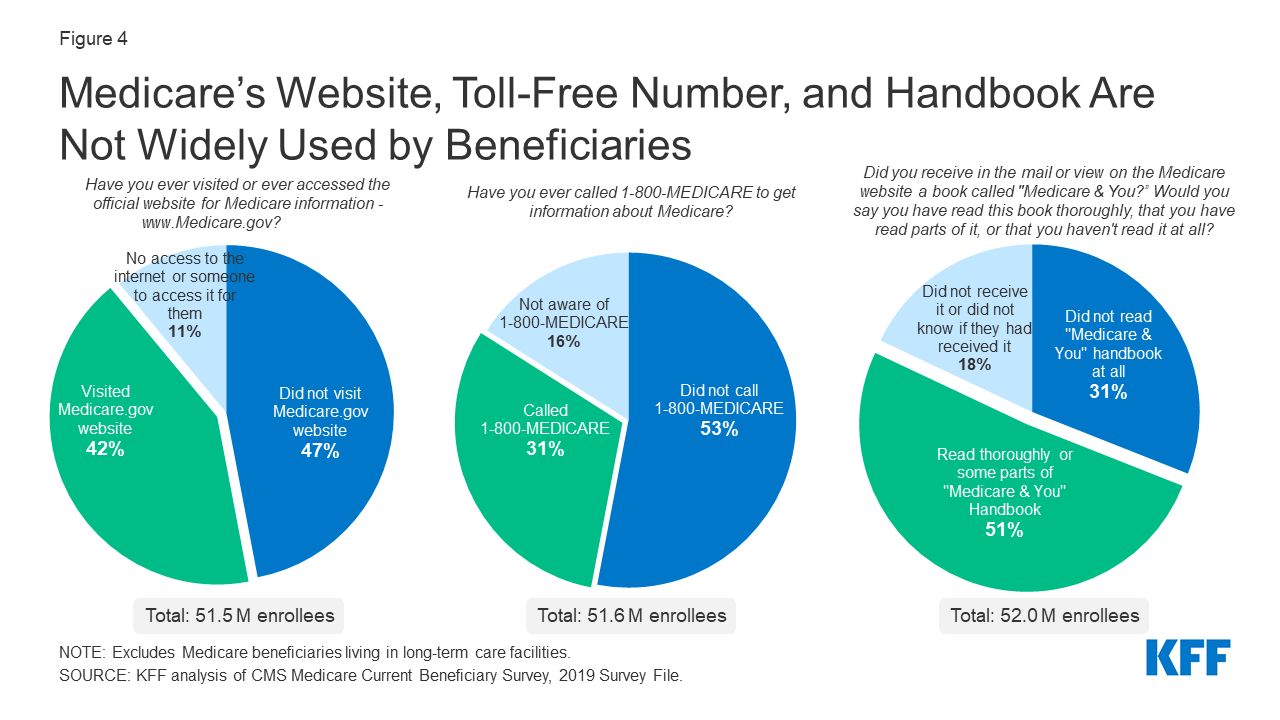
Figure 4: Medicare’s Website, Toll-Free
Number, and Handbook Are Not Widely Used by Beneficiaries
The share of Medicare beneficiaries who did
not use Medicare information sources varied among subgroups of beneficiaries (Table 3). For example, a larger share of Black (52%)
beneficiaries than White (46%) never visited the Medicare.gov website.
Additionally, 52% of beneficiaries with incomes under $10,000 did not visit the
Medicare.gov website, compared to 41% among those with incomes greater than
$40,000. Over one in three (39%) beneficiaries enrolled in Medicaid and Medicare
read the Medicare & You handbook compared to 53% of those not enrolled in
Medicaid and Medicare.
Discussion
The marketplace of Medicare private plans
operates on the premise that people with Medicare will generally compare plans
to select the best source of coverage, given their individual needs and
circumstances. This analysis finds that most Medicare beneficiaries did not
compare plans during the 2018 open enrollment period for coverage in 2019, and
most people in stand-alone drug plans and Medicare Advantage drug plans did not
compare the drug coverage offered by their PDP or MA-PD to other drug plans in
2019.
We also find that beneficiaries who may be
more likely to be affected by plan changes from one year to the next, such as
older beneficiaries, beneficiaries who are under age 65 with disabilities, and
those in worse health, were the least likely to report comparing plans during
the 2018 open enrollment period for their 2019 coverage, which can lead to
higher out-of-pocket costs and disruptions in care. Additionally, our analysis
finds that beneficiaries who are Black and Hispanic, with low incomes, and
fewer years of education were less likely to compare plans during the 2018 open
enrollment period.
This analysis builds on previous KFF analyses
which suggest that the marketplace of Medicare plans may not be working as
intended. Previous KFF analyses have shown that more than half of Medicare
beneficiaries do not compare or review their Medicare health coverage options
annually and that a small share of Medicare beneficiaries
voluntarily switch plans. This “stickiness” could suggest
beneficiaries are satisfied with their current coverage. However, past KFF analysis,
based on focus groups, has revealed that while many Medicare beneficiaries know
about the open enrollment period and are generally aware that they should
compare plans, many also find the process of comparing plans challenging.
With a growing number of Medicare private plan
choices available each year, the fact that such a large share of seniors and
people with disabilities report not comparing plans during the open enrollment
period warrants attention, given the potential consequences of year-to-year
plan changes for their coverage, access to care, and out-of-pocket costs.
|
Methods |
|
This analysis uses survey data for
community-dwelling Medicare beneficiaries from the Centers for Medicare &
Medicaid Services (CMS) Medicare Current Beneficiary Survey (MCBS) 2019
Survey File. The analysis of plan comparison during open
enrollment and use of Medicare information sources used questions from the
Medicare Plan Beneficiary Knowledge topical segment, and the analysis was
weighted to represent the ever-enrolled Medicare population in 2019 using the
topical survey weight KNSEWT and relevant replicate weights. This analysis
excludes beneficiaries who reported just enrolling in Medicare. The analysis of MA-PD/PDP drug plan
comparison used questions from the RX Medication topical segment; similar as
above, the analysis was weighted to represent the ever-enrolled Medicare
population in 2019 using the topical survey weight RXSEWT and relevant
replicate weights. Both analyses exclude
beneficiaries with Part A or Part B only and those with Medicare as secondary
payer. Results from all statistical tests were reported with p<0.05 are
considered statistically significant. |
No comments:
Post a Comment