Kathleen Gifford, Eileen Ellis, Aimee
Lashbrook, Mike Nardone, Elizabeth Hinton, Robin Rudowitz Follow @RRudowitz on
Twitter, Maria Diaz, and Marina Tian Published: Oct 18, 2019
·
REPORT
·
METHODS
·
ENDNOTES
Medicaid covers one in five Americans,
accounts for one in six dollars spent on health care in the United States, and
makes up more than half of all spending on long-term services and supports.1 Medicaid
is a state budget driver as well as the largest source of federal revenue to
states. The program is constantly evolving in response to federal policy
changes, the economy, and state budget and policy priorities. As states began
state fiscal year (FY) 2020, the economy in most states was strong. With fewer
budget pressures, many states reported expansions or enhancements to provider
rates and benefits. As several states implemented, adopted, or continued to
debate the ACA Medicaid expansion, a number of states also continued to pursue
work requirements and other policies promoted by the Trump administration that
could restrict eligibility. Other key areas of focus highlighted in the report
include Medicaid initiatives to address social determinants of health, control
prescription drug spending, improve birth outcomes and reduce infant mortality,
and address the opioid epidemic.
This report provides an in-depth examination
of the changes taking place in Medicaid programs across the country. The
findings are drawn from the 19th annual budget survey of Medicaid officials in
all 50 states and the District of Columbia conducted by the Kaiser Family
Foundation (KFF) and Health Management Associates (HMA), in collaboration with
the National Association of Medicaid Directors (NAMD). This report highlights
certain policies in place in state Medicaid programs in FY 2019 and policy
changes implemented or planned for FY 2020. The District of Columbia is counted
as a state for the purposes of this report. Given differences in the financing
structure of their programs, the U.S. territories were not included in this
analysis. Key findings from the report are pulled from five sections:
eligibility, delivery systems, benefits, long-term services and supports, and
provider rates and taxes. Each section highlights key issues to watch for
future policy development (ES Figure 1).
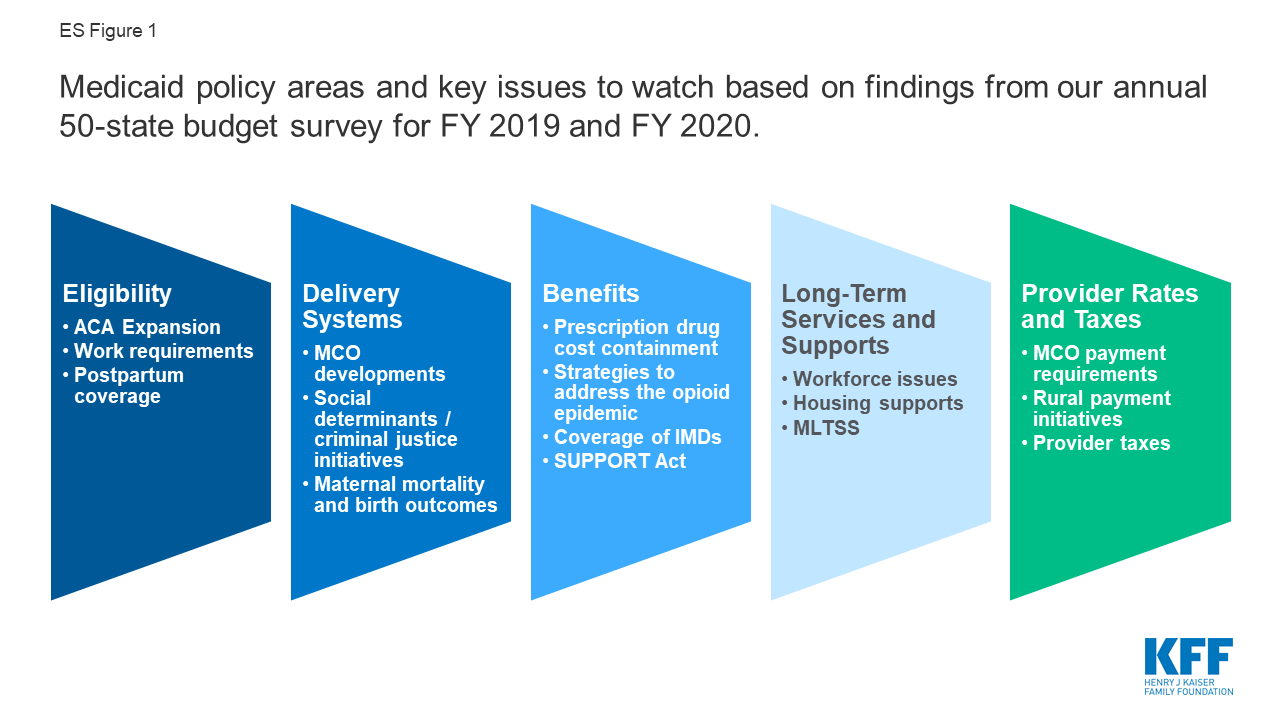
ES Figure 1: Medicaid
policy areas and key issues to watch based on findings from our annual 50-state
budget survey for FY 2019 and FY 2020.
Eligibility &
Premiums
Since 2014, most major eligibility policy
changes have been related to adoption of the ACA Medicaid expansion. Maine and
Virginia implemented the ACA Medicaid expansion in FY 2019, bringing the total
number of states with the expansion in place to 34 as of July 2019. Three
additional states have adopted the expansion but have not yet implemented it,
including Idaho which plans to implement the ACA Medicaid expansion to 138% of
the federal poverty level (FPL) in FY 2020. Most other Medicaid eligibility expansions
for FY 2019 and FY 2020 were narrow and targeted to a limited number of
beneficiaries. In contrast, eligibility restrictions implemented in FY 2019 (by
7 states) or planned for implementation in FY 2020 (by 6 states) generally
target broader Medicaid populations including expansion adults and
parents/caretakers. All states implementing or planning eligibility policies
that are counted as restrictions in FY 2019 or FY 2020 are doing so through
Section 1115 waiver authority, whereas most states implementing or planning
eligibility expansions are doing so through state plan authority.
What to watch:
·
Medicaid expansion. Utah and Nebraska adopted the Medicaid expansion through
2018 ballot initiatives but both states are pursuing waivers to implement the
expansion with program elements that differ from what is allowed under federal
law, leading to implementation delays. Idaho also adopted the Medicaid
expansion through a 2018 ballot initiative but submitted a Section 1332 waiver
seeking to make changes to the expansion. In August 2019, CMS rejected Idaho’s
waiver request; the state will implement the Medicaid expansion to 138% FPL
effective January 2020. Medicaid expansion debates are active in Kansas,
Missouri, and North Carolina.
·
Coverage for postpartum women. In FY 2020, three states are seeking waivers to extend
coverage for postpartum women beyond the current statutory requirement of 60
days after delivery.
·
Work requirements. An appeal is underway in the DC Circuit after the DC federal
district court stopped implementation of Arkansas’ work and reporting
requirement waiver in March 2019, and prohibited Kentucky’s waiver from going
into effect in April as planned. In July 2019, the DC federal district court
also set aside New Hampshire’s work requirement waiver, stopping the
implementation of the work requirement. Litigation challenging Indiana’s work
requirements was also recently filed in the same court. Work requirement waiver
requests from six non-expansion states – which may have much lower levels of eligibility
based on income for parents and do not cover childless adults – are now
pending. The outcomes of these requests will have implications for other states
seeking to adopt similar policies.
Delivery Systems
As of July 1, 2019, among the 40 states with
comprehensive risk-based managed care organizations (MCOs), 33 states reported
that 75% or more of their Medicaid beneficiaries were enrolled in MCOs. States
continue to carve-in behavioral health services to MCO contracts and nearly all
states have in place managed care quality initiatives like pay for performance
or capitation withholds. Medicaid programs have been expanding their use of
other service delivery and payment reform models to achieve better outcomes and
lower costs. Forty-four states had one or more delivery system or payment
reform initiatives in place in FY 2019 (most often patient centered medical
homes or ACA Health Homes) with 14 states adding or expanding such reforms in
FY 2020.
What to watch:
·
MCO developments. North Carolina reported plans to implement a new MCO
program in FY 2020. In FY 2019, 21 states set a target percentage of MCO
provider payments or covered lives that must be in alternative payment models
(APMs), three additional states plan to do so in FY 2020, and several states
noted that their APM targets would increase in the future.
·
Social determinants of health and criminal justice. Over three-quarters of the 41 MCO states
as of FY 2020 (35 states) are leveraging MCO contracts to promote at least one
strategy to address social determinants of health. Non-MCO states also report
moving forward with initiatives to identify and address social determinants of
health. States are also working with their MCO and corrections partners to
coordinate care for justice-involved individuals prior to release with the goal
of improving continuity of care and smoothing community transitions.
·
Maternal mortality and birth outcomes. About two-thirds of states reported new
or expanded Medicaid initiatives to improve birth outcomes and/or reduce maternal
mortality in FY 2019 or FY 2020.
Benefits &
Cost-Sharing
The number of states reporting benefit
expansions (23 in FY 2019 and 28 in FY 2020) continues to significantly outpace
the number of states reporting benefit restrictions (4 in FY 2019 and 2 in FY
2020). The most common benefit enhancements reported were for mental
health/substance use disorder (SUD) services, but other service expansions
include dental services, pregnancy and postpartum benefits, and diabetes
prevention and care. Eleven states reported policies to eliminate or reduce a
cost-sharing requirement for FY 2019 or FY 2020, compared to five states that
reported new or increased cost-sharing requirements.
What to watch:
·
Prescription drug cost containment. Twenty-four states in FY 2019 and 26 states in
FY 2020 reported newly implementing or expanding at least one initiative to
contain prescription drug costs. Strategies cited included efforts to address
pharmacy benefit manager (PBM) transparency and the impact of spread pricing in
managed care and implementation of new purchasing arrangements, including
value-based contracts linking pharmacy reimbursement to patient outcomes. Some
states reported unique models, including a modified subscription model for
hepatitis C drugs in Louisiana and a drug spending cap in New York.
·
Strategies to address the opioid epidemic. All states reported using pharmacy
benefit management strategies (such as adoption of opioid prescribing
guidelines prospective drug utilization review, prior authorization based on
clinical criteria/step therapy, retrospective drug utilization review and state
prescription drug monitoring programs (PDMP)) to prevent opioid-related harms.
States also reported a variety of initiatives to expand access to
medication-assisted treatment (MAT), including removing or relaxing prior
authorization for MAT drugs.
·
Institutions for Mental Disease (IMDs). In an effort to address the opioid
epidemic as well as broader behavioral health issues, CMS and Congress have
provided states additional flexibility to provide services in settings that
would otherwise qualify as “institutions for mental disease,” or IMDs, and thus
be ineligible for federal Medicaid funding. A large majority of states (43
states) reported they plan to use at least one of the flexibilities (MCO “in
lieu of authority, Section 1115 waiver authority, or The Substance Use Disorder
Prevention that Promotes Opioid Recovery and Treatment for Patients and
Communities [SUPPORT Act] state plan option) to provide services in IMDs in FY
2020.
·
SUPPORT Act. States
are implementing new SUPPORT Act requirements including pharmacy benefit
management strategies to reduce prescription opioid abuse and misuse and
providing coverage for all FDA approved MAT drugs. Some states are also
pursuing options such as enhanced matching funds for implementation of PDMPs or
coverage of residential pediatric recovery centers (RPRC) for services provided
to infants under age one with neonatal abstinence syndrome (NAS) and their
families.
Long-Term Services and
Supports
Nearly all states in FY 2019 (48 states) and
in FY 2020 (47 states) are employing one or more strategies to expand the
number of people served in home and community-based settings. Of these states,
the vast majority report using home and community-based services (HCBS) waivers
and/or state plan options (i.e., 1915(c), Section 1115, 1915(i), and 1915(k))
to serve more individuals in the community. As of July 1, 2019, 25 states
covered LTSS through one or more capitated managed care arrangements, and
another two states operated managed fee-for-service LTSS models.
What to watch:
·
Workforce issues. States continue to work to address challenges finding and
retaining LTSS direct care workers. Roughly half of states reported raising
wages for direct care workers in FY 2019 and FY 2020, a notable increase from
prior years. In addition, 15 states had direct care workforce development
strategies (e.g., recruiting, training, credentialing) in place in FY 2019, and
10 states reported expanding (7 states) or implementing new workforce
development strategies (3 states) in FY 2020.
·
Housing supports. Housing supports remain an important component of state
LTSS rebalancing efforts. Thirty-seven states offer housing-related supports,
such as community transition services, case management, or transitional
supports as part of their HCBS and Section 1115 waiver programs. States were
set to phase out their Money Follows the Person (MFP) programs in federal FY
2020, but Congress provided additional funding for a short-term extension of
the program; however, the uncertain future of MFP may place some of the
initiatives funded through MFP at risk.
·
Managed Long-Term Services and Supports (MLTSS). Several states will expand their MLTSS
programs in FY 2019 and FY 2020. Pennsylvania is positioned to complete its
statewide expansion of MLTSS in FY 2020, and several other states (Idaho,
Illinois, and Tennessee) reported geographic or population expansions for FY
2020.
Provider Rates and
Taxes
A strong economy and state revenue growth
allowed most states to implement and plan more fee-for-service (FFS) provider
rate increases for FY 2019 (50 states) and FY 2020 (45 states). This holds true
across all major provider types. As more states increasingly rely on capitated
managed care, however, FFS rate changes are a less meaningful measure of
provider payment unless the state establishes MCO payment requirements. Nearly
half of MCO states reported doing so: 19 states reported mandating minimum
provider reimbursement rates in their MCO contracts for inpatient hospital,
outpatient hospital, or primary care physicians and 17 states reported
requiring MCOs to change provider payment rates in accordance with FFS payment
rate changes for one or more of these provider types. As in prior years, all
states except Alaska rely on provider taxes and fees to fund a portion of the
non-federal share of the costs of Medicaid. Six states indicate plans for new
provider taxes in FY 2020.
What to watch:
·
Rural payment initiatives. About half of states reported at least one policy related
to payment adjustments in place to promote access to rural hospitals or other
rural providers.
·
Provider taxes. With the addition of California in FY 2019, eight states
reported that they have a provider tax on ground emergency medical
transportation, or on ambulance providers.
Looking Ahead
While national attention on health care is
focused on broader debates involving prescription drug pricing and the
presidential candidates’ health plans, states continue to administer and make
changes to Medicaid programs, adapting to state budget and policy priorities as
well as new federal Medicaid options. When asked about key priorities for state
Medicaid programs, over half of states reported that delivery system and
payment reforms are a key priority. A number of states also pointed to
developing and implementing demonstration waivers as well as controlling
Medicaid costs as key areas of focus. States are also pursuing a broad range of
policies to help address increased Medicaid demands associated with an aging
population.
When asked about potential for Medicaid block
grant waivers, only a limited number of states expressed interest in such an
option, particularly since CMS guidance on such policies has not been released.
When asked about potential challenges or opportunities related to federal or
state-level coverage expansions such as Medicare-for-All, few states had
assessed the implications for state Medicaid programs of these broader health
reforms. At the time of the survey, litigation challenging the ACA was
pending before the U.S. Court of Appeals for the 5th Circuit that could have
complex and far-reaching consequences for Medicaid and the entire health care
system if the ACA is overturned. Looking ahead, the trajectory of the economy,
the direction of federal policies around Section 1115 Medicaid waivers, and the
focus of the debate and attention to health care issues in the lead up to the November
2020 elections will also be factors that continue to shape Medicaid in FY 2020
and beyond.
Acknowledgements
Pulling together this
report is a substantial effort, and the final product represents contributions
from many people. The combined analytic team from the Kaiser Family Foundation
and Health Management Associates (HMA) would like to thank the Medicaid directors
and Medicaid staff in all 50 states and the District of Columbia. In a time of
limited resources and challenging workloads, we truly appreciate the time and
effort provided by these dedicated public servants to complete the survey, to
participate in structured interviews, and to respond to our follow-up
questions. Their work made this report possible. We also thank the leadership
and staff at the National Association of Medicaid Directors (NAMD) for their
collaboration on this survey. We offer special thanks to Jim McEvoy at HMA who
developed and managed the survey database and whose work is invaluable to us.
https://www.kff.org/medicaid/report/a-view-from-the-states-key-medicaid-policy-changes-results-from-a-50-state-medicaid-budget-survey-for-state-fiscal-years-2019-and-2020/?utm_campaign=KFF-2019-The-Latest&utm_source=hs_email&utm_medium=email&utm_content=78261977&_hsenc=p2ANqtz-9tU6Sz9WZ8lCa3dMRcJBtLIFiss8KSzbV6kwbSoRiEWK67uNnZi1R5-CjQ2piYwjdzB9mzwMg94riPBt5UV2cUGl1Jnw&_hsmi=78261977

No comments:
Post a Comment