 |
Just Released
|
|
|
Private Insurers Are Expected to Pay a Record of at Least $1.3
Billion in Rebates to Consumers Beginning in September for Excessive Premiums
Relative to Health Care Expenses
Analysis Shows Expected Rebates by
State and by Insurer
Private
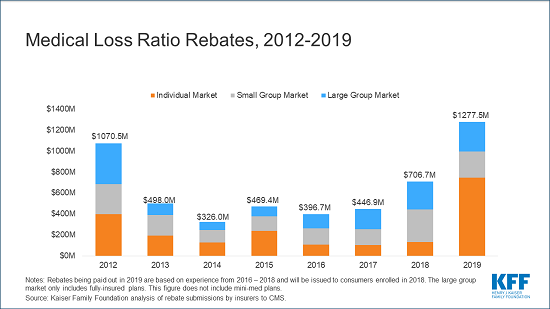
insurance companies are expecting to pay out a record of at least $1.3
billion in rebates to consumers this fall based on their share of premium
revenues devoted to health care expenses in recent years, surpassing the
previous record high of $1.1 billion in 2012, according to a new KFF analysis.
Individual
market insurers are driving this record year, with expected rebate payments
of at least $743.3 million, their highest ever, finds the analysis of data
reported by insurers to the Centers for Medicare and Medicaid Services.
Individual market insurers appear to have been exceptionally profitable in
2018, on average, which is part of the basis for this year’s rebate payments.
Rebates in the small and large group insurance markets are more similar to
past years, at $250 million and $284 million, respectively.
The
analysis also finds that millions of dollars in rebates from previous years
have gone unclaimed by consumers -- $37.5 million in the individual market,
$22.2 million in the small group market and $11.6 million in the large group
market.
By law, insurers must begin
issuing the latest rebates to eligible consumers by September 30. They are
the result of insurance companies not meeting the Affordable Care Act’s
medical loss ratio threshold, which requires insurers to spend at least 80
percent of premium revenues (85% for large group plans) on health care claims
or quality improvement activities.
Rebates
will vary by state. The states with the largest expected rebates in total
include Virginia ($149.6 million), Pennsylvania ($130 million) and Florida
($107.4 million). In an estimated 13 states insurers are expecting to pay no
rebates at all.
In
the individual market alone, insurers will pay out the highest rebates in
Virginia ($111.3 million), followed by Arizona ($92.3 million) and Texas
($80.4 million). On a per subscriber basis, insurers will pay the highest
rebates in Pennsylvania ($990 per subscriber), Virginia ($770 per subscriber)
and Minnesota ($670). Virginia ranks high largely because one insurer,
Sentara (also known as Optima), had the highest individual premiums in the
country in 2018 and now owes especially large rebates.
Rebates
also will vary by insurer. Other insurers issuing large rebates across the
individual market include Centene (at least $216.9 million), HCSC ($78.5
million), Cigna ($55.9 million), and Highmark ($50.8 million). These insurers
tend to have high enrollment and participate in a number of states.
Insurers
may issue the rebates in the form of a check to consumers or as a credit
applied to the premiums consumers must pay. For people with employer coverage,
the rebate may be shared between the employer and employee.
Filling the need for trusted
information on national health issues, the Kaiser Family Foundation is a nonprofit organization
based in San Francisco, California.
|
||
|
|
||
|
Connect with us:
    |
||
To be a Medicare Agent's source of information on topics affecting the agent and their business, and most importantly, their clientele, is the intention of this site. Sourced from various means rooted in the health insurance industry - insurance carriers, governmental agencies, and industry news agencies, this is aimed as a resource of varying viewpoints to spark critical thought and discussion. We welcome your contributions.
No comments:
Post a Comment