Monday, March 4, 2019

Diplomat Pharmacy Postpones Earnings Release Amid PBM Struggles


Diplomat Pharmacy Inc.'s stock value plummeted recently after the company said it would delay the release of its fourth-quarter and full-year earnings results — primarily because of difficulties with its PBM business.

Diplomat entered the PBM space in 2017 when it acquired National Pharmaceutical Services and LDI Integrated Pharmacy Services. The company disclosed in a Feb. 22 press release that it anticipates writing down a "significant portion" of its PBM business' approximately $630 million in assets. It also said it is withdrawing its preliminary 2019 full-year earnings outlook, in part because it's seen "additional customer losses in its PBM business since early January," which combined with a "softer outlook for client wins and other factors" has led to a lower-than-expected outlook for its PBM business in 2019.

Asked why Diplomat's PBM may be losing customers, William Sullivan, principal consultant at Specialty Pharmacy Solutions LLC, says part of the issue may be that pharmaceutical manufacturers are unsure "how things may shake out" regarding the newly proposed changes to the drug-rebate system. That could mean they want to stick with the "big players who will have the most impact on helping steer potential changes," he says.

Another factor is the consolidation in the PBM industry — with Cigna Corp. now owning Express Scripts, UnitedHealth Group having its PBM OptumRx, and CVS Health Corp. owning both a PBM and health insurer Aetna Inc.

That "gives them even greater purchasing power which, reciprocally, makes it much harder for the smaller players to cut deals that enable them to be competitive with the big guys," Sullivan says.


Friday, March 1, 2019

Kicking Off DD Awareness Month


News & Events
March 01, 2019
DD Awareness Month Banner

Kicking Off DD Awareness Month

Today marks the first day of Developmental Disabilities Awareness Month. All month, ACL will be sharing blogs and resources through our listserv and Facebook and Twitter pages. We hope you will join us in celebrating the inclusion of people with developmental disabilities in the community!
To help you get involved, the National Association of Councils on Developmental Disabilities, Association of University Centers on Disabilities and National Disabilities Rights Network have partnered on a social media campaign that highlights the many ways in which people with and without disabilities come together to form strong, diverse communities. The campaign seeks to raise awareness about the inclusion of people with developmental disabilities in all areas of community life, as well as the barriers that people with disabilities still sometimes face in their communities.
The campaign has developed a social media guide with content you can post throughout the month. The guide includes four themed weeks and will be updated with additional content each Monday. There are no set guidelines for posting – feel free to share whatever you want, whenever you want, and remember to use #DDAwareness19!
If you have resources or materials that you think should be included, please email Jessica Misilo at jmisilo@nacdd.org. Examples of resources include videos, toolkits, news articles, photos, personal stories, and promising practices.
New this year, the campaign will be highlighting artwork created by people with disabilities. NACDD will be showcasing the artwork on its Facebook page and art by Gary Murrel is featured in the DD Awareness Month banner above.

FacebookTwitterYoutube

Empowering Patients and Unleashing Innovation: eMedicare for Today and Future Generations


Centers for Medicare & Medicaid ServicesCMS.gov News Room
CMS BLOG 
March 1, 2019
By: Seema Verma, Administrator, Centers for Medicare & Medicaid Services

Empowering Patients and Unleashing Innovation: eMedicare for Today and Future Generations
 Public service is a privilege. My primary mission as the Administrator of the Centers for Medicare and Medicaid Services (CMS) is to deliver on President Trump’s commitment to strengthen and modernize Medicare for the millions of Americans who depend on us every day.
To this end, at CMS we are constantly looking for new ways to better serve our beneficiaries. That’s why we started the eMedicare initiative.
eMedicare is a multi-year initiative to modernize the way people with Medicare get information about their benefits, and create new ways to help them make the best decisions for themselves and their families. eMedicare empowers patients with the kinds of tools they are used to using in the private sector and other parts of their lives. Tools in the eMedicare suite include enhanced interactive online decision support to help beneficiaries and their caregivers better understand and evaluate their coverage options and costs between Original Medicare and Medicare Advantage, a new online service that lets people see how different coverage choices will affect their estimated out-of-pocket costs, new price transparency tools that let consumers compare the national average costs of certain procedures between settings, and a new webchat option in the Medicare Plan Finder.
As part of eMedicare, CMS created the “What’s covered” app, which lets people with Original Medicare, caregivers, and others quickly see on a mobile device whether Medicare covers a specific medical item or service. People can now get accurate, consistent Original Medicare coverage information more easily—at the doctor’s office, in the hospital, or anywhere else.
This app is designed to meet the needs of the growing population of people with Medicare. The Medicare population is projected to increase from 57 million beneficiaries in 2016 to more than 80 million beneficiaries in 2030.
I’ve learned that with any improvement you try to make, there will always be naysayers. A recent article by Kaiser Health News surprised me, though, because it took a disappointing view of our nation’s seniors: that they are incapable of and not interested in using modern technology.
Sadly, this type of ageism isn’t anything new. But it is inaccurate. CMS research has demonstrated repeatedly that many people with Medicare own smartphones and tablets, download apps, and use them all the time. According to the Pew Research Center, as of 2016, about two-thirds of Medicare beneficiaries indicate they use the Internet daily or almost daily (65 percent). There has been a 55 percent increase in Internet use among seniors since 2000 (from 12 percent to 67 percent). and around four-in-ten of seniors (42 percent) now report owning smartphones—compared to just 18 percent in 2013. The “What’s covered” app anticipates that smartphone use among people with Medicare will continue to grow. In addition, younger caregivers also use and benefit from apps to help understand health coverage.
Questions about what Medicare covers are some of the most frequent inquiries CMS receives. There are approximately 15 million page views annually for coverage-related content on Medicare.gov and 1-800 MEDICARE receives more than 3 million coverage-related calls each year. Questions come from people with Medicare, caregivers, clinicians, and others who engage with the Medicare program.
Critics may disparage our efforts, but more than 230,000 people downloaded our new app in less than a month. Before its launch, people with Medicare tested the app and told us they found it easy to use. We’ve already released updates to address feedback and plan to offer more features in future versions.
The eMedicare initiative expands and improves on current consumer service options. It doesn’t replace them. If beneficiaries like the convenience of apps, we now have one. If they prefer to search online, Medicare.gov has tons of content. If they prefer to leaf through a book, the Medicare & You handbook continues to be a great resource. And if they want to talk to a person, our 1-800-MEDICARE call center is open 24 hours a day, 7 days a week.
Our goal is to continue our efforts to empower patients and unleash innovation to deliver results. We are developing eMedicare tools that will help people select their best coverage and evaluate the quality of providers. We will continue to anticipate the needs of Medicare beneficiaries and their caregivers to help them take greater control of their healthcare. This is how we are putting patients first and strengthening Medicare.
###
Get CMS news at cms.gov/newsroom, sign up for CMS news via email and follow CMS on Twitter CMS Administrator @SeemaCMS, @CMSgov, and @CMSgovPress.

Closing the Books on 2018

Yesterday, after a delay due to the government shutdown, the Bureau of Economic Analysis (BEA) released its first look at gross domestic product (GDP) in the final quarter of 2018. The release will be the occasion for lots of commentary on whether the Trump Administration has hit its economic growth targets, whether the tax cuts “worked,” and a variety of other political takes on the numbers.

Sometimes, however, it is useful to step back and assess the big picture. The table (below) is intended to help this effort. It shows top-line GDP growth, growth in various components of GDP, and a few measures of price inflation.

Technical aside: In each case, the entry for a year shows the growth rate in the 4th quarter measured from the 4th quarter the previous year. This is the cleanest comparison because it automatically adjusts for purely seasonal impacts like the Christmas shopping season, August vacations, and so forth.

What do we learn? First, the economy grew at an appreciably more rapid rate – 3.1 percent – than in recent years, and is up considerably from the most recent low in 2016. If one looks at the quarter-by-quarter data, GDP growth has accelerated every quarter since the 2nd quarter of 2016.

Second, where does that growth come from? It is built on a very solid household sector; personal consumption expenditures (PCE) growth has been in the 2.7 to 3.0 percent range from 2015 to the present. With an extremely low unemployment rate and rising wages, household income is growing solidly, and there is no reason to expect PCE growth to tail off. It is the biggest reason why we should not fear a 2019 downturn.

While PCE provides a strong foundation, the acceleration in growth is due to the recent rise in business spending and government spending. Non-residential fixed investment has grown at 6.3 and 7.0 percent the past two years and is well above its 2015-16 pace. The components – equipment, structures, and intellectual-property products (e.g., software) – are all showing strength. Residential investment reflects the weak 2018 housing market. The strength in investment was a concern after a weak 3rd quarter in 2018, but the big picture provides a clear image of acceleration. The additional government spending may taper off, but there is no particular reason to expect a downshift in investment.

In short, there is sustained and accelerating growth and low unemployment – both good news.

The flip side of the equation is inflation performance. There has been constant chatter about the Fed failing to meet its 2 percent inflation target. Looking at the growth of the price index for PCE, both the overall and “core” (excluding food and energy) versions, it looks like the Fed is nearly on target at 1.9 percent inflation. It is certainly moving in the right direction and up notably over the past several years.

As it turns out, the BEA has to impute the price of some goods and services. For example, if you own your home, the BEA imputes the monthly amount you would have to pay to rent it to yourself. Since these estimations are prone to error, the final two rows show the PCE calculated using only market transactions (and, thus, prices). These measures come in a bit lower at 1.7 percent, but are also moving in the right direction.

It is easy to lose perspective in the midst of daily fluctuations in financial markets, weekly measures of unemployment insurance claims, and an avalanche of noisy monthly data. Stepping back and looking at the recent record on a year-by-year basis washes out a lot of the noise and shows an economy that is accelerating, benefitting from stronger investment spending, and moving toward the Fed’s inflation target. 

Fact of the Day

Accounting for certain assumptions, a universal health care model like that proposed in the Green New Deal could cost roughly $36 trillion between 2020 and 2029.

Your One-Stop SHOP for Tools and Resources


shop marketplace health insurance for small business healthcare.gov

Your One-Stop SHOP

for Tools and Resources

If you’re considering Small Business Health Options Program (SHOP) health insurance for your employees, the SHOP tools and resources page offers calculators, how-to guides, fact sheets and more to help you apply for and enroll in SHOP coverage.

Check out helpful resources such as:
If you’re ready to enroll in SHOP coverage, learn more about getting started here.

Find Tools and Resources

Questions? Contact the SHOP Call Center at 1-800-706-7893 (TTY: 1-888-201-6445), or find an agent or broker near you.

Poll: Nearly 1 in 4 Americans Taking Prescription Drugs Say It’s Difficult to Afford Their Medicines, including Larger Shares Among Those with Health Issues, with Low Incomes and Nearing Medicare Age


KFF
Just Released
Poll: Nearly 1 in 4 Americans Taking Prescription Drugs Say It’s Difficult to Afford Their Medicines, including Larger Shares Among Those with Health Issues, with Low Incomes and Nearing Medicare Age
Bi-Partisan Majorities Support Range of Policy Changes Aimed at Lowering Drug Costs
Views of Medicare-for-All Hold Steady
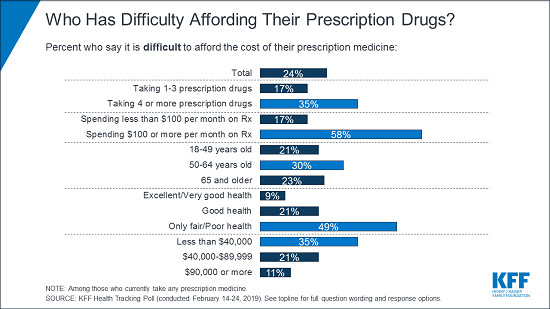
As the Trump Administration and Congress weigh policy options to address high prescription drug prices, a fourth of people taking prescription drugs (24%) and seniors taking drugs (23%) say it is difficult for them to afford their medications, the latest KFF Health Tracking Poll finds.
The groups most likely to report difficulties affording their medications include people with monthly drug costs of $100 or more (58%), in fair or poor health (49%), with annual incomes less than $40,000 (35%), or taking at least four drugs monthly (35%). Three in ten 50-64 year olds report problems affording drugs. This group takes more prescriptions on average than younger people but isn't old enough to qualify for Medicare and its drug benefit.
Febpollchart_1revise
In addition to difficulty affording prescriptions, about three in ten (29%) of all adults report not taking their medicines as prescribed at some point in the past year because of the cost. This includes about one in five who say they didn’t fill a prescription (19%) or took an over-the counter drug instead (18%), and about one in 10 (12%) who say they cut pills in half or skipped a dose. Three in ten of those who report not taking their medicines say their condition got worse as a result (8% of the public overall).
The poll also assesses the public’s views of a range of proposed legislative and administration actions aimed at lowering drug costs.
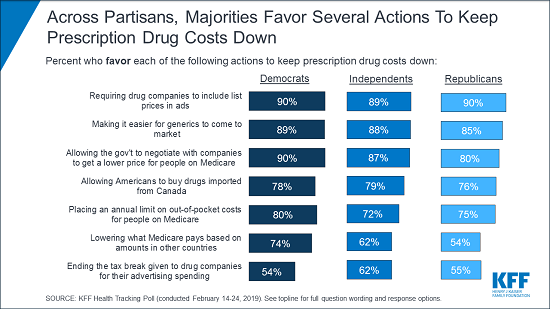
Large majorities favor most of these options, including requiring drug companies to list prices in their ads (88%), making it easier for generic drugs to come to market (88%), allowing the federal government to negotiate with drug companies to get lower prices for people with Medicare (86%), and allowing Americans to buy drugs imported from Canada (80%). Each of these four options receive support from large majorities of Republicans, Democrats and independents.
Bi-partisan majorities support two other Medicare changes: placing an annual limit on out-of-pocket drug costs for Medicare beneficiaries (76% support, including 75% of Republicans) and lowering what Medicare pays based on prices in other countries (65%, including 54% of Republicans). Fewer support options that could limit Medicare beneficiaries’ access to medications, such as allowing Medicare Part D drug plans to impose more restrictions on certain drugs’ use (53%) or exclude more drugs (25%).
newpollchart-usethis2.28
Among seniors, nearly all of whom are covered by Medicare, majorities support three Medicare policy changes: allowing the government to negotiate prices (82%), setting an out-of-pocket spending limit (68%), and setting prices based what people in other countries pay (60%). Fewer seniors support allowing Part D plans to place more restrictions on drugs’ use (45%) or exclude more drugs (24%).
Arguments about Medicare Drug Price Negotiations Can Shift Many People’s Views
This month’s poll also tests a range of arguments for and against allowing the government to negotiate with drug companies to lower the prices Medicare beneficiaries pay.
As noted above, a large majority (86%) initially supports this policy change. The share in favor rises to 91 percent when opponents are told it could save seniors money on their drug.  The share in favor drops sharply when supporters hear opponents’ potential arguments that it could lead to less research and development of new drugs (31% still favor while 66% oppose) or that Medicare might not cover some prescription drugs (29% still favor while 67% oppose).
Medicare-for-All Views Hold Steady
The poll finds the public’s views toward a Medicare-for-all proposal, which would expand public coverage through a national insurance plan, holding steady this month amid heightened attention in Congress and among Democratic presidential candidates on the campaign trail. The poll finds 57 percent of the public support Medicare-for-all, statistically unchanged from January (56%).
Designed and analyzed by public opinion researchers at KFF, the poll was conducted Feb. 14-24, 2019 among a nationally representative random digit dial telephone sample of 1,440 adults, including an over-sample of adults, 65 and older (606). Interviews were conducted in English and Spanish by landline (464) and cell phone (976). The margin of sampling error is plus or minus 3 percentage points for the full sample and 5 percentage points for the over-sample. For results based on subgroups, the margin of sampling error may be higher.
Read the Poll
Filling the need for trusted information on national health issues, the Kaiser Family Foundation is a nonprofit organization based in San Francisco, California.
Contacts:
Rakesh Singh | (650) 854-9400 | rsingh@kff.org
Craigh Palosky | (202) 347-5270 | cpalosky@kff.org
Connect with us: email-icon facebook-icon twitter-icon instagram-icon