Monday, February 3, 2020

Weekly Influenza Surveillance Report -Week 04 ending January 25-

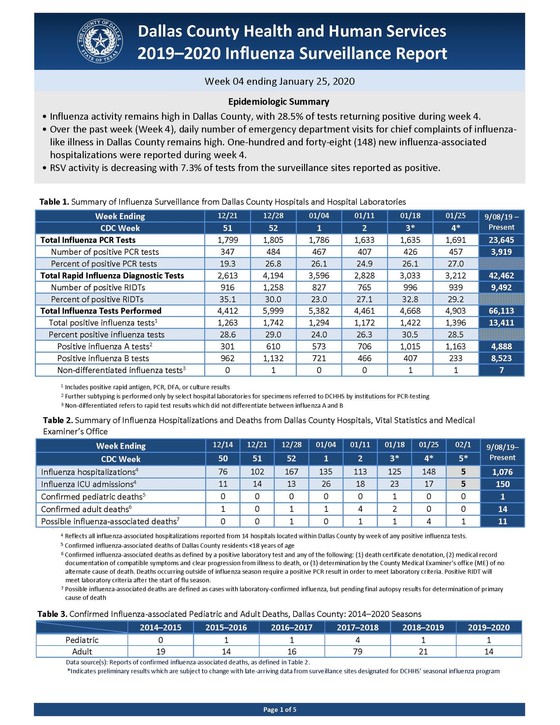
DCHHS has released its Weekly Influenza Surveillance Report - Week 04


new DCHHS logo


Weekly Influenza Surveillance Report
-Week 04 ending January 25-

For current and previous reports click here:

Visit our Homepage
Stay Connected with Dallas County Health & Human Services: 

Like us on Facebook
Follow us on Twitter
Subscribe to our other newsletters


Aging in Place—or Trapped in Place?


By Stephen M. Golant
As older adults age into later life, they often face disruptive changes that make their dwell­ings, neighborhoods and communities seem less appealing. When they retire and seek new leisure, volunteer or career activities, they may be disappointed by what is available nearby. After their children depart, older adults may feel that their homes are uncomfortably large, and utility costs, property taxes and mortgage payments are overly high. The smaller income stream in retirement can mean that such home expenses become financially burdensome. About 54 percent of ages 65 and older renters and 26 percent of older homeowners are cost-burdened, paying more than 30 percent of their monthly income for housing.
Because these dwellings also are aging, they typically require constant repairs and upgrades, and may pose fall risks due to stairs that are expensive to modify. Only about 15 percent of house­holds with moderate mobility difficulties occupy dwellings that are accessible.
Often, older adults must weather loneliness and depression from the deaths of a spouse or friends. And as neigh­­borhoods evolve, chances for social isolation can increase if surroundings no longer seem safe or socially compatible. Nationally, among people ages 65 to 69 and ages 70 and older, 36 percent and 24 percent felt lonely, respectively.
As health conditions, mobility limi­tations and mental declines occur, activities such as residen­tial upkeep, self-care, medication management and getting around become challenging. Low-den­sity suburbs in particular present trans­portation barriers when elders give up driving. About one-third of older persons have unmet travel needs.
Despite these factors, older people find that moving is an unwelcome way to change their im­perfect worlds. In most years, only about 2 percent of homeowners ages 65 and older, and 10 per­cent of the same-age-cohort of renters, change their addresses—rates of moving that are much lower than for any other age group.
Older Adults Are Not Leaving Home
Strong magnetic attractions keep older persons from moving. They are emotionally attached to their dwellings and possessions, which they treat as untouchable archeological evidence of their interesting and successful pasts. Also sacred are ritualistic everyday activities—weekend dinners with friends, movie nights, club activities or neighborhood walks. Elders cringe at the prospect of relocating and having to find new doctors, restaurants, stores and recreational opportunities. They worry about living in a place where nobody knows their name and having to find new friendships and trusted neighbors. By remaining in familiar places, they feel engaged, competent and in con­trol, despite other uncertainties in their lives.
Also, older adults’ family relationships can account for an unwillingness to move. Larger houses can accommodate visits or the return of grown children who, saddled with debt, may seek to save on housing expenses. The dwelling equity of older homeowners—often their primary source of wealth—can be preserved as an inheritance for loved ones.
So how do aging-in-place older adults cope with their incongruent worlds? They play mind games, rationalizing the failings of where they live. More constructively, they take on more debt or cut back on other expenses. They make only essential home modifications and avoid difficult-to-use areas in their dwellings. They look for alternative social relationships or become more seden­tary. They become car passengers rather than drivers, or depend upon door-to-door van services. They cling to independence by depending on families for assistance. To a lesser extent, they secure paid or publicly supported in-home supportive services.
Caveat lector: Some older persons age in place not because they choose to, but because they must. The elders with the most limited options—the poorest, oldest, least educated, unmarried women and minorities—are best characterized as trapped in place. They want to move, but cannot find decent and affordable housing—either to own or to rent—in what they consider appropriate neighborhoods or communities.
Some of the usually mentioned housing options are not realistic. Even if older adults have fam­ily members willing and able to accommodate them in their homes—which many don’t—they fear losing privacy and independence. Also, they view as too extreme the downsizing required by living in an accessory dwelling unit or spare bedroom. Senior care facilities, such as assisted living, which might accommodate their vulnerabilities, are, for other reasons, not an option. Older adults often object to living with other frail older people, or simply cannot afford to. Only about 17 percent of available units now accommodate older persons who are dependent upon Medicaid.
Can It Be Easier to Age in Place?
Given these downsides, it might appear counterintuitive to argue that it is becoming easier to age in place. But surprisingly, today’s older adults have more ways to connect to their activities, people, goods and services and care in their communities. Why? Consider the following:
•  Higher percentages of older women now drive; and new technologies are making vehicles easier and safer to operate, plus the advent of self-driving cars is on the horizon.
•  Ride-sharing apps such as Uber and Lyft have increased travel options. Such companies also col­laborate with homecare agencies and medical facilities to make it easier for older clients to reach ser­vices.
•  Vendors and service providers deliver goods and services to an increasing number of neigh­borhoods mainly occupied by elders (known as naturally occurring retirement communities). These enclaves also offer social opportunities to combat loneliness.
•  With the growth of e-commerce, older persons can access prescriptions, banking services, gro­ceries, meals and more without leaving their homes, and apps like TaskRabbit can provide labor for home upkeep or organizational tasks.
•  Comprehensive health and care services delivered to older adults’ homes speed hospital-stay recuperation and assist with self-care activities. And physician house calls are on the upswing.
•  Internet connectivity allows online entertainment, distance learning and self-help and vir­tual reality experiences. Texting, Skype and FaceTime can enable “intimacy-at-a-distance” social relationships. And emotionally responsive robotic pets can be fill-in social companions.
•  Smart home sensor-based technologies—monitoring and responding to problems—enable older persons to live independently for longer. And home telehealth and telemedicine allow older persons to receive medical assessments and care management once only available in clinical settings.
Can Aging-in-Place Elders Weather the Headwinds?
A cautionary note, however, is in order. There are four reasons why in the future older people may have more difficulty remaining in their familiar abodes.
First, elders may reject the new ways of connecting with their communities because they resist adopting innovations and worry about privacy violations. Older adults may view sensor technolo­gies and telehealth services as impersonal and dehumanizing options that eliminate face-to-face human contacts.
Second, caregiving assistance will become less available, as demographic projections show that the ratio of family members to mobility-limited older persons declines over the next two decades; and the current shortage of paid home­care workers will worsen.
Third, paid in-home care, home modifications, assisted living residences and technological so­lutions will become prohibitively costly, making these options unaffordable to all but those elders with higher incomes. Two uncertainties—the extent to which federal programs and insurance companies will defray costs and whether middle-income elders, who are ineligible for most gov­ernment assistance, can pay for these alternatives.
And fourth, over the next three decades, the elder population will become top-heavy with indi­viduals in their mid-80s and older—an age cohort that has the most difficulty living independently because of their very low incomes, high disability rates and more serious chronic illnesses.
The bottom line is this: It will become more likely that older persons who age in place will not be aging in the right place.
Stephen M. Golant, Ph.D., is a speaker, author and researcher on the housing, mobility, transporta­tion and long-term-care needs of older adult populations. He is a Fellow of the Gerontological Society of America, a Fulbright Senior Scholar and professor emeritus at the University of Florida, in Gaines­ville. Golant is the author of Aging in the Right Place (Baltimore: Health Professions Press, 2015). He can be contacted at golant@ufl.edu.

Top 12 Side Effects Of Sitting Down For A Longer Time

1. Low energy expenditure
Role of Low Energy Expenditure and Sitting in Obesity, Metabolic Syndrome, Type 2 Diabetes, and Cardiovascular Disease
Sitting at your desk for too long reduces your non-exercise activity thermogenesis is generally a much greater component of total energy expenditure than exercise.

2. Slower metabolism
Sitting Time and All-Cause Mortality Risk in 222 497 Australian Adults
The decreased muscle contractions that occurs with prolonged, immobile sitting slows the clearance of fat from the blood stream and decreases the effect of insulin.

3. Compromised posture
Sitting bio-mechanics
Sitting causes the pelvis to rotate backward and puts pressure on the lumbar discs. This position forces the head forward and cause the shoulders to curve to compensate for the weight transfer.

4. Back and spine injuries
The bio-mechanics of low back injury: Implications on current practice in industry and the clinic
Prolonged, static loading of tissues over time puts undue pressure on the low back and stress the surrounding muscles and joints.

5. Reduced social skills
Internet paradox: A social technology that reduces social involvement and psychological well-being?
Interaction limited to communication over the internet is associated causes a decline in social involvement and psychological well-being.

6. Loneliness or depression
Internet paradox: A social technology that reduces social involvement and psychological well-being?
When the computer is used as the single form of communication, the size of a person’s social circle is believed to decline, and and feelings of depression and loneliness increase. Being stuck at your desk also means you’re probably not getting outside enough. This lack of sunshine can cause person to become deficient in vitamin D and ultimately lead to depression.

7. Metabolic Syndrome
Role of Low Energy Expenditure and Sitting in Obesity, Metabolic Syndrome, Type 2 Diabetes, and Cardiovascular Disease

8. Chronic Pain
Ergonomics of posture—Review of various problems of standing and sitting posture
Inadequate sitting postures, associated with long periods of sitting at a desk, provoke excessive increases of lower back pressure. These somatic pains can become the symptoms of chronic diseases.

9. Rheumatic disorders
Ergonomics of posture—Review of various problems of standing and sitting posture
Some rheumatic diseases like osteoarthritis are the result of “wear and tear” to the joints, like that of excessive amounts of sitting.

10. Obesity
Sitting at a desk reduces a person’s energy expenditure because the body’s major muscle groups aren’t being utilized and calorie burning is minimized. Over an extended period of time this can lead to weight gain and in severe cases obesity.

11. Diabetes
Sitting Time and All-Cause Mortality Risk in 222 497 Australian Adults and more in adults in the U.S and U.K
Sitting at a desk all day impairs the body’s ability to handle blood sugar, causing a reduced sensitivity to the hormone insulin, which helps carry glucose from the blood into cells where it can be used for energy.

12. Cancer
Occupational physical activity and the incidence of cancer of the breast, corpus uteri, and ovary in Shanghai.
Low physical activity occupations have an increased incidence of cancer. A study found women’s chances of developing breast, corpus uteri, and ovary cancer were heighten if working in a sedentary job.


https://theahelenu.clickfunnels.com/optin

WHO Declares Coronavirus A Global Health Emergency, Praises China’s ‘Extraordinary Measures’

Lisette Voytko Forbes Staff Business (Updated: 4:29 p.m. EST, Jan. 30 2020) Jan 30, 2020, 01:12pm
Topline: The World Health Organization (WHO) said Thursday in a press conference that it is declaring coronavirus an international health emergency.
·         The declaration is not a vote of no confidence in China, according to WHO Director-General Dr. Tedros Adhanom Ghebreyesus, who praised China’s efforts: “The Chinese government is to be congratulated for extraordinary measures it has taken to contain the outbreak.”
·         “We don’t know what sort of damage coronavirus could do if it spreads to a country with a weaker health system,” said Ghebreyesus. “We must act now.”
·         The Washington Post reported earlier on Thursday that a Chicago woman in her 60s who traveled to Wuhan, China, last month contracted coronavirus and then spread it to her husband here in the U.S., marking the first time that that coronavirus has spread person-to-person inside the U.S.
·         WHO reconvened its emergency committee in a meeting to evaluate the crisis Thursday, after declining to declare the outbreak an international health emergency during a meeting January 23, 2020.
·         A global emergency includes recommendations to all countries for the prevention and reduction of cross-border spread of the virus, as well as guidelines for worldwide health officials to monitor, prepare and contain any infection, but WHO has no legal authority to sanction countries.
·         The WHO meeting also follows earlier reports that the total number of infected cases in China (over 8,100) surpassed the number of people infected with SARS during the 2002-2003 outbreak, with the Chinese death roll reaching 171.
Chief critic: Dr. James Shepherd, a Yale School Of Medicine professor specializing in infectious diseases, said WHO’s decision was “fair” and that China has responded “incredibly quickly” in efforts to control the virus, but that “in the coming weeks, we may see that China’s efforts to isolate and lock down places has been counterproductive.” (Millions of Chinese people are under travel restrictions as part of the government’s response to coronavirus). “People are going to move, whatever you do...Whether you tell them not to, they have to get food, stretch their legs, go to work, et cetera. What is the end point of this lock down approach?” asked Shepherd.
Key background: The first case of coronavirus was reported in December. Chinese authorities say the disease broke out in a seafood market in Wuhan, where it was transmitted from an animal, and is now being transmitted between humans. The disease is spread through airborne droplets from coughing and sneezing. Symptoms range from coughing and sneezing to pneumonia and kidney failure in the severest cases; the incubation period is up to 14 days. This week, Australian scientists created the virus in a lab, which could be used to speed up the development of a vaccine and develop a better understanding of the virus. Countries including the U.S., Australia, the U.K., Japan and more have evacuated their citizens from China, while multiple airlines have suspended trips to and from China. Global markets are down as investors react to the virus’ spread, and businesses like Starbucks, Disney, IKEA and others have temporarily closed their doors in affected areas.
Surprising fact: The WHO only rarely declares a disease a “Public Health Emergency of International Concern,” according to Reuters. WHO has previously used the “international public health emergency” designation for the 2019 ebola outbreak, the 2016 Zika virus, the 2014 polio and ebola outbreak, and the 2009 H1 flu pandemic. 

https://www.forbes.com/sites/lisettevoytko/2020/01/30/coronavirus-1st-us-human-to-human-transmission-confirmed-right-before-who-emergency-meeting/?utm_source=newsletter&utm_medium=email&utm_campaign=daily-dozen&cdlcid=5d1670731802c8c524c78889#7338d6cfcacd

Buying U.S. Medications From Canada Is Not the Same As Importing Them


By Allan Golombek September 11, 2019
The Trump Administration announced in July it will allow Americans to buy cheaper prescription drugs from Canada, including penicillin treatments for diabetes. Only one problem: Canada develops few drugs. Most that are used in the country actually come from multinational companies, mostly American. It is impossible to believe that drug companies will provide the gun to shoot themselves in the foot.
Buying medications from Canada is not importing them, it is reimporting them - from the subsidiaries of multinational companies that are seen as the source of high prices. All that Americans are doing when they purchase penicillin and other pharmaceuticals from Canada is buying from U.S producers - who ultimately will not supply Canada with the means to decimate domestic sales. There have been numerous concerns raised in Canada about whether Canadians could meet U.S needs without precariously diminishing Canadian supplies. They can’t, for a simple reason: Multinational companies would obviously not welcome a change that would cannibalize their own market. Hoping to buy back medications that originated with U.S suppliers is like robbing Peter - and hoping to use the same money to pay him back.
The truth is, when it comes to the cost of penicillin, Canada is something of a free rider - or at least a cheap rider. The country keeps prices relatively low through a ceiling on costs of brand name drugs and by permitting governments to negotiate directly with drug companies. But these policies only work because pharma companies see Canada as an ancillary market. That isn’t surprising. The total value of pharmaceutical drugs sold in Canada per annum is $33 billion – a drop in the bucket, considering that the U.S. market is worth close to half-a-trillion. It is in the United States that multinational drug companies recover the cost of development, as well as ensure a healthy profit. The U.S market provides them with their meat and potatoes. Canada only provides some gravy.
In the midst of U.S prices for penicillin that are more than 10 times as high as prices in Canada, it is tempting to recall that penicillin was invented in Canada. The Canadian co-developer, Sir Frederick Banting, sold the original patent for one dollar in the express hope that the medication would be available to all who need it. But that was almost a century ago. Since that time, diabetes treatment has improved dramatically. A range of insulin therapies more closely resembling the insulin our bodies produce naturally are available.
Moreover, more than 160 medications are now in development by multinationals for diabetes and related conditions, including cutting edge treatments that will make diabetes easier to manage and better tailored to individual patients. But developing a pharmaceutical is an expensive proposition. The risks are high, as most potential pharmaceuticals never make it out of the laboratory. Development costs could run hundreds of millions of dollars, with no guarantee of cost recovery. Like all companies, drug firms are in a constant struggle for capital. 
While the hope of reimporting penicillin and other medications from Canada is a wistful dream, the pressure is nonetheless on in the United States for cheaper drugs. In order to meet this demand, the industry and its Canadian consumers may well face a Hobson’s choice: Canadians can pay substantially more for penicillin and other medications. Or drug companies will have to curtail their R&D and produce fewer improvements in the medication in the future. Most likely, we would see an amalgam.
Canadians won’t like paying more. And Canadians and Americans won’t be well-served by an industry that puts the brakes on R&D. But the bear has been awakened. Americans will not simply return to figurative slumber unless the price they pay for penicillin and other pharmaceuticals is brought down.
Those looking to Canada as a savior will be disappointed. There is no reason for multinationals operating in Canada or anywhere else to undercut themselves by shipping drugs back to the United States. There is no huge stash of penicillin or other medications north of the border. Hoping that Canada can come to the rescue of Americans unable to afford insulin and other medical pharmaceuticals is not just hoping to find a castle in the sky; it is trying to move in the furniture. If they are to be more widely available, someone is going to have to give something up. That someone is going to have to be Canadians or Americans - or both.
Allan Golombek is a Senior Director at the White House Writers Group. 

Eakinomics: Sorry, Harry

President Harry Truman is famous for his plea “Give me a one-handed economist. All my economists say ‘on one hand...,’ then ‘but on the other....’” Harry would have hated yesterday’s Bureau of Economic Analysis (BEA) report on gross domestic product (GDP) in the 4th quarter of 2019.

What about top-line growth? On the one hand, the expansion continues. On the other hand, growth was only 2.1 percent (annual rate) in the 4th quarter, up only 2.3 percent from the 4th quarter of 2018 (compared to 2.5 percent and 2.8 percent in 2018 and 2017, respectively).

What about reliance on the household sector? On the one hand, personal consumption expenditures contributed 1.2 percentage points of the 2.1 percent top-line growth, and year-over-year growth rates continue to exceed 2.5 percent since 2017. On the other hand, growth in goods spending weakened to just 1.2 percent (annual rate), and growth in personal income has slowed by over a percentage point.

What about the slump in investment? On the one hand, residential investment contributed to GDP growth for the second consecutive quarter, adding 0.21 percentage points. On the other hand, non-residential structures continued to slump (-10.1 percent) and were joined by equipment investment (-2.9 percent).

What about special factors? On the one hand, the large inventory swing that subtracted 1.1 percentage points from growth is unlikely to be repeated. On the other hand, the trade war crushed imports and added over 1.3 percentage points to growth. Oh, and a bonus third hand: the real impact of Boeing shutting down the 737 Max will appear in the 1st quarter of 2020.

Is there a bottom line to all this? Yes: The U.S. economy has proved resilient enough to survive a lot of these “other hands.” And there is every reason to believe that trade policy will reverse course and join regulatory, tax, and monetary policy in supporting faster growth in the future. 

National Paralysis Resource Center Hosting Reeve Summit Feb. 26-28 in Washington, DC


From Our Partners
February 3, 2019

National Paralysis Resource Center Hosting Reeve Summit Feb. 26-28 in Washington, DC

The National Paralysis Resource Center, managed by the Christopher and Dana Reeve Foundation, has announced its first ever summit "Where Care, Cure and Community Connect" on February 26-28, 2020, at the Marriott Marquis in Washington, DC.
The three-day summit will bring together hundreds of community members, caregivers, health professionals, key thought leaders and individuals who have had an extraordinary impact on the lives of people with paralysis and related disabilities to foster collaboration, independence, health promotion, and innovation.
The Summit will kick off with a welcome reception and evening entertainment on Wednesday, February 26, followed by two days of notable keynote speakers and educational panels. ACL's Commissioner of the Administration on Disabilities Julie Hocker will be a keynote speaker at the event.
The event will bring together thought leaders who will guide informative discussions and educational sessions on topics and themes relevant to the paralysis community, including:
  • Caregiving;
  • Employment & understanding government benefits;
  • Health & wellness; and
  • Advocacy.
Building upon its groundbreaking past and deeply-rooted expertise, the Reeve Foundation will highlight its new approach to research, what is changing in 2020, and promising new treatments for individuals living with paralysis.
Visit the event website to register for the Summit and learn more about the agenda and speakers.

ACL funds the National Paralysis Resource Center to provide comprehensive information for people living with spinal cord injury, paralysis and mobility-related disabilities and their support networks. Resources include information and referral by phone and email in multiple languages including Spanish; a peer and family support mentoring program; a military and veterans program; multicultural outreach services; quality of life grants; and a national website.
FacebookTwitterYoutube