Wednesday, July 1, 2020

On the Record July 1, 2020

"The question is, when they say the words 'medically necessary,' how are they really instituting that without some kind of prior authorization? The reality is, they're probably not [using prior authorization] as long as it's being ordered by a health care provider."
— Danielle Showalter, principal at Avalere, talked with AIS’s Health Plan Weekly about recent federal guidance that requires insurers to cover "medically necessary" diagnostic and antibody tests for COVID-19, and how the industry is responding.

Subscribers may read the Health Plan Weekly article in which this quote appeared online. Learn more about subscribing to AIS Health's publications.

Blue Cross and Blue Shield of North Carolina last week launched...

...its Accelerate to Value program, an initiative that will incentivize independent primary care groups in North Carolina to transition to value-based care. Beginning in September, participating practices will receive direct payments from the insurer based on 2019 revenue, which will continue into 2021. By the end of 2020, the providers must join one of Blue Cross NC’s existing accountable care organizations or work with Aledade to transition independently. Blue Cross NC is currently the largest insurer in North Carolina, serving 2,593,316 members.

From AIS’s Directory of Health Plans

FDA Approves New Treatments for nr-axSpA, But Coverage May Be Tricky


by Jane Anderson
The FDA's approval of two interleukin-17A (IL-17A) antagonists — Eli Lilly and Co.'s Taltz (ixekizumab) and Novartis Pharmaceuticals Corp.'s Cosentyx (secukinumab) — to treat active non-radiographic axial spondyloarthritis (nr-axSpA) offers providers new options for patients who are intolerant of non-steroidal anti-inflammatory medications (NSAIDs) and other therapies.
Axial spondyloarthritis (axSpA), an inflammatory arthritis of the spine, was reclassified into two categories. In the more commonly known ankylosing spondylitis (AS), also called radiographic axial spondyloarthritis (r-axSpA), damage to the spine is visible on an X-ray. In the earlier-stage form of the disease, non-radiographic axial spondyloarthritis (nr-axSpA), joint deterioration is not yet evident on an X-ray.
"It's possible that with the emerging trend of biologics gaining expanded indications to treat non-radiographic axial spondyloarthritis, payers will respond by choosing a preferred agent from the three [biologics] approved," says Mesfin Tegenu, R.Ph., president of PerformRx. "However, expanded indications for biologics in the treatment of non-radiographic axial spondyloarthritis, being a less advanced form of ankylosing spondyloarthritis, might cause no changes to formularies."
Nicole Kjesbo, Pharm.D., principal clinical program pharmacist at Prime Therapeutics LLC, says that although Taltz and Cosentyx provide a new mechanism of action to treat nr-axSpA, "at this time, their FDA approvals for this indication will not change the course of therapy, as they were already recommended for off-label use by guidelines."
The two newly approved biologics are listed in clinical guidelines as third-line treatments, behind NSAIDs and tumor necrosis factor inhibitors (TNFis), Kjesbo says, and according to the guidelines, "TNFis are recommended over Taltz or Cosentyx."
"NSAIDs are most commonly used for axial SpA (AS and nr-axSpA), and in many patients this is the only drug ever needed," Tegenu says. "Most NSAIDs are available generically."
"Second-line therapy is any tumor necrosis factor inhibitor (TNFi)," adds Tegenu. And Kjesbo explains that "TNFi treatment is recommended over treatment with Taltz, Cosentyx or [Pfizer Inc.’s] Xeljanz/XR (tofacitinib)."
Only one other drug was previously labeled to treat nr-axSpA: UCB's TNFi, Cimzia (certolizumab pegol). In patients who try and fail or have contraindications to NSAIDs and to TNFis, the two IL-17A inhibitors — Taltz and Cosentyx — are indicated for AS, Tegenu says.

KHN and AP Investigate the State of the Nation’s Public Health Infrastructure


KFF
News Release
KHN Associated Press3-01


July 1, 2020

KFF’s Kaiser Health News (KHN), AP Investigate the State of the Nation’s Public Health Infrastructure as It Confronts the Challenge of the COVID-19 Pandemic
A new investigation from KFF’s Kaiser Health News (KHN) and The Associated Press examines the troubling state of the public health infrastructure the nation is relying on to navigate the health and economic threats presented by the COVID-19 pandemic.
The multipart investigation, which launched today, finds that the public health workforce in the United States is underfunded and under threat, lacking the basic tools to confront the worst pandemic in a century. The novel coronavirus has infected at least 2.6 million people in the U.S., killed more than 12,000 people and cost tens of millions of jobs and $3 trillion in federal rescue money.
Among the key findings in the series’s first story, “Hollowed-Out Public Health System Faces More Cuts Amid Virus”:
  • Since 2010, spending on state health departments has dropped by 16% per capita, and in local health departments by 18%, in 2019 dollars after adjusting for inflation, according to the KHN and AP analysis.
  • At least 38,000 state and local public health jobs have been eliminated since the Great Recession in 2008, leaving an inadequate workforce in what was viewed in the mid-20th century as one of the world’s best public health systems.
  • At least 14 states have already cut or are actively considering cuts to health department budgets or positions. States, cities and counties, facing declining revenues amid the economic downturn, are laying off and furloughing the already limited staff.
For their first investigative collaboration, KHN and AP journalists interviewed more than 150 public health workers, policymakers and experts, analyzed state and federal financial records, and surveyed statehouses around the country. Their investigation finds that governments at every level have failed to provide the public health system with the resources — both human and financial — that are required to protect the nation from pandemics.
The reporting also shows how public health officials, who already work on an array of tasks for their communities — such as administering vaccination programs, tracking and preventing infectious diseases, screening infants, monitoring water and air quality, and conducting food and restaurant inspections — are stretched thinner than ever as they work to reduce and monitor the effects of the pandemic. Departments are having to spend already constrained budgets on adequate supplies to keep workers safe as they try to implement preparedness plans and mount effective contact tracing efforts with limited staff. And they have been targeted for criticism by frustrated elected officials and members of the public who blame them for unpopular lockdowns and safety restrictions.
“Bringing together the resources of both The Associated Press and KHN enabled us to marry hard-to-wrangle data with compelling stories from the front lines of the nation’s public health system as it grapples with this pandemic,” said KHN national editor Kytja Weir.
“We are pleased to be working with Kaiser Health News to take a deep look at what is really happening inside the U.S. public health system," said AP investigative editor Alison Kodjak. "This is important public service journalism at a critical time.”
Through the collaboration, AP and KHN have shared data and offered guidance to news organizations that are AP members and customers to help them localize the findings of the investigation for their regions. KHN and AP expect to publish more stories in the series over the coming weeks and months.
About KFF and Kaiser Health News
Filling the need for trusted information on national health issues, KFF (Kaiser Family Foundation) is a nonprofit organization based in San Francisco, California. KHN (Kaiser Health News) is a nonprofit news service covering health issues. KHN is an editorially independent program of KFF and, along with Policy Analysis and Polling, is one of the three major operating programs of KFF. KFF is not affiliated with Kaiser Permanente.
About AP
The Associated Press is an independent global news organization dedicated to factual reporting. Founded in 1846, AP today remains the most trusted source of fast, accurate, unbiased news in all formats and the essential provider of the technology and services vital to the news business. More than half the world’s population sees AP journalism every day. Online: www.ap.org
Contacts:
Chris Lee | KFF | (202) 654-1403 | chrisl@kff.org
Patrick Maks | The Associated Press | (212) 621-7536 | pmaks@ap.org
Connect with us: email-icon facebook-icon twitter-icon instagram-icon
Share this email   


As COVID-19 cases surge, state agency reverses decision to require Texans on unemployment to look for a job


By Jason Wheeler, Erica Proffer – WFAA June 2, 2020
This story is available as part of a content partnership with WFAA-TV. For more local news, visit WFAA.com.
In an extraordinary move, the Texas Workforce Commission decided Tuesday to retreat from a plan to require work searches starting July 6.
Typically, the state's unemployment agency requires people receiving unemployment benefits to perform job searches for each week in which they request unemployment benefits.
Early in the COVID-19 pandemic, stay-at-home orders and a shuttered economy led TWC to waive that work search mandate for Texans applying for unemployment.
Since then, millions of Texans have lost their jobs, and have been able to collect state and federal unemployment payments without the added pressure of looking for work.
As the Texas economy aggressively reopened, in mid-June TWC commissioners decided to reinstate work searches.
Starting July 6, the agency was set to begin requiring beneficiaries to make three attempts per week to find a job in order to keep receiving unemployment.
But with COVID-19 cases and hospitalizations surging in some of the state's most populated metropolitan areas, and the governor pausing and rolling back recent reopening efforts, TWC has now re-suspended work searches.
"Based on the increase in COVID-19 cases and the governor's June 26 executive order, we'll be pausing the reinstatement of the work search requirement for unemployment insurance," Ed Serna, the executive director of the agency, said during a meeting Tuesday morning. "We'll continue to monitor the situation and come back to the commission in late July with a recommendation regarding reinstatement at the current time."
So far, the agency has not set a new date for when searches might be required again. Any decision to return to work searches will likely come with at least two weeks of warning.
Therefore, since the agency is not expected to meet again until late July, it is likely that work searches will be suspended through at least mid August.

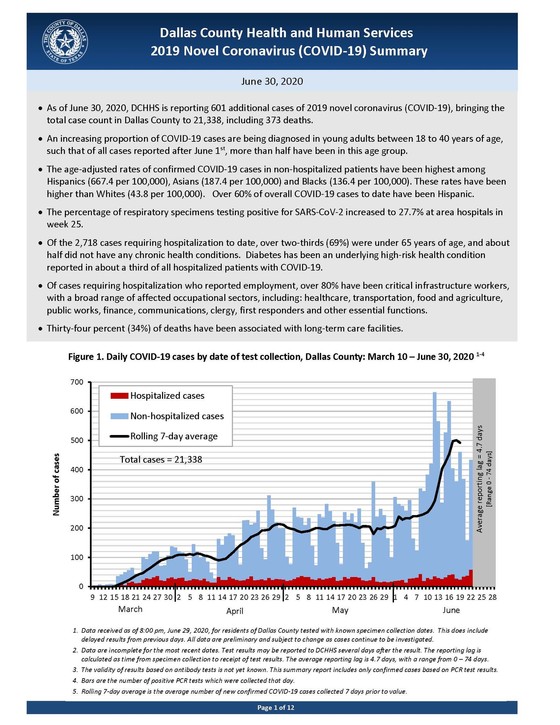
DCHHS has released its 2019 Novel Coronavirus (COVID-19) Summary, 6/30/20


new DCHHS logo

2019 Novel Coronavirus (COVID-19) Summary
June 30, 2020


For more information on COVID-19 click here:

Visit our Homepage
Stay Connected with Dallas County Health & Human Services: 

Like us on Facebook
Follow us on Twitter
Subscribe to our other newsletters


The Future Looks Brighter


By Alex Eule |  Wednesday, July 1
Push and Pull. Investors will have to get used to days like this, if they haven't already. There was good news about the future just as current conditions get worse. 
Arizona, California, Georgia, and Texas all reported a record number of  daily Covid-19 infections. California is re-closing bars and indoor dining in many of its counties, and New York City said it was delaying its own planned reopening of indoor restaurant spaces. 
That would all be particularly depressing save for one bright spot: Drug giant Pfizer reported positive early results on its vaccine candidate. The vaccine news helped push the S&P 500 up 0.5% on the day, its third-straight day of gains. The Nasdaq Composite jumped nearly 1% to a new record.
Barron's Josh Nathan-Kazis notes that the Pfizer data was received more positively than recent disclosures from other vaccine makers, including Moderna and Inovio Pharmaceuticals. 
The release was more detailed than similar updates from Moderna and Inovio have been. What’s more, the companies made a manuscript of the full results available on a so-called pre-print server, which publishes scientific papers as they await peer review.
Pfizer's stock closed up 3.2%. The initial results came from a testing universe of 45 people. A trial slated to begin later this month will include 30,000 subjects. If all goes well, Pfizer and its German biotech partner BioNTech could manufacture up to 100 million doses of the vaccine by the end of the year and "potentially more than 1.2 billion doses by the end of 2021."
There was mixed news on the job front. Payroll processor ADP said 2.4 million workers were hired in June. That's significant progress from the huge losses early in the pandemic, but the figure was below expectations. Economists had been forecasting an increase of 3 million jobs. ADP, meanwhile, revised its May figure to a gain of 3.1 million jobs. It originally  reported a loss of 2.8 million.