By Press Release
InsuranceNewsNet Courtesy of LIMRA
With
the U.S. unemployment rate almost at a 50-year low, it is not surprising that
one of the biggest challenges facing employers is recruiting and retaining good
employees. According to LIMRA research, nearly 7 in 10 employers say this is
one of the biggest challenges they face.
Offering
employee benefits is one way employers can stay competitive in the market,
attracting and retaining solid performers.
(Courtesy of LIMRA)
LIMRA
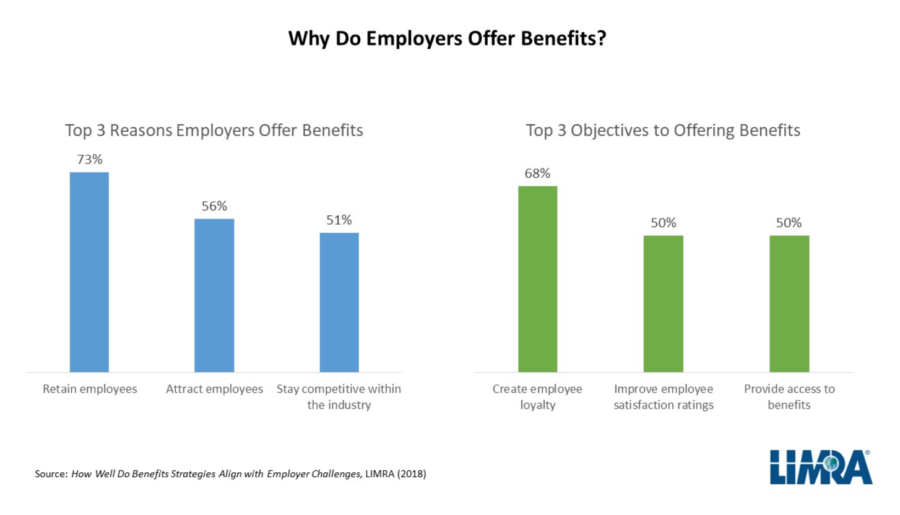
research finds the top reason employers offer benefits is to retain employees
(73%), followed by attracting new employees (56%) and staying competitive in
the market (51%).
One
reason that retaining employees is a significantly bigger motive than
attracting new employees comes down to cost — with continued low unemployment
rates employers may see more employees seeking other job opportunities.
Each
time an employee leaves, a company has to spend money recruiting and training
new talent. It is more efficient and economical for businesses to keep good
employees rather than recruit new ones.
While
the drive to boost employee loyalty and improve employee satisfaction is top of
mind with employers, LIMRA research shows employers are concerned about
controlling benefit costs, managing benefit enrollment and plans, and adhering
to legal and regulatory requirements.
Balancing
these with the desire to provide a benefits package that will best serve the
employee and the company is often a difficult challenge for employers. In
today’s work environment, employers recognize some of their employees are
finding it difficult to afford benefits yet employers are unable to absorb the
cost increases themselves. The average cost of benefits for private industry
workers has risen 28% over the past 10 years.
One way
an employer can better manage its benefits program is by developing a
comprehensive strategic approach. Regrettably, LIMRA research finds barely 4 in
10 employers have a formal plan in place and only a quarter manage their health
and retirement benefits as part of a broader total rewards compensation
package.
When
planning, three quarters have planning cycles of 1 year or less. This can make
it more difficult for employers to holistically view all of the components of
their benefits package.
When
looking at the benefits programs being offered, 7 in 10 employers believe that
their current program meets their employees’ needs and what is what their
employees want. However, just 53% of employees say they are actually satisfied
with the benefit packages offered by their employer.
In
addition, LIMRA research finds few employers benchmark their benefits programs
against their peers’ programs to learn how competitive they are. It is not
surprising to learn that nearly 1 in 5 employees say their benefit package is
not robust enough to prevent them from considering other employment options.
This
shows there is still room for improvement. Employee surveys are one way to help
make sure the benefits program aligns with what employees want. LIMRA research
finds only 18% of employers survey their employees to find out what they want
regularly and less than half (48%) do it once in a while.
This
leaves 34% of employers who never solicit feedback about their benefits program
from their employees. If they did, it might lead to stronger retention rates —
their main objective.

No comments:
Post a Comment