Tara
O'Neill Hayes, Kate Dixon October 8, 2019
Executive Summary
·
Hospital costs account
for nearly 40 percent of personal health care expenditures in the United
States.
·
Despite a decrease in
hospital utilization, spending on hospital care grew 32 percent on a per capita
basis between 2008 and 2017, and spending is expected to grow 5.7 percent per
year, on average, from 2020 to 2027, largely because prices rose 29 percent
from 2005 to 2018 and are expected to continue rising.
·
Hospital prices are
highest in markets with the least competition, and vertical and horizontal
hospital consolidation is occurring at a rapid pace, largely fueled by various
policies and regulations that provide financial incentives for
consolidation—yet the quality of care often declines as consolidation and
prices increase.
·
Reducing the overall cost
of health care in the United States will be difficult without reducing hospital
prices.
Hospital Expenditures
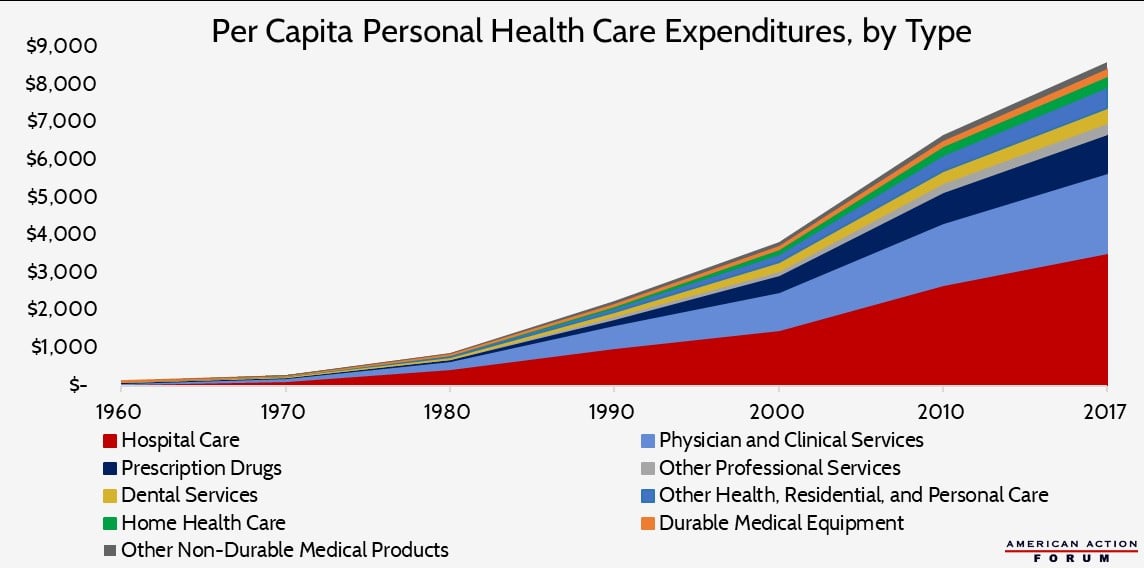
One-third, or $1.1 trillion, of all national
health care expenditures in the United States in 2017 was attributable to care
provided in hospitals.[1] When narrowed to just personal
health care expenditures—those expenses directly tied to treating and
preventing disease in an individual person—hospital costs increase to 38.6
percent of expenditures. For comparison, physician services provided outside the
hospital and excluding home health care or care provided at nursing facilities
accounts for 31 percent of personal health care expenditures (and 26.3 percent
of total national health expenditures). For their part, prescription drugs
account for 11.3 percent of personal health care expenditures.
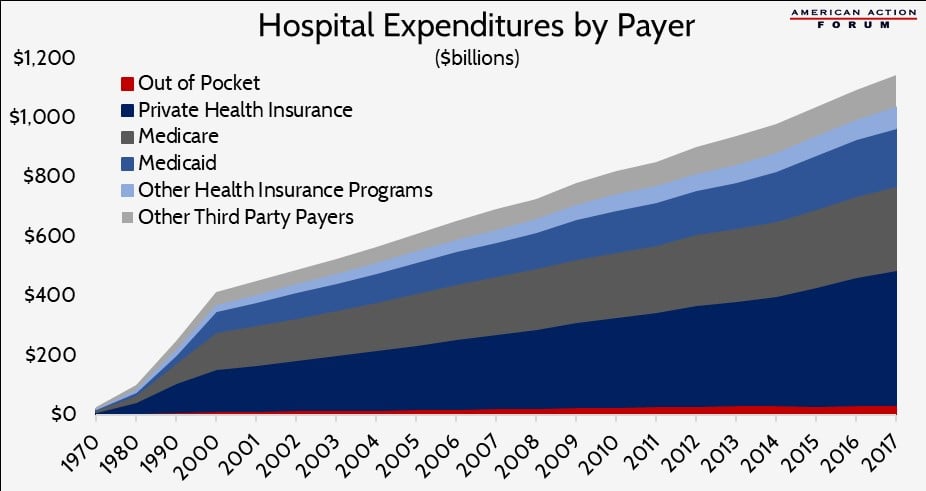
But while total hospital spending was more than
$1 trillion, patients paid directly for less than 3 percent of that cost (or
$33.9 billion) through out-of-pocket (OOP) expenditures, as shown in the chart
below.
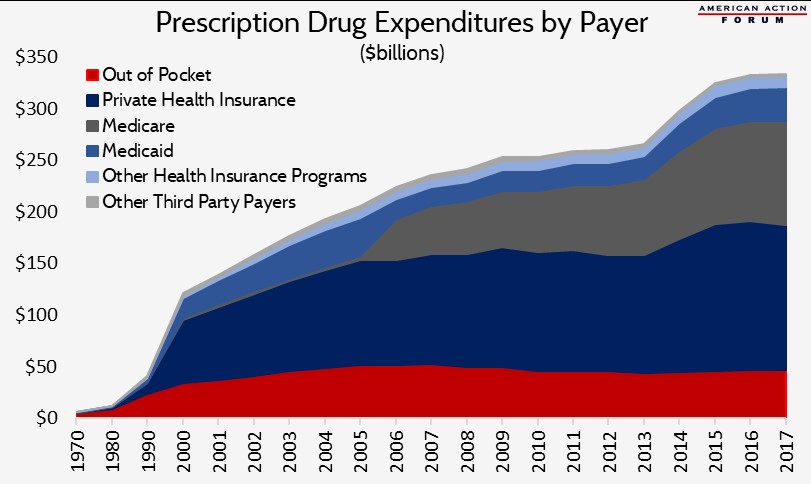
In contrast, prescription drug costs totaled
$333.4 billion in 2017, but $46.7 billion (or 14 percent of that cost) was paid
by Americans out-of-pocket.[2] In other words, the country spends
nearly 450 percent more on hospital care than on prescription drugs, but
individual consumers pay 38 percent more out-of-pocket for prescription drugs
than for hospital care.
This discrepancy in OOP costs may partially
explain why policymakers are devoting so much attention to
reducing drug prices rather
than hospital costs (aside from surprise billing issues,
which are another instance where patients are likely to face rather large OOP
expenses). OOP costs are the most direct cost to the patient and are tied
directly to the good or service the patient receives. In contrast, an employer
typically pays much of the premiums (reflected above in the amounts paid by
insurers), and the individuals’ portion is usually deducted from their
paycheck, making it less noticeable. Further, enrollees usually do not know how
much each care component drives the premium cost. Thus, people have a distorted
perception of which aspects of the health care system drive overall costs, and
policymakers tend to focus on the issues on which their constituents are
focused. (Of course, all this is not to say policymakers can’t address
real problems and
make worthwhile
changes regarding drug pricing.)
How Hospital Spending is Changing
Hospital spending growth is projected to average
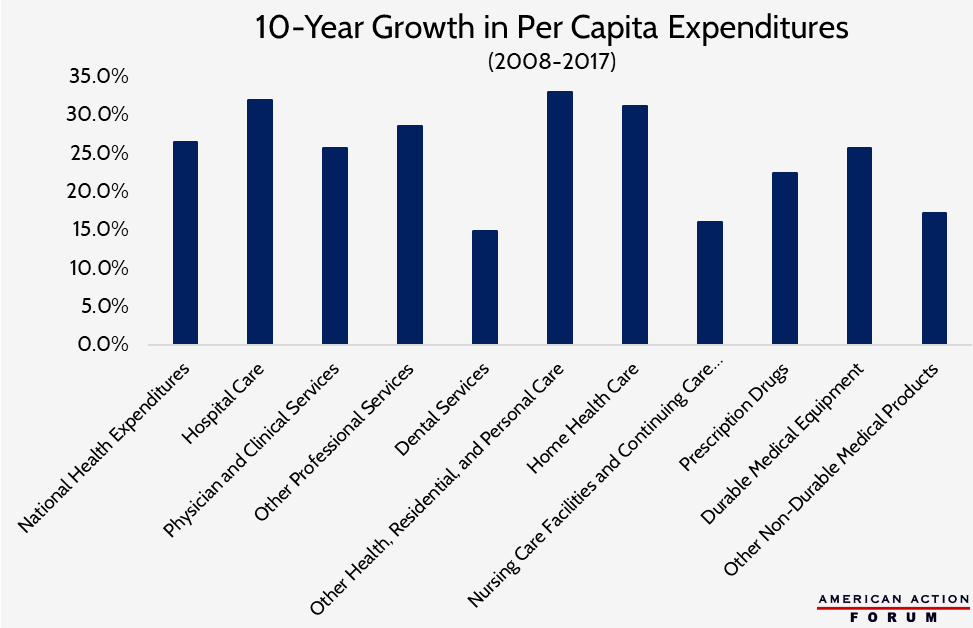
5.7 percent per year from 2020 to 2027.[3] This growth is not simply a result
of population growth. Between 2008-2017, hospital spending grew 32 percent on a
per capita basis, one of the fastest growth rates across all categories of
health care, as shown here.
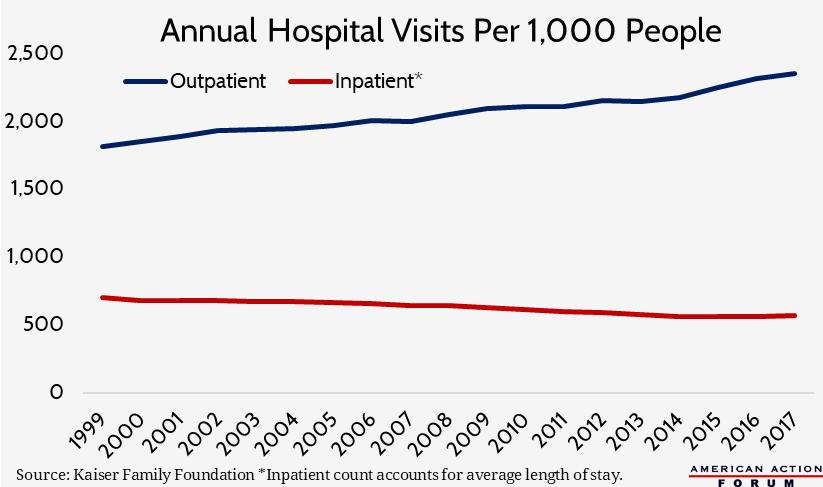
This growth in hospital spending per person is
occurring even though the rate at which patients utilize hospital services,
particularly more expensive hospital inpatient services, has been declining for
years. There are nearly 1,000 fewer hospitals in the United States than in
1981, though most of that decline occurred in the 1980s and 1990s; there are
also fewer hospital beds at the remaining hospitals.[4] This decline in capacity appears to
mark a recognition that care is moving out of the hospital: Rates of inpatient
surgeries have declined more than 40 percent, while outpatient surgeries have
increased nearly 400 percent since 1981.[5] When patients are admitted
to the hospital, they aren’t staying as long as they used to: The average
length of stay is two days shorter now than in 1981.[6] The chart below, based on Kaiser
Family Foundation data of inpatient and outpatient visits,
illustrates these trends (the inpatient figure accounts for the average length
of stay rather than simply the number of persons admitted). Going forward, it
is estimated that inpatient visits are expected to decline 2 percent between
2018 and 2027, while outpatient visits (at all sites, not just hospitals) will
increase 15 percent.[7]
Advances in medicine and technology are enabling
this shift away from hospital inpatient services as well as allowing for
shorter average lengths of stay for inpatient procedures.[8] The shift toward outpatient care is
largely a response to demands from payers and patients to improve quality and
reduce costs. Patients often do not want to spend days in a hospital, and
outpatient care is typically much cheaper than inpatient care.
Hospital Prices
As services have shifted toward outpatient
care—which is less expensive—hospitals are adjusting their prices, presumably
to maintain the revenue at least partially demanded by around-the-clock
staffing, substantial overhead costs, and other costs unique to modern hospital
infrastructure. In 2013, hospitals’ revenue from outpatient care was equal to
83 percent of its revenue from inpatient care. That ratio increased to 95
percent in 2017 as prices for and utilization of outpatient services rose.[9] Much of the increase is the result
of increased prices, rather than utilization: In a single year, 2016-2017,
outpatient volume increased 1.2 percent, while hospital outpatient revenue
increased 5.7 percent.[10]
Comparing the prices for inpatient and
outpatient services illustrates both the inpatient-outpatient dynamic facing
hospitals and the high prices they charge. The weighted average submitted
charge for an inpatient procedure
in 2017 was $54,618, though the average total payment was only $13,029 and the
average Medicare payment was $10,990.[11] For outpatient procedures,
the weighted average charge was $19,855, while the average Medicare payment was
$2,638.[12] This difference is why it is
difficult to explain what a hospital procedure “costs”: On average, Medicare
paid just 20 percent of charges for inpatient services and even less for
outpatient services, at merely 13 percent of charges.
While hospital prices are growing, physicians do
not appear to be the primary beneficiaries of revenue increases. Between 2007
and 2014, insurer-negotiated hospital prices for all in-patient care grew 42
percent, while the prices paid to the physicians for that care grew just 18
percent; insurer-negotiated prices for hospital-based outpatient care grew 25
percent, while outpatient physician prices grew 6 percent.[13] The same study found that nearly
all of the price increases for six different hospital-based procedures during
this period were the result of increased hospital facility fees, which
accounted for 92 percent of the growth in the cost of a cesarean section and 97
percent of the growth in the cost of a knee replacement.[14]
Another study by Altarum found similar results:
The cumulative growth in overall health care prices from 2005 to 2018 was 29
percent, but hospital prices increased 36 percent while prices paid for
physician and clinical services grew just 15 percent.[15] This spread grew substantially over
the second half of this period: Since 2012, physician and clinical services
prices grew just 1 percent, while hospital prices grew 13 percent. Payments
from private insurers in particular are driving this price growth: Hospital
reimbursement rates from public payers grew just 19 percent from 2005 to 2018,
but prices paid by private insurers grew 56 percent.
Some of this price growth may be to account for
a number of factors leading to increased costs. For example, the American
Hospital Association estimates that the regulatory burden amounts to $39
billion per year.[16] Hospitals’ labor costs have
increased an estimated 19 percent over the past 10 years.[17] Hospitals also need to cover the
cost of new technology purchases. Though, there is a question as to how much
new technology is needed and how much is purchased simply because the funds are
available: For instance, the United States has three times as many MRI machines
as comparable countries, on average.[18] Lastly, hospitals may be trying to
offset the impact from a shift in payer mix, as a growing number of beneficiaries
are covered by Medicare and Medicaid which, as discussed, provide lower
reimbursement rates.
Prices also vary substantially, not just across
the country, but within cities and counties and even within a hospital itself.
One study found that variation in prices accounts for roughly half of the
variation in spending per privately insured individual, which varies more than
three-fold.[19] Roughly 20 percent of hospital
price variation is variation of prices within a hospital (different prices paid
by different insurers for the same procedure to the same hospital).[20] According to a study by RAND
analyzing the reimbursement rates negotiated by private insurers, prices paid
in a single hospital system ranged from 150 percent of Medicare rates to more
than 400 percent.[21]
That same RAND study assessing $13 billion worth
of hospital payments from 2015 to 2017 found that private payers (i.e. private
insurers and self-insured employers) pay significantly more than Medicare, and
that difference is growing over time: The average relative price of a service
paid by private insurers was 136 percent greater than the Medicare
reimbursement rate in 2015 and increased to 141 percent greater in 2017.[22] The average price differential for
outpatient services is significantly higher (193 percent greater) than for
inpatient care (104 percent).[23] The self-insured employers in this
study paid an estimated $7.7 billion over what Medicare would have paid for the
same services.
Hospital Markets
The Connection Between Market Share and Prices
Unsurprisingly, hospital prices are highly
correlated with a hospital’s market power as well as the competitiveness of the
insurance market.
In highly concentrated hospital markets—where
one or few hospitals dominate—prices are significantly higher than in less
concentrated markets, and hospital prices increase following market
consolidation. One study noted, “the clearest differences between low- and
high-price hospitals were their size and market share.… [H]igh-price hospitals
had market shares about three times as large as those of low-price hospitals”
and were more likely to be part of a large hospital system with significant
market share.[24] Hospitals with a monopoly in a
given area command prices from insurers that are 12 percent higher, on average,
than the prices of hospitals with four or more competitors.[25] Numerous studies show that prices
charged by hospitals increase 20-40 percent, on average, and as high as 65
percent when hospitals within the same market merge. The greatest price
increases occur when merging hospitals are closer together.[26] In economics, this is referred to
as the substitution effect: When products have a close substitute, consumers
will switch to the substitute when the price of the other product increases;
thus, the substitutes act as competitors. The closer two hospitals are, the
greater their ability to be substituted for the other. When they merge and are
no longer competing for patients, prices rise significantly.
The price differential also depends on the
strength of the insurer, which is a function of both the insurer’s market share
and the insurance plan’s structure. The likely impact is less straightforward,
however, because the strength of the insurer can have counteracting effects. On
the one hand, a dominant insurer may be able to exert significant downward
pressure on hospital prices; on the other hand, a dominant insurer faces little
pressure to offer low premiums.
One study found that, unlike with hospitals,
when insurers increased their market share by 10 percentage points, hospital
prices declined by 7 percent.[27] Another study of highly
concentrated hospital markets similarly found hospital admission prices were 5
percent lower in areas where the insurer market was also highly concentrated,
relative to markets with low insurer concentration.[28] Of note, though, prices were lowest
where both hospital and insurer market concentration was low: Power was
disbursed on both sides. Further, a Health Affairs study found
that the median hospital price paid by insurers with more restrictive provider
networks was lower and increased more slowly than the prices paid by other
insurers.[29]
The lower prices extracted by dominant insurers
do not necessarily result in lower insurance premiums, however. In an
examination of the individual market, premiums were 5 percent higher in highly
concentrated hospital markets, with the highest premiums in markets that also
had a dominant insurer.[30] While premiums declined when the
number of insurers in a market increased, the reduction was not enough to
offset the increase in premiums related to high hospital market concentration.
Thus, while the nature of the insurance market is important to the cost of
hospital care and the prices patients pay, the evidence suggests the nature of
the hospital market has the biggest impact on prices and insurance premiums.
The Current Landscape
The majority of markets are now dominated by one
or two hospital entities, leaving many parts of the country without hospital
competition. The Health Care Cost Institute (HCCI) has done extensive work
documenting and analyzing hospital market concentration, and it recently
released the Healthy
Marketplace Index in conjunction with the Robert Wood Johnson
Foundation, which includes an interactive tool. HHCI found that 72 percent of
metropolitan areas had highly concentrated hospital markets in 2016.
Hospital mergers are on the rise. Between 1998
and 2018, there were 1,667 hospital mergers, but the frequency has increased in
the past decade: 66 percent of those mergers occurred in 2006 or later.[31] Further, roughly half of these
mergers were between hospitals in the same market, hindering competition.[32] Between 2013 and 2017, the number
of hospitals that were part of a hospital system increased 5 percent.[33]
The shift toward outpatient care has also
incentivized hospitals to acquire physician practices and outpatient clinics.
Between July 2012 and January 2018, all regions in the United States saw an
increase in the number of physicians employed by a hospital, with a nationwide
increase of 71 percent.[34] During this time, hospitals
acquired 44,300 physician practices, increasing the total number of
hospital-employed physicians to 168,800, or 44 percent of all physicians.[35] This consolidation matters because
hospital acquisition affects physician pricing behavior in a way similar to the
impacts of hospital mergers: Prices at physician practices acquired by
hospitals increased by 14 percent, on average, after the integration, and
patient spending increased by 4.9 percent.[36]
The rise of the 340B Prescription Drug Discount
Program has also encouraged hospitals to acquire physician practices, as
explained here.
Hospitals can generate significant savings and profits from these discounts,
and their eligibility for the program extends to any outpatient clinic they own.
A study by Milliman found that the percentage of chemotherapy infusions
delivered to Medicare beneficiaries in hospital outpatient departments (HOPDs)
increased from 15.8 percent in 2004 to 45.9 percent in 2014, with most of the
increase occurring at 340B hospital-owned sites, and that this shift led to
increased Medicare expenditures of more than $4,000 per beneficiary.[37] Further, another study by Avalere
found that treatments in HOPDs cost 53 percent more than the same treatment in
a physician office.[38] UnitedHeath Group recently released
a report showing that between $16,000 to $37,000 per patient (or $4 billion
total) could be saved annually if the specialty drugs provided to patients for
five different chronic conditions were provided in a physician office or the
patient’s home rather than an HOPD.[39]
Hospital Profits
The increased consolidation—and thus, increased
negotiating power—has unsurprisingly resulted in increased profits for many
hospital systems. Hospital systems with no competition can demand contracts
that are more favorable for the health system and may include anticompetitive
clauses such as anti-tiering, anti-steering, and “gag” clauses.[40] In 2017, hospitals’ all-payer
margins increased to 7.1 percent, on average, a 27 percent increase from
2013—the year prior to the insurance coverage expansions of the Affordable Care
Act.[41] This increase is in spite of
negative Medicare margins of nearly 10 percent, suggesting significant
cost-shifting to private insurers and patients. One study found, however, that
the formula may be a little more complicated: Many private insurers set their
payment rates as some percentage of Medicare rates; when Medicare rates have
been reduced, private payment rates have also fallen.[42] This connection suggests that while
there may be some cost-shifting to the private market, some of the price
differential may depend more on the hospital and insurers’ relative negotiating
leverage, as discussed earlier.
Not all high-price hospitals yield significant
profits, though. One study found that high prices may simply reflect a more
expensive (less efficient) cost structure: High-price hospitals had operating
margins (which measures revenue in excess of daily expenses and is considered
to be a measure of a business’s efficiency) of negative 2.8 percent, while
low-price hospitals had operating margins of positive 1.5 percent. [43] Low-price hospitals also had the
highest total margins (which is a broader measurement inclusive of income from
interest earned, donations, government appropriations, etc.), while high-price
hospitals’ total margins were 1.2 percentage points less. Further, high-price
hospitals only performed better than low-price hospitals on one quality measure
studied. These hospitals likely commanded higher prices because of both their market
share and the greater likelihood of providing specialized services, such as
neonatal intensive care and Level 1 trauma services, that other hospitals in
the area do not.
Urban and rural hospitals also differ
significantly. Data from the University of North Carolina show that 113 rural
hospitals have closed since 2010, primarily in the South.[44] Between 2013 and 2017, there was a
2 percent increase in urban hospitals, while the number of rural community
hospitals declined nearly 8 percent during that same time period.[45] In February 2019, Navigant reported
that 21 percent of rural hospitals are
still at high risk of closure based on their financial status: The average
operating margin for Medicare patients at these hospitals is -8.2 percent (when
excluding critical access hospitals).[46]
Quality Impacts
One argument that proponents of hospital
consolidation make is that such consolidation is necessary to better coordinate
care and improve patient outcomes. In fact, recent laws, regulations, and
payment structures have been put in place to create Accountable Care
Organizations and Patient-Centered Medical Homes and to adjust payment rates
based on various patient outcomes. These changes give health care providers a financial
incentive to do what is necessary to improve care coordination. For many, the
solution has been to consolidate, both vertically (hospitals acquiring
physician practices and outpatient clinics) and horizontally (hospitals merging
with other hospitals).
Nevertheless, study after study has
failed to document improvements in quality; rather, quality is often worse in
highly concentrated markets even while prices are higher, as Marty Gaynor,
Carnegie Mellon University Professor and former Director of the Bureau of
Economics at the Federal Trade Commission, recently testified to
Congress. For example, the risk-adjusted one-year mortality rate for Medicare
patients suffering a heart attack was 4.4 percent higher in the most
concentrated hospital markets relative to the least, which translates to 2,000
more deaths.[47] In another study Gaynor concluded,
“We find that the effect of competition is to save lives without raising costs.
Patients discharged from hospitals located in markets where competition was
more feasible were less likely to die, had shorter length of stay, and were
treated at the same cost.”[48]
Conclusion
Hospital expenditures have consistently
constituted a third of all health care expenditures in the United States.
Hospital-market concentration is highly correlated with high and rising prices
for health care services of all kinds, not just hospital services. Numerous
policies enacted over the years have incentivized continued market
consolidation, both horizontally and vertically. The evidence shows these
trends are exacerbating the health care spending crisis in our country.
[1] https://www.cms.gov/Research-Statistics-Data-and-Systems/Statistics-Trends-and-Reports/NationalHealthExpendData/NationalHealthAccountsHistorical.html
[2] Though,
the NHE calculated by CMS includes the costs for non-retail prescription drugs,
those administered in the hospital or by physicians, in those respective
spending categories, rather than in the prescription drug cost category. The
Altarum Institute estimates that non-retail prescription drug expenditures
totaled $132 billion in 2017, $34.2 billion of which were provided in
hospitals: https://www.altarum.org/publications/projections-prescription-drug-share-national-health-expenditures-including-non-retail-0
[3] https://www.cms.gov/Research-Statistics-Data-and-Systems/Statistics-Trends-and-Reports/NationalHealthExpendData/NationalHealthAccountsProjected.html
[7] https://www.beckersasc.com/asc-turnarounds-ideas-to-improve-performance/10-key-trends-for-ascs-and-outpatient-surgery-in-the-next-10-years.html
[9] https://www.modernhealthcare.com/article/20190103/TRANSFORMATION02/190109960/aha-data-show-hospitals-outpatient-revenue-nearing-inpatient
[10] https://www.modernhealthcare.com/article/20190103/TRANSFORMATION02/190109960/aha-data-show-hospitals-outpatient-revenue-nearing-inpatient
[11] Author’s
calculation based on data from CMS: https://data.cms.gov/Medicare-Inpatient/Inpatient-Prospective-Payment-System-IPPS-Provider/fm2n-hjj6/data
[12] Author’s
calculation based on data from CMS: https://data.cms.gov/Medicare-Outpatient/Provider-Outpatient-Hospital-Charge-Data-by-APC-CY/fmbt-qrrw/data
[14] https://healthcarepricingproject.org/paper/paper-2-hospital-prices-grew-substantially-faster-physician-prices-hospital-based-care-2007%E2%80%9314 (Exhibit
4)
[18] https://www.healthsystemtracker.org/chart-collection/u-s-health-care-resources-compare-countries/#item-per-capita-u-s-three-times-many-mri-machines-comparable-countries-average
[19] https://www.nihcm.org/categories/what-is-driving-variation-in-spending-and-prices-for-those-with-private-health-insurance
[25] https://www.nihcm.org/categories/what-is-driving-variation-in-spending-and-prices-for-those-with-private-health-insurance
[26] https://www.nihcm.org/categories/hospital-consolidation-trends-impacts-outlook-citations#slide10
[27] https://www.nihcm.org/categories/what-is-driving-variation-in-spending-and-prices-for-those-with-private-health-insurance
[31] https://docs.house.gov/meetings/JU/JU05/20190307/109024/HHRG-116-JU05-Bio-GaynorM-20190307.pdf , https://www.nihcm.org/categories/hospital-consolidation-trends-impacts-outlook
[33] https://www.modernhealthcare.com/article/20190103/TRANSFORMATION02/190109960/aha-data-show-hospitals-outpatient-revenue-nearing-inpatient
[34] http://www.physiciansadvocacyinstitute.org/Portals/0/assets/docs/021919-Avalere-PAI-Physician-Employment-Trends-Study-2018-Update.pdf?ver=2019-02-19-162735-117
[35] http://www.physiciansadvocacyinstitute.org/Portals/0/assets/docs/021919-Avalere-PAI-Physician-Employment-Trends-Study-2018-Update.pdf?ver=2019-02-19-162735-117
[36] https://www.scholars.northwestern.edu/en/publications/the-effect-of-hospital-acquisitions-of-physician-practices-on-pri
[39] https://www.unitedhealthgroup.com/content/dam/UHG/PDF/2019/UHG-Administered-Specialty-Drugs.pdf
[41] https://www.modernhealthcare.com/article/20190103/TRANSFORMATION02/190109960/aha-data-show-hospitals-outpatient-revenue-nearing-inpatient
[45] https://www.modernhealthcare.com/article/20190103/TRANSFORMATION02/190109960/aha-data-show-hospitals-outpatient-revenue-nearing-inpatient
[46] https://www.navigant.com/-/media/www/site/insights/healthcare/2019/rural-hospital-public-option.pdf
[47] Kessler,
D. and McClellan, M. (2000). Is hospital competition socially wasteful?
Quarterly Journal of Economics, 115(2):577–615.
https://www.americanactionforum.org/research/hospital-markets-and-the-effects-of-consolidation/#ixzz61roLjNcZ
Follow @AAF on Twitter

This comment has been removed by a blog administrator.
ReplyDelete