|
Poll: Democrats Say They Are Hearing Enough From Presidential
Candidates About Medicare-for-All and Expanding Coverage, But Want Them to
Talk More about Health Costs and Women’s Health Care
More
Seniors Trust Democrats than Republicans on Medicare, Drug Costs and Other
Health Issues
Large Majority of Public Initially Favors Government Drug Price Negotiations,
But Counterarguments Dampen Support
Heading
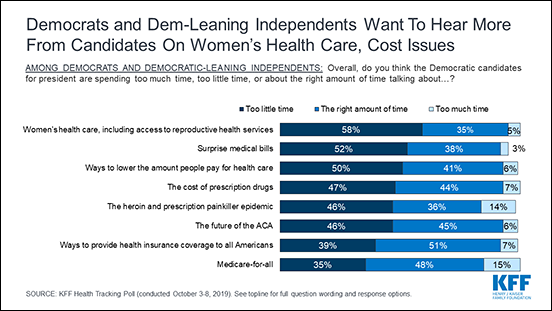
into tonight’s Democratic primary debate, most Democrats and
Democratic-leaning independents say the candidates are spending the right
amount or too much time talking about ways to provide coverage to more
Americans and Medicare-for-all, two topics that have dominated health care
discussions in the past three rounds of Democratic debates, the latest KFF Health Tracking Poll finds.
In
contrast, large shares of Democrats and Democratic-leaning independents say
that the presidential candidates are spending too little time on other health
care issues such as women’s health care, including reproductive health
services (58%), surprise medical bills (52%), and lowering the amount people
pay for health care (50%).
Medicare-for-all
and other approaches to expand public coverage have gotten substantial
attention at prior debates, and critics have focused their attacks on
Medicare-for-all, which would create a single government health plan that
would cover all Americans.
Amidst
this attention, the new poll finds about half (51%) of the public now favors
a Medicare-for-all plan, down 5 percentage points since April. Nearly as many
(47%) now oppose a Medicare-for-all plan, up significantly since April (38%).
The
poll also finds more than seven in 10 (73%) now favor a government-run
“public option” plan available to all Americans that would compete with
private health insurers, while one in four (24%) are opposed.
More Americans, Including Seniors,
Trust Democrats than Republicans on Health Care
President
Trump warned seniors in an Oct. 3 speech in Florida that Democrats would harm
their health care. Fielded after the President’s speech, the poll finds more
seniors trust the Democratic Party than the Republican Party on health care
overall (45% v. 35%), as well as on making sure seniors can get needed care
(49% v. 33%), and lowering drug costs (46% v. 34%).
The
broader public also trust Democrats more than Republicans on health care
overall (44% v. 29%), as well as on the future of Medicare (47% v. 35%),
making sure seniors can get needed care (51% v. 32%), and lowering drug costs
(49% v. 30%).
Not
surprisingly, majorities of partisans trust their own party to do a better
job on each of these issues. Independents are more likely to trust the
Democrats than Republicans, though about a third (32%) say they don’t trust
either party when it comes to handling health care.
Large Majorities across Parties Favor
Government Negotiations to Lower Drug Prices, Though Counterarguments
Significantly Dampen Support
As
Congress weighs options to lower what people pay for prescription drugs,
large majorities continue to favor a range of actions, including allowing the
government to negotiate with drug companies to get a lower price for people
with Medicare (88%), or for both people with Medicare and private insurance
(85%). This includes large majorities of Democrats, Republicans and
independents.
About
seven in 10 (72%) – including a similar share of Republicans (69%) also favor
increasing taxes on drug companies that refuse to negotiate with the
government.
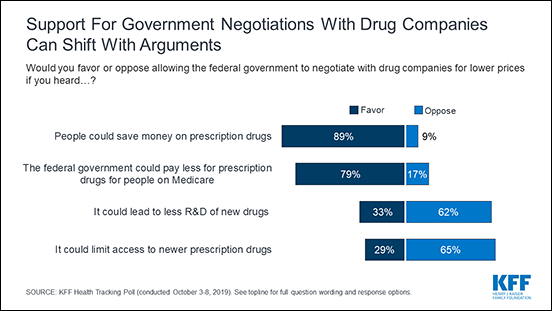
The
poll also tests common arguments made for and against allowing the federal
government to negotiate with drug companies to obtain lower prices and finds
that some arguments can significantly affect public support.
For
example, two thirds (65%) say they oppose government negotiations after
hearing the argument that it could limit access to new prescription drugs,
and nearly as many (62%) oppose it after hearing it could lead to less
research and development of new drugs. On the flip side, support is as high
as 89% when people are told that government negotiations could help people
save on their drug costs.
Other
proposals aimed at lowering prescription drug costs are also popular,
including: placing an annual limit on out-of-pocket costs for seniors in
Medicare drug plans (81%); allowing Americans to buy drugs imported from
licensed Canadian pharmacies (78%); allowing Medicare to limit drug
companies’ price increases based on annual inflation rates (76%); and setting
Medicare prices based on prices in other countries with more government
control (62%). Majorities of Democrats, independents and Republicans favor
each of these options.
The
public is divided on whether Congress can pass legislation on issues such as
drug costs and surprise medical bills at the same time it is working on
impeachment, with nearly equal shares saying Congress can do both (45%) as
saying impeachment will prevent action on those issues (47%). Most
Republicans (78%) and just over half of independents (53%) say impeachment
will keep Congress from passing such legislation, while most Democrats (79%)
say Congress can do both.
Nearly Two Thirds of the Public Do Not
Want the Courts to Overturn the ACA’s Pre-Existing Condition Protections,
Though Nearly Half of Republicans Do
The
poll also looks at the public’s views on a pending court case that could
overturn all or parts of the Affordable Care Act. A federal judge in Texas
last year ruled in favor of conservative state attorneys general that the
entire law was invalid since Congress zeroed out the penalty. The Trump
Administration subsequently expressed its support for eliminating the entire
ACA, including the provisions that prevent insurance companies from
discriminating against people with pre-existing conditions. An appeals court
is now weighing its decision in the case, and the results could eventually
end up before the Supreme Court.
The
poll finds the public narrowly divided on whether the Supreme Court should
overturn the entire ACA, with 43% favoring such a decision and 48% opposing
it. This reflects partisan views of the law itself, with most Republicans
(75%) wanting it overturned, most Democrats (69%) wanting to keep it, and
independents falling in between (51% want to keep it, 40% want it overturned).
At
the same time, most (63%) do not want to see the Supreme Court overturn the
law’s protections for people with pre-existing condition protections. This
includes most Democrats (71%) and independents (73%). Among Republicans, 47%
say they want the court to overturn those protections and 42% say they do
not.
The
poll finds half (51%) of the public views the ACA favorably this month, while
40% view it unfavorably. The split is similar to other KFF polls over the
past two years since President Trump and Republicans in Congress attempted to
repeal the 2010 law.
Designed
and analyzed by public opinion researchers at KFF, the poll was conducted
October 3-8, 2019 among a nationally representative random digit dial
telephone sample of 1,205 adults. Interviews were conducted in English and
Spanish by landline (300) and cell phone (905). The margin of sampling error
is plus or minus 3 percentage points for the full sample. For results based
on subgroups, the margin of sampling error may be higher.
Filling the need for trusted
information on national health issues, the Kaiser Family Foundation is a nonprofit
organization based in San Francisco, California.
|




No comments:
Post a Comment