Tuesday, July 2, 2019

On the Record


"Educated employers are clearly defining brand, generic and single source drugs in their contract to prevent the PBM from satisfying their own needs, i.e., freely moving drugs from one category to the other to increase profits and/or meet contract guarantees."
— Cheryl Larson, vice president of the Midwest Business Group on Health (MBGH), spoke with AIS's RADAR on Drug Benefits about how employers can strategize with PBMs to reach agreements on drug pricing transparency. 

Sanofi and Regeneron's Dupixent last week scored an...

...FDA approval for a third indication — the treatment of sinusitis with nasal polyps. The drug will be the first biologic therapy to treat the condition. For the treatment of asthma, Dupixent currently holds preferred status for just 1% of covered lives, growing to 20% with prior authorization and/or step therapy. The therapy is not covered for 13% of lives.
SOURCE: MMIT Analytics, as of 6/28/19

Employers Appreciate Increased Flexibility in New HRA Rule

The Trump administration touts its recent release of final regulations expanding employers' flexibility in offering health reimbursement arrangements (HRAs) to their employees as promoting more consumer choice and likely to cover more uninsured workers.
Under the regulations, starting on Jan. 1, 2020, employers will be able to offer stand-alone HRAs to help certain employees buy individual health insurance policies. Or they may offer "excepted-benefit" HRAs to reimburse employees for certain medical expenses with annual employer contributions of up to $1,800.
"Philosophically, it's a big change, giving employees flexibility to go out on the [individual] market and find coverage," says Nicole Tapay, principal at Avalere Health. "I think in the near term you'll see most likely the small employers will be giving it a closer look, [deciding] whether they want to use this flexibility to give them more predictability on costs." Insurers offering coverage in the individual market "may see it as an opportunity," she says, while those offering group plans may want to tweak their offerings over time to anticipate employer shifts.
The HRA regulations come with guardrails to protect the individual market. "Opponents will say [these regulations] will cause employers to dump their older and sicker workers onto the individual market," says Dorian Smith, national practice leader for Mercer’s law and policy group, "while proponents will say there are guardrails."
Smith notes Mercer's clients generally are larger employers, most of whom have already decided on their 2020 offerings and would need to provide 90-day notice of changes for calendar year plans.
But for mid-2020 or calendar year 2021, "they might consider [HRAs] for certain employees, like part-time workers not eligible for the group health plan….It still provides a way to offer something different from the employer across the street."
From Health Plan Weekly

Blue Shield of California last week revealed its...

...revamped Wellvolution platform, created in partnership with Solera Health. Members can use online apps and in-person lifestyle programs to address issues that can vastly improve overall health and prevent disease, such as sleep quality, exercise, diet and tobacco cessation. Blue Shield of California is currently the third-largest insurer in California, with 3,371,824 members. Just over half of its members (51.3%) are enrolled in group risk plans.

New York Bill Targets on Pricing Transparency from PBMs


By Jane Anderson

Lawmakers in New York this month approved wide-ranging legislation designed to require pricing transparency from PBMs and to eliminate key PBM practices. But the bill could potentially limit plans' ability to respond to pricing moves by manufacturers, one consultant says.

The New York bill (S.B. 6531) would require that PBMs disclose key pricing and rebate information and pass through all rebates and discounts to the plans and payers, and that they act in the best interests of the covered individual and the health plan or provider.

The New York Health Plan Association, which did not support the legislation, is particularly concerned with the "best interests" section, which imposes a fiduciary relationship on PBMs "in all but name," says Ashley Stuart, director of government affairs for the association.

The legislation also would prohibit mid-year formulary changes and drug substitutions, and it would require PBMs operating in the state to be licensed beginning next year.

Josh Golden at Arthur J. Gallagher & Co.'s Solid Benefit Guidance says, "formulary strategies are designed to help keep drug costs in check. In moving forward with this legislation, the state potentially limits the ability of health plans to apply pricing pressure on pharmaceutical manufacturers throughout the year."

More generally, the legislation will lead to higher health insurance premiums for employers and consumers, warned New York Health Plan Association President and CEO Eric Linzer in a statement.

The legislation comes at a time when several states are considering efforts to rein in PBMs. "At least four or five states are looking at the impact of Medicaid [pharmacy benefit] price transparency," says Alex Shekhdar, founder of Sycamore Creek Healthcare Advisors. "It goes back to the larger fundamental conversation of what states should be looking at — they recognize there’s money under the table, especially in the PBM space."


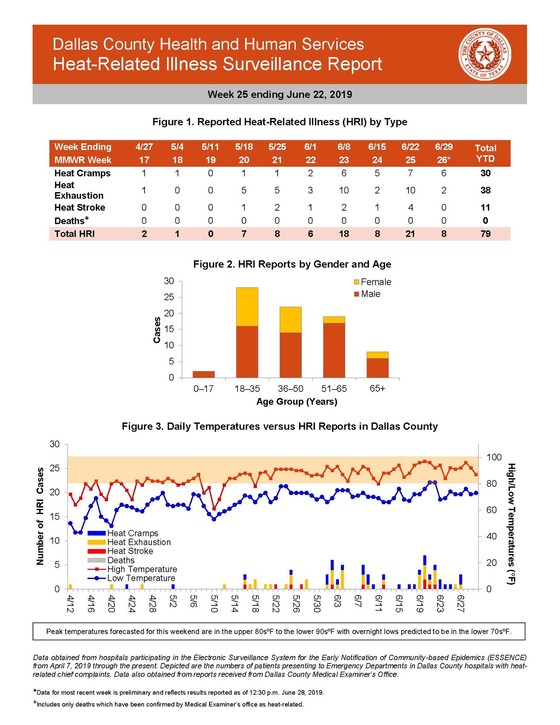
Weekly Heat-Related Illness Report


new DCHHS logo


Weekly Heat-Related Illness Report
-Week 25 ending June 22 -

For current and previous reports click here:

Visit our Homepage
Stay Connected with Dallas County Health & Human Services: 

Like us on Facebook
Follow us on Twitter
Subscribe to our other newsletters


Trump Administration Approves Two New State Medicaid Demonstrations to Treat Substance Use Disorders and Combat National Opioid Epidemic


Centers for Medicare & Medicaid ServicesCMS.gov News Room

CMS NEWS

For Immediate Release
June 28, 2019
Contact: CMS Media Relations
(202) 690-6145 | CMS Media Inquiries

Trump Administration Approves Two New State Medicaid Demonstrations to Treat Substance Use Disorders and Combat National Opioid Epidemic

The Centers for Medicare and Medicaid Services (CMS) announced today that Minnesota and Nebraska have become the 23rd and 24th states who have received approval under the Trump Administration for innovative demonstration projects that increase access to treatment for opioid use disorder (OUD) and other substance use disorders (SUD). 

Under the section 1115 demonstrations, Minnesota and Nebraska are approved to receive Medicaid matching funds for treatment in facilities that meet the definition of an institution for mental diseases (IMD). Since announcing a more flexible approach to these demonstrations through a November 2017 Medicaid policy announcement, the Trump Administration has accelerated efforts to help states combat the national opioid epidemic, decreasing overuse and saving lives.

 “The Trump administration is committed to offering a more flexible, streamlined approach to accelerate states’ ability to expand addiction treatment services during this national crisis,” said CMS Administrator Seema Verma, “Whereas only a handful of states were approved for these demonstrations before 2017, our approach has allowed us to approve nearly 20 more demonstrations in just 18 months.”  Under the Minnesota demonstration, Medicaid eligible individuals will receive enhanced mental health services through Minnesota’s Certified Community Behavioral Health Clinics (CCBHCs). Temporary expenditure authority will allow CCBHCs to integrate community health care providers to increase rates of identification, initiation, and engagement in treatment for SUD.  

CMS expects the Nebraska demonstration will enhance existing substance abuse related services and offer those services to beneficiaries in more appropriate treatment locations, including residential facilities.  As a result the anticipated outcome is that more patients will receive a more complete array of required treatments than before the demonstration.

States will monitor and report the impact of changes to address SUD and OUD over the course of the demonstrations. States who have already implemented their programs are beginning to report positive results. For example, Virginia experienced a 4 percent decrease in acute inpatient SUD admissions during the first 10 months of implementation, along with a 6 percent decrease in opioid use disorder inpatient admissions. During the first year, the total number of prescriptions for opioid pain medications among Medicaid beneficiaries decreased by 27 percent while the number of prescriptions for non-opioid pain relievers remained unchanged. In one year of early implementation of the Maryland demonstration, over 8,000 Medicaid beneficiaries received residential treatment services.

Expanding access to treatment for people with opioid use disorder (OUD) is one key strategy identified in CMS’s Roadmap to Address the Opioid Epidemic, which details agency efforts in combatting the opioid crisis. More than two million people suffer from OUD, yet only 20 percent of people with OUD receive treatment. These demonstrations will allow Minnesota and Nebraska to improve access to high quality, clinically appropriate treatment for OUD and other SUDs, in ways that take into account the particular challenges the opioid epidemic has caused in their respective states. Both demonstrations are approved for a five year period beginning on July 1, 2019, and ending on June 30, 2024.

For More information regarding the Minnesota and Nebraska, demonstrations please visit:

States with previously approved demonstration approvals include Illinois, New Jersey, Louisiana, Indiana, Kentucky, Utah, Vermont, Pennsylvania, New Hampshire, Washington, North Carolina, Wisconsin, Alaska, New Mexico, Kansas, Rhode Island, Michigan, Massachusetts, Maryland, Virginia, California and West Virginia.

###

Get CMS news at cms.gov/newsroom, sign up for CMS news via email and follow CMS on Twitter CMS Administrator @SeemaCMS@CMSgov, and @CMSgovPress.