 |
Just Released
|
|
|
Poll: Two-thirds of Americans Don’t Want the Supreme Court to
Overturn Roe v. Wade
Equal
Pay and Fair Employment Practices are Voters’ Top Concerns among Women’s
Issues
Large
Majority of the Public View Federal Funding of Family Planning Services for
Low-Income Women as “Important”
As President Trump
prepares to make a new Supreme Court nomination, new polling from the Kaiser Family Foundation finds
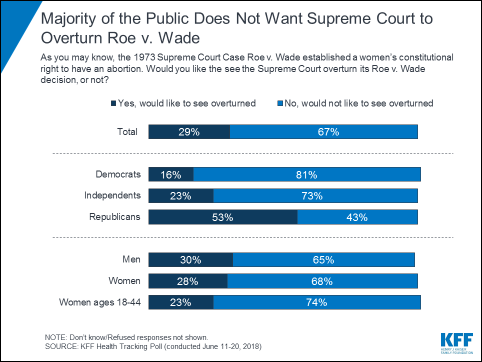
that two-thirds (67%) of the public do not want the Supreme Court to overturn
the 1973 landmark Roe v.
Wade decision that established women’s constitutional right to
abortion.
Fielded this month
prior to Justice Anthony Kennedy’s retirement announcement, the poll finds
about three in 10 Americans (29%) say they want the Supreme Court to overturn
Roe v. Wade.
The case is expected to be a major flashpoint in the Senate debate over
Justice Kennedy’s replacement, as Justice Kennedy has been a swing vote on
abortion on a court closely divided on the issue.
The poll finds a slim
majority (53%) of Republicans would like to see Roe v. Wade overturned, while
large majorities of Democrats (81%) and independents (73%) would not. Similar
shares of women (68%) and men (65%) want Roe v. Wade to stand, but among women of reproductive age,
three-quarters (74%) want Roe v. Wade to stand.
The public overall is
split on how easily they think women can access abortion services in their
communities today – with major differences in perceptions by party. About a
quarter (27%) say it is “too easy” for women to get these services, while one
in five (22%) say it is “too difficult” and about a third (35%) say it is
“about right.” Half (51%) of Republicans say it is too easy, while nearly
four in 10 (37%) Democrats say “too difficult.”
In light of the attention generated by the #MeToo
movement and 2018 primary victories by female candidates, the poll looks
ahead to November’s midterm elections and examines the public’s and voters’
views on a broad range of issues affecting women, including sexual
harassment, paid parental leave and reproductive health.
While not at the top of voters’ concerns heading
into the midterms, most voters (56%) do say it is at least “very important”
for candidates to discuss issues that primarily affect women.
When this group is asked to say in their own words
what issues they mean, about four in 10 (44%, or 25% of all voters) mention
issues related to equal pay or fair employment. This is twice as many as
those who mention reproductive health issues including abortion or
contraception (20%, or 11% of all voters).
In addition, substantial shares of voters say that
a candidate’s position on certain policies that mainly affect women will
influence their vote.
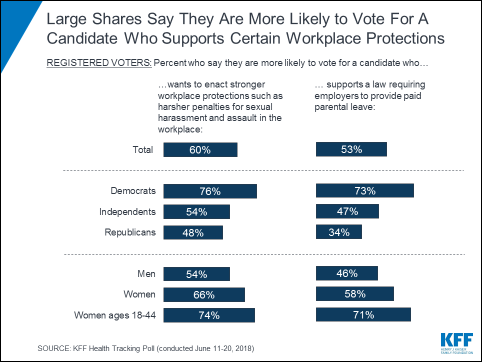
For example, six in 10 (60%) voters say they would
be more likely to vote for a candidate who supports increased workplace
protections against sexual harassment and assault, and a majority (53%) say
the same about a candidate who supports a law requiring paid parental leave.
Democratic voters and women voters are more likely to favor candidates who
support each of these positions than are Republican voters and men voters.
Voters are divided along partisan lines on how a
candidate’s position on access to abortion services will affect their vote.
Overall about four in 10 (42%) voters say they are more likely to vote for a
candidate who supports access to abortion services, while three in 10 (29%)
say they are more likely to vote for a candidate who wants to restrict access
to abortion services. Most (72%) Democratic voters say they are more likely
to vote for a candidate who supports abortion access, while most (58%)
Republican voters say they are more likely to vote for a candidate who wants
to restrict abortion access.
The international #MeToo movement working to raise
awareness about sexual harassment and assault is also a touchstone for many
voters. Half (49%) say they are more likely to support a candidate who is a
strong supporter of the #MeToo movement, while just 7 percent say they are
more likely to vote for a candidate who does not address the issues raised by
the movement.
Other findings from the poll include:
Designed and analyzed by public opinion researchers
at the Kaiser Family Foundation, the poll was conducted from June 11-20, 2018
among a nationally representative random digit dial telephone sample of 1,492
adults. Interviews were conducted in English and Spanish by landline (319)
and cell phone (1,173). The margin of sampling error is plus or minus 3
percentage points for the full sample. For results based on subgroups, the
margin of sampling error may be higher.
Filling
the need for trusted information on national health issues, the
Kaiser Family Foundation is a nonprofit organization based in San Francisco,
California.
|
||
|
||
|
Connect with us:
    |
||
Friday, June 29, 2018
Two-thirds of Americans Don’t Want the Supreme Court to Overturn Roe v. Wade

Insurers See a Viable Market as Final Rule on AHPs Is Issued
Jun 26, 2018
The Trump
administration on June 19 issued the long-awaited final rule aimed at expanding
access to association health plans (AHPs) that are not compliant with the
Affordable Care Act (ACA). A day later, the New York and Massachusetts
attorneys general said they intend to file suit to safeguard ACA protections.
As the situation plays out, industry experts assert that health insurers
generally have reason to view AHP market expansion in a favorable light.
Leerink analysts
describe the final rule on AHPs as “a positive” for managed care organizations,
“creating a viable market for about 4 million lives.” This total includes up to
400,000 individuals who currently lack health insurance, according to recent
estimates, the analysts said in a June 19 note to investors.
Sean Creighton, vice
president in the policy practice at Avalere Health, suggests that insurers can
grab hold of such opportunity “particularly if they can figure out…the correct
relationships with legitimate AHPs that are in the business of aggregating the
risk pools across various regions or industries.” He notes that there is a lot
of interest from the brokerage community in the formation of AHPs.
Creighton offers
cautious optimism for plans as events unfold. “I think it’s fair to say the
small group provisions under the ACA haven’t been too successful, so doing
something in that space isn’t the worst thing in the world,” he says. “But
doing it this way [i.e., through expansion of AHPs] is an open question.”
In the end, Creighton
says the rule may not go far enough on safeguards for AHPs. He cites a “history
of shady plans” in the individual market, though “a lot of them went away with
the ACA.” He adds, “I don’t know [that] the [Dept. of Labor] addressed that” in
the reg.
CMS Regulator Changes Create More Marketing Flexibility for MA Plans
Jun 27, 2018
Recent regulatory
changes as well as program modifications being considered by CMS will likely
allow greater flexibility in Medicare Advantage plans’ efforts to engage MA and
Part D plan members throughout the year. One of these is the reinstatement of the
MA open enrollment period (OEP), which allows members to switch plans during
the first 90 days of the year.
While the return of
the OEP technically gives plans more time to attract potential enrollees, it
also adds to marketing budgets and means customer retention is more important
than ever, said Matt Feret, chief sales officer and executive director,
Medicare, with Aetna Inc., who spoke at the Second National Medicare Advantage
Summit.
Plans will have to be
careful not to engage in “targeted marketing” efforts that would, for example,
go after competitors’ enrollees and inform them of the opportunity to switch,
said health care attorney Kelli Back at the conference. More general,
educational material will be acceptable, added Back and Feret.
Another meaningful
marketing-related change in CMS’s recent rule is the addition of
“communications” to the newly renamed Medicare Communications and Marketing
Guidelines that are revised annually. By categorizing certain items as
communications, this created a much narrower definition of marketing materials
that are subject to agency review, said Back.
Also speaking at the
conference, Michael Adelberg, a principal with FaegreBD Consulting and a former
top CMS MA official, pointed out that CMS in the past five years has imposed 16
fines for activities that fall under a broad definition of marketing and
communications. With more and more plans coming onto the market and CMS
providing greater marketing flexibilities, it will be important that plans
continue to make sure their practices are in sync with current guidelines.
NCQA Launches Initiative to Measure Person-Driven Outcomes
Jun 28, 2018
Trying to propel the
U.S. health care system beyond measuring good technical quality of care, the
National Committee for Quality Assurance (NCQA) is launching a $2.1 million
initiative to measure person-centered outcomes.
“The future of quality
will be more outcomes-oriented,” says Bruce Chernof, M.D., president and CEO of
the SCAN Foundation — which, together with The John A. Hartford Foundation, is
funding NCQA’s ambitious project. “These quality metrics really are going to
underpin how we think about measuring quality in a value-based purchasing
environment.”
NCQA’s demonstration,
called the Person-Driven Outcomes Measures Project, is focusing on older adults
with complex care needs. NCQA-developed approaches will be used to collect
outcomes through a combination of person-reported outcome measures that will
frame goal parameters, track progress and perhaps revise goals over time.
The quality initiative
will run over the next three years. Information is being collected by case
managers in the demo’s first year using a digital application and via a web
portal — generating reports for patients and providers, along with summaries
for the medical record.
Overall, NCQA says the
demo will include 800-plus participants and roughly 30 clinicians across four
organizations, including Medstar Good Samaritan Hospital Center in Baltimore,
Priority Health in Grand Rapids, Mich., Kaiser Permanente Northwest in
Portland, Ore., and Community Health Plan of Washington.
“We do hope the
application could be used more broadly as a clinical tool to help improve
care,” says Erin Giovannetti, the project’s principal investigator and a senior
research scientist at NCQA. “In the future we hope the quality measures that we
calculate from using this approach…will become part of NCQA’s evaluation
products which could include HEDIS [Healthcare Effectiveness Data and
Information Set] or PCMH [Patient-Centered Medical Home] or another evaluation
program.”
States Take Actions on Drug Costs
Jun 25, 2018
Though the spotlight
recently has been trained on President Trump’s blueprint to rein in drug
prices, there’s already been a plethora of state-level legislation concerning
drug prices and reimbursement.
Earlier this month, a
three-judge panel in the Eighth Circuit Court of Appeals unanimously struck
down a law enacted in Arkansas back in 2015 that requires PBMs to reimburse
pharmacies for generic drugs at or above the cost the pharmacy paid to acquire
the drug. Meanwhile, in April, a different three-judge panel struck down a
Maryland law that prohibits price gouging for “essential drugs.”
Gerard Anderson, a
health policy professor at the Johns Hopkins Bloomberg School of Public Health,
says that such laws often don’t stand up to legal scrutiny. “This happens all
the time when you’re first passing the law at the state level — you don’t quite
get it right,” he says. “And so you learn from your mistakes, and you make
modifications.”
That said, it can be
difficult for states to target drug costs through legislation and should be
done at the national level, according to Anderson.
Another type of law
that’s faced legal pushback concerns drug-price transparency.
One of the most
visible was a California law enacted last October, which requires drug
manufacturers to give public and private purchasers 90 days’ advance
notification — and justification — when they raise the price of certain drugs,
according to the National Conference of State Legislatures (NCSL).
Another noteworthy
transparency law comes from Nevada, which forces drugmakers to report the costs
of marketing and manufacturing all essential anti-diabetes medications and
requires them to justify price hikes for such drugs that exceed a set amount.
On the PBM regulation
side, Colleen Becker at the NCSL says it’s possible that additional states will
aim to assign fiduciary duty to PBMs. Yet it remains unclear whether any of
these measures will have a tangible impact on drug prices and costs.
The High Toll of High-Deductible Health Care Plans
June 27, 2018
Bloomberg
looks at an important trend in health care coverage: the rise of employer-based
high-deductible plans that mean many patients and families simply can’t afford
to get sick.
Some
companies are now rethinking those policies, Bloomberg’s John Tozzi and Zachary Tracer report,
after realizing that their goal of reducing costs by getting patients to have
more “skin in the game” instead led workers to delay or forgo care, including
medications. Patients didn’t become “better” health-care consumers. They simply
cut back on what they thought they couldn’t afford — potentially driving up
costs in the long run.
“High-deductible
plans do reduce health-care costs, but they don't seem to be doing it in smart
ways,” said Neeraj Sood, director of research at the Leonard D. Schaeffer
Center for Health Policy and Economics at the University of Southern
California.
The trend: Nearly
40 percent of large employers offer only high-deductible plans, up from 7
percent in 2009, according to a survey by the National Business Group on Health
cited by Bloomberg. And half of all covered workers now have a deductible of at
least $1,000 for an individual, up from 34 percent in 2012 and 22 percent in
2009, according to the Kaiser Family Foundation. Nearly one in four
covered workers has a deductible of $2,000 or more.
The key
quote: “Why did we design a health plan that has the ability to
deliver a $1,000 surprise to employees?” Shawn Leavitt, a senior human
resources executive at Comcast, said at a recent conference, according to
Bloomberg. “That’s kind of stupid.”
Why it
matters: As employers move away from simply shifting more and more costs
to their workers, Axios’ Sam Baker notes, they’re also paying
more attention to bringing down underlying health care prices.
Mass gets a thumbs-down on negotiating Medicaid prices, but Oklahoma wins on ‘value’ rebates
JUNE 27, 2018
WASHINGTON
— The Trump administration wants states to experiment with drug prices — but
not too much.
In a pair
of decisions Wednesday, top health officials offered the first clear signals of
just how far they will let state Medicaid agencies go when it comes to
negotiating discounts for prescription drugs. The administration declined to
approve a bolder proposal from Massachusetts to
use a formulary to exclude some drugs from Medicaid coverage, a common
negotiating tactic for commercial plans. At the same time, it approved a
separate idea from Oklahoma to let the
state’s Medicaid program negotiate extra rebates if a given drug isn’t as
effective as expected.
The
Massachusetts decision is more consequential, in part because the proposal was
inherently more controversial. It is also a setback for health officials in
Massachusetts, who had painted the proposal as a bold plan to help lower the
cost of prescription drugs, in keeping with the Trump administration’s other
regulatory efforts in that space. And it’s a win for pharmaceutical companies
and patient groups that had opposed the idea of Medicaid formularies, saying
they would deny Medicaid beneficiaries in the state access to lifesaving
treatments.
The
decision also offers a clear example of the limits of President Trump and his
administration’s efforts to lower prescription drug prices. Health officials
proposed in their February budget letting five states experiment with the way
their Medicaid programs pay for drugs, including with formularies. The same
five-state experiment was a key pillar of the administration’s blueprint of
ideas to lower prescription drug prices, though top health officials have since
implied that broader experimentation with formularies could require
authorization from Congress.
In its
letter to Massachusetts, CMS did not formally reject the formulary proposal.
Rather, it said it was an idea “on which CMS continues to work with the state,”
and that the agency would “continue to provide technical assistance on options
to test innovative drug coverage mechanisms.”
Massachusetts’ proposal was relatively
simple: It wanted to exclude some drugs from coverage under its Medicaid
program — a common negotiating tactic for private insurers looking to avoid
paying for costly therapies. The state argued it should be able to use its
purchasing power to help lower its increasing spending on prescription drugs.
In
addition to concerns about access, pharmaceutical companies had argued the
proposal would upend the bargain that underpins Medicaid drug coverage across
the country: States guarantee the programs will cover just about any drug, in
exchange for steep discounts.
“Such a
one-sided waiver would tear up the careful legislative bargain Congress created
in the Medicaid rebate statute,” two representatives for the drug maker
lobbying group PhRMA wrote when Massachusetts first proposed the idea.
In its
rejection, the federal agency that oversees Medicaid, the Centers for Medicare
and Medicaid Services, did outline a path forward for state experimentation
with formularies — but it’s a complicated one. CMS said that to proceed, a
state would have to give up the discounts it gets under the Medicaid Drug
Rebate Program. The state would instead “negotiate directly with
manufacturers.” Should a state proceed with that route, it would have to ensure
the federal government wouldn’t spend more than it would have without the
experiment.
A
spokesperson for the state’s health care agency said it was open to exploring
other options — but emphasized, too, that participating in the drug rebate
program saved both the state and federal government millions each year. The
state says the rebate program is effective for some 99 percent of prescription
drugs, but hasn’t helped rein in costs for some newer, very expensive products,
the spokesperson said.
“While it
is disappointing that our request to more effectively control rising pharmacy
costs was not approved at this time, we remain committed to finding more
innovative state-based solutions to reduce the growth in drug spending while
maintaining access to necessary medications,” the spokesperson said in a
statement.
Oklahoma’s
proposal was simpler and less contested. It is based on an increasingly popular
point in the debate about how best to lower prescription drug costs:
value-based purchasing arrangements. The idea is that an insurer — in this
case, the state Medicaid agency — brokers a deal with the drug maker to get
some money back if the drug doesn’t work as well as it’s expected to.
Manufacturers
behind some particularly pricey therapies — like Novartis, which charges some
$475,000 for Kymriah, a CAR-T treatment for some patients with leukemia — have
already backed a similar idea. Novartis and Spark Therapeutics, which makes an
$850,000 drug for a rare form of blindness, have suggested they are working
with the federal government to find a similar way to offer outcomes-based
rebates in Medicare
Trump
health officials, led by Health and Human Services Secretary Alex Azar, have
included the value-based purchasing ideas as another key initiative in their
efforts to lower drug prices.
“Oklahoma’s
plan for value-based drug contracts is an important example of how states can
innovate to bring down drug costs,” he said in a statement Wednesday. “The
Trump Administration is committed to giving states the flexibility they need to
make healthcare more affordable, and strongly supports innovations like
value-based purchasing for prescription drugs.”
Subscribe to:
Posts (Atom)