|
Medicare Intravenous Immune
Globulin (IVIG) Demonstration - Updated Interim Report to Congress
Updated
Interim Report to Congress - Key Takeaways:
The
Medicare IVIG Demonstration was initially authorized under Title I,
section 101 of the “Medicare IVIG Access and Strengthening Medicare and
Repaying Taxpayers Act of 2012 (P.L. 112-242)”, was subsequently
extended several times, and is currently scheduled to end December
2023. The Demonstration is being implemented to evaluate the benefits
of providing payment and items for services needed for the in-home
administration of intravenous immune globulin for the treatment of
primary immune deficiency disease (PIDD). Under the Demonstration,
Medicare provides a bundled payment for items and services needed for
in-home administration of IVIG. The updated Interim Report to Congress
provides evaluation findings of the Demonstration for the period
October 2014 through December 2020. During this time, 3,793 eligible
Medicare FFS beneficiaries enrolled in the Demonstration, of which over
70 percent received in-home IVIG therapy. Active demonstration
participants received a greater number of IVIG infusions compared to
non-participants, reduced likelihood of missing or having to postpone
their IVIG therapies, and a decrease in receipt of infection-related
services. In surveys, 71 percent of enrollees reported better health,
better access to IVIG therapy, and less trouble obtaining their
treatments than non-enrollees. Overall annual Medicare payments
increased on average by $8,082 per beneficiary among active
demonstration participants relative to the comparison group.
The Report
(includes an Executive Summary):
Additional
Supporting Materials:
Part D Senior Savings Model
- First Evaluation Report
First
Evaluation Report - Key Takeaways:
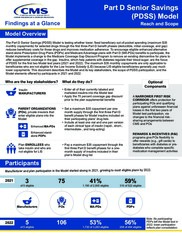
The Part D
Senior Savings (PDSS) Model is testing whether lower, fixed beneficiary
out-of-pocket spending (maximum $35 monthly copayments) for selected
drugs through the first three Part D benefit phases (deductible,
initial coverage, and gap) reduces beneficiary costs for those drugs
and improves medication adherence. To encourage eligible enhanced
alternative stand-alone Prescription Drug Plans (PDPs) and Medicare
Advantage plans with Part D (MA-PDs) benefits to participate, the Model
implements a change to the Medicare Coverage Gap Discount Program to
remove an existing disincentive for plans to offer supplemental
coverage in the gap. Insulins, which help patients with diabetes
regulate their blood sugar, are the focus of PDSS for the first two
Model test years (2021 and 2022). The maximum $35 monthly copayments
are only applicable to beneficiaries who are not eligible for the Low
Income Subsidy (LIS) because LIS-eligible beneficiaries generally pay
much lower copayments. This Evaluation report describes the Model and
its key stakeholders, the scope of PDSS participation, and the Model
elements offered by participants in 2021 and 2022.
By 2022,
all United States insulin manufacturers and most eligible plans
participated in the Model. Participating MA-PDs had higher average
enrollment than eligible nonparticipants, while average enrollment for
participating and nonparticipating PDPs was similar. Enrollees who
filled at least one Model insulin in early 2021 were largely similar
across participating and nonparticipating plans, but insulin-using
enrollees of participating MA-PDs were more likely to be White,
compared with eligible nonparticipants. Most participating plans
charged enrollees the maximum $35 copayment for insulins. A substantial
proportion of plans adopted the narrower first risk corridor component,
but very few opted for the R&I program.
|
 The Two
Page Overview: The Two
Page Overview:
The
Report (includes an Executive Summary):
Additional
Supporting Materials:
|
Evaluation of Phase II of
the Medicare Advantage Value-Based Insurance Design Model (2020-2021)
Phase II
(2020-2021) Evaluation Report - Key Takeaways:
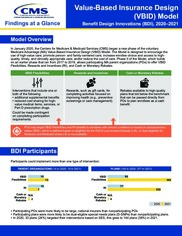
In January
2020, the Centers for Medicare & Medicaid Services (CMS) began a
new phase of the voluntary Medicare Advantage (MA) Value-Based
Insurance Design (VBID) Model. The Model is designed to encourage the
use of high-value care; promote person and family-centered care;
increase enrollee choice and access to high quality, timely, and
clinically appropriate care; and/or reduce the cost of care. Phase II
of the Model, which builds on an earlier phase that ran from 2017 to
2019, allows participating MA parent organizations (POs) to offer VBID
Flexibilities, Rewards and Incentives (RI), and Cash or Monetary
Rebates. The evaluation report found that PO and plan participation in
the Model grew substantially between 2020 and 2021. In plans with
participation requirements, 10–12% of targeted enrollees took action to
receive VBID benefits. BDI implementation was associated with
reductions in plan bids but increases in premiums. The estimates for
BDI effects in 2020 and 2021 are preliminary.
|
The Two
Page Overview:
The
Report (includes an Executive Summary):
Additional
Supporting Materials:
|
|
|
|




No comments:
Post a Comment