Fact Sheet
FOR IMMEDIATE RELEASE
April 13, 2018
Contact: CMS Media Relations
(202) 690-6145 | CMS
Media Inquiries
Market Saturation and Utilization Data Tool
The Centers for Medicare & Medicaid Services (CMS) has developed a
Market Saturation and Utilization Data Tool that includes interactive maps
and a dataset that shows national-, state-, and county-level provider
services and utilization data for selected health service areas. Market
saturation, in the present context, refers to the density of providers of a
particular service within a defined geographic area relative to the number
of the beneficiaries receiving that service in the area.
The seventh release of the data tool includes a quarterly update of the
data to the fourteen health services areas from release 6, and also includes
Federally Qualified Health Centers and Ophthalmology data. Release 7 will therefore include seven, twelve-month
reference periods and the following health service areas: Home Health,
Ambulance (Emergency, Non-Emergency, Emergency & Non-Emergency), Independent
Diagnostic Testing Facilities (Part A and Part B), Skilled Nursing
Facilities, Hospice, Physical and Occupational Therapy, Clinical Laboratory
(Billing Independently), Long-Term Care Hospitals, Chiropractic Services,
Cardiac Rehabilitation Programs, Psychotherapy, Federally Qualified Health
Centers, and Ophthalmology. Also new to Release 7 is a trend analysis
graphing tool that allows users to graph the percentage change and trend
over time at the national level for the available metrics and health
services areas.
The Market Saturation and Utilization Data Tool is one of many tools
used by CMS to monitor and manage market saturation as a means to help
prevent potential fraud, waste, and abuse. The data can also be used to
reveal the degree to which use of a service is related to the number of
providers servicing a geographic region. Provider services and utilization
data by geographic regions are easily compared using an interactive map.
There are a number of secondary research uses for these data, but one
objective of making these data public is to assist health care providers in
making informed decisions about their service locations and the beneficiary
population they serve. The tool is available through the CMS website
at: https://data.cms.gov/market-saturation.
Future releases may include comparable information on additional health
service areas.
Methodology
The
analysis is based on paid Medicare Fee-for-Service (FFS) claims data from
the CMS Integrated Data Repository (IDR). The IDR contains Medicare FFS
claims, beneficiary data, provider data, and plan data. FFS claims data are
analyzed for a 12-month reference period, and results are updated quarterly
to reflect a more recent 12-month reference period.
The
Market Saturation and Utilization methodology is different from other
public use data with respect to determining the geographic location of a
provider. In this analysis, claims are used to define the geographic
area(s) served by a provider rather than the provider’s practice address.
Further, a provider is defined as “serving a county” if, during the
12-month reference period, the provider had paid claims for more than ten
beneficiaries located in a county. A provider is defined as “serving a
state” if that provider serves any county in the state.
The
Market Saturation and Utilization methodology is also different from other
public use data with respect to determining the number of Medicare
beneficiaries who are enrolled in a fee-for-service (FFS) program. In this
analysis, a FFS beneficiary is defined as being enrolled in Part A and/or
Part B with a coverage type code equal to “9” (FFS coverage) for at least
one month of the 12-month reference period. There must not be a death date
for that month or a missing zip code for the beneficiary so that the
beneficiary can be assigned to a county. Other public use data may define a
FFS beneficiary using different criteria, such as requiring the beneficiary
to be enrolled in the FFS program every month during the reference period.
Starting
with Release 7 (April 2018), the interactive data set for all reference
periods includes state- and county-level data for the following United
States territories, commonwealths, and freely associated states: American
Samoa (AS); Micronesia (FM); Guam (GU); Northern Mariana Islands (MP);
Puerto Rico (PR); and the U.S. Virgin Islands (VI). The national-level data
in the interactive data set for all previous reference periods reflects the
U.S. plus the aforementioned territories.
The
Market Saturation and Utilization Tool does not include information on
market saturation and utilization for Medicaid or private insurance.
However, the Medicare information included in the Tool may be a useful
proxy for researchers or providers in these markets.
The
Market Saturation and Utilization Data Tool includes an interactive map
that is color-coded based on an analysis that separates the distribution
into the following categories of states/counties for the selected metric:
lowest 25 percent, second lowest 25 percent, third lowest 25 percent, top
25 percent excluding extreme values, and extreme values. An extreme
value is one that greatly differs from other values in its field (e.g.,
Number of Providers). Counties that are excluded from the analysis are colored
gray in the interactive map.
For
those interested in states and counties affected by CMS’ temporary provider
enrollment moratoria during the reference periods for which data are
available, the interactive map permits a visualization that identifies those
states and counties. In this visualization, Ambulance and Home Health
service areas for moratoria versus non-moratoria states/counties are
identified based on color scheme.
The
examples below utilize the Ambulance (Emergency & Non-Emergency)
service area data (selected for illustration purposes only). Similar maps
can be created through the Data Tool for all of the health service areas
included in the seventh release and for the seven, twelve-month reference
periods: 2014-10-01 to 2015-09-30, 2015-01-01 to 2015-12-31, 2015-04-01 to
2016-03-31, 2015-07-01 to 2016-06-30, 2015-10-01 to 2016-09-30, 2016-01-01
to 2016-12-31, and 2016-04-01 to 2017-03-31.
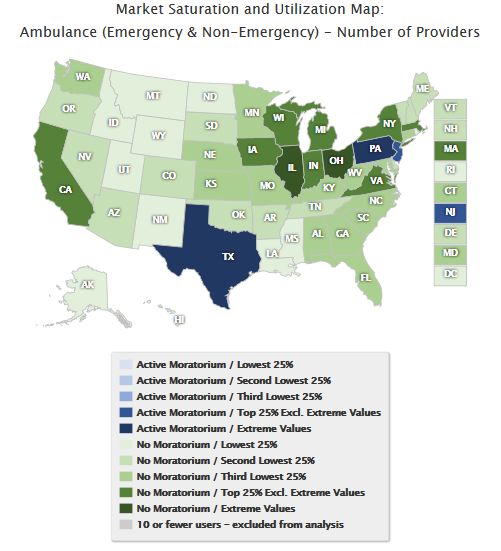
Map 1 displays the distribution of
providers by state for the October 1, 2014 through September 30, 2015 reference
period. The dual color scale distinguishes between moratoria (blue) and
non-moratoria states (green).
Map 1. Ambulance
(Emergency & Non-Emergency):
National Distribution of Number of Providers
October 1, 2014 – September 30, 2015
Color by Moratoria Status
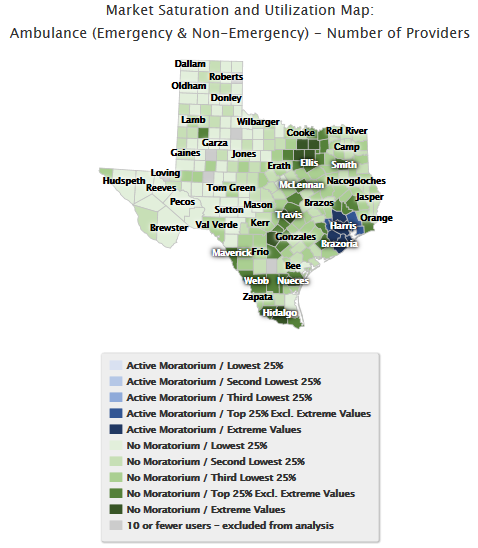
Map 2 drills down to the county level and displays the distribution of
providers by county within the State of Texas for the October 1, 2014
through September 30, 2015 reference period. The dual color scale
distinguishes between moratoria (blue) and non-moratoria counties (green).
Map 2. Ambulance
(Emergency & Non-Emergency):
County Distribution of Number of Providers
October 1, 2014 – September 30, 2015
Color by Moratoria Status
Similar maps can be created at the national- and state-level for the
other metrics included in the Data Tool: Number of FFS Beneficiaries,
Average Number of Users per Provider, Percentage of Users out of FFS
Beneficiaries, Number of Users, Average Number of Providers per County and
Total Payments.
###
|


No comments:
Post a Comment