Christopher
Holt
March 30, 2018
Today, almost 70 million Americans receive their
health care through Medicaid. There are myriad implications of this fact, and
ample room for debate about the appropriate role and size of the social safety
net in American society. But one implication, as The Wall Street
Journal noted this week, is that state budgets
are increasingly squeezed by Medicaid costs.
As ever more Americans
are covered by Medicaid—which is jointly funded by the federal and state
governments—and health care costs continue to rise, states are struggling to
make ends meet. According to the WSJ, one-fifth of state and local tax revenue
is used to finance Medicaid and pension obligations, which is the highest share
in over 60 years. States don’t have the option of operating with long-term
deficits, as the federal government can. Yet 22 states faced budget deficits
last year, thanks in part to growing Medicaid costs—despite the fact that the
federal government now covers 63 percent of the program’s expenses. In
1966, the program’s first year, expenditures were $900 million. In 2017, total Medicaid
expenditures were more than $565 billion.
In this context,
congressional attempts to reform Medicaid last year amid the larger Affordable
Care Act repeal/replace effort seem quite reasonable. However, a strong case
can me made that attempts to reform Medicaid were one of the most significant
obstacles to passing either the American Health Care Act or the Better Care
Reconciliation Act.
The politics surrounding
Medicaid reform are difficult, no question—nobody wants to throw poor people
off of their insurance. But the long-term budgetary challenges presented by
sticking our collective heads in the sand are worse than the political
challenges. Both the House and the Senate made serious efforts at Medicaid
reform last year—detailed by AAF’s Tara O’Neill Hayes here and here. And while those reforms shipwrecked on
the shoals of political expediency, Congress can’t walk away from this debate.
Medicaid needs reforming; eventually fiscal reality will leave us no choice.
Chart Review
Jonathan Keisling, Health Care Policy Analyst
Jonathan Keisling, Health Care Policy Analyst
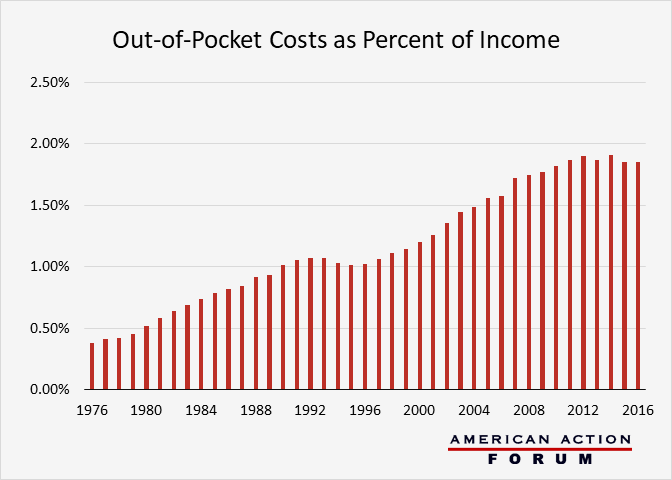
This chart shows how per
capita out-of-pocket spending on personal health care has
increased over time, relative to median household income. By this metric, out-of-pocket spending
has more than quadrupled since 1976; these data, however, are merely one piece
of much larger narrative on how health care spending has changed over time.
Read
more: https://www.americanactionforum.org/weekly-checkup/need-medicaid-reform-isnt-going-away/#ixzz5BjN1EDrM
Follow us: @AAF on Twitter
Follow us: @AAF on Twitter

No comments:
Post a Comment