|
Key insights from
Four Thousand Weeks: Time Management for
Mortals
By
Oliver Burkeman
|
|
|
What you’ll learn
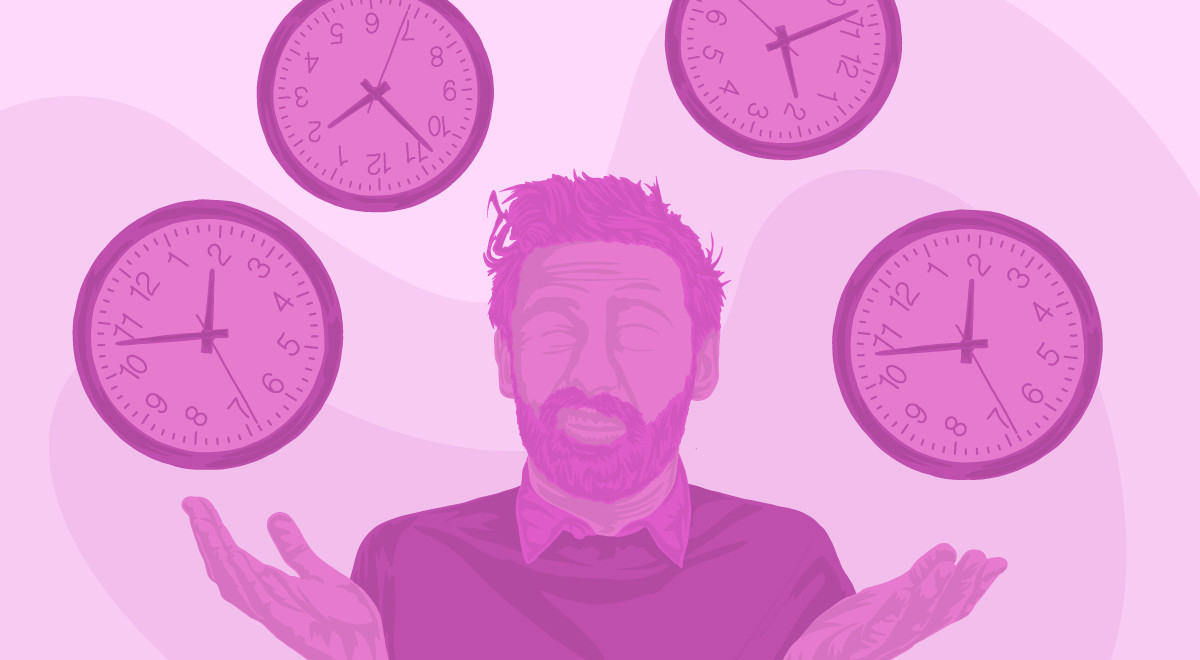
For the writer Oliver Burkeman, our orientation toward time
is flawed. Despite the fact that most people live for only 4,000 weeks,
many people regiment their hours, strategize their days, and predict and
direct the course of their lives with little thought for their true end.
Though it seems that this effortful planning is necessary, it actually
catches people in a losing battle. Burkeman exposes this myth in his work Four
Thousand Weeks—a provocative, surprisingly uplifting meditation on the
nature of time and humanity, and how the two might learn to get along.
Read on for key insights from Four Thousand Weeks.
|
|
1. The concept of
time has undergone various changes—from the clockless Middle Ages to our
clock-oriented modernity.
As German philosopher Friedrich Nietzsche wrote over a
century ago, “One thinks with a watch in one’s hand.” To modern people, the
presence of the clock often feels inescapable. According to historians,
though, time wasn’t always in charge. In medieval life, for instance,
people completed their daily chores according to a method called “task
orientation,” tending to their animals and land peacefully and taking all
the time they needed to do so. Interestingly, in place of today’s typical
method of dividing time into minutes or hours, medieval people often
compared the time a task took to the amount of time required to read a
specific excerpt from the Bible. Much of medieval life may have been
physically grueling, but the frantic hustle of our contemporary situation
simply didn’t exist. It was an age of bare, simple existence, without a
checklist or an agenda in sight.
This way of life couldn’t last forever, though. According to
historians, when it came to running medieval monasteries, monks needed
something tangible to help them coordinate their daily schedules. As a
result, they contrived an early version of the clock to guide their hours.
This development and the various changes that came after, such as the
evolution of the working day during the Industrial Revolution, were hugely
influential. As Burkeman writes, such changes helped fuel the contemporary
notion of time as a “resource,” rather than a simple component of one’s
experience that used to be as natural and unregimented as a tree or the
wind. From here, people started to look at time anew—it became a tool that
helped them get things done and a way to measure their value as human
beings.
Unfortunately, the negative consequences of this innovation
are clear throughout modern life. It’s nearly impossible now for people to
simply enjoy the events of a day without growing anxious about what’s next
or stewing over the past. Driven by the desire to stuff every second with
something “important,” they see every moment as nothing more than a vessel
to get something else done. When they fail to reach the goals they heap on
themselves every morning, they inevitably feel worried, worthless, and
sometimes, less human, too.
The clock is like a double-edged sword. With a close
awareness of time, people are able to tackle their many tasks, ensuring
they aren’t late to sign their kids out of camp or submit an assignment for
work. But, when they trip up, they’re crushed. After all, being the last
parent in carline, finishing an important project a week late, or simply
not living up to everything you set out to accomplish is never a great
feeling. And yet, so many of us experience mental setbacks like these every
single day—just like clockwork.
|
|
|
Sponsored
by Curiosity Stream
Want To Stream
Documentaries Anywhere?

Curiosity Stream
has thousands of documentaries that will keep you entertained for hours.
Curiosity Stream has educational, captivating content available wherever
and whenever. Get a full year’s subscription for just $14.99 when you use
code THINKR.
Start Streaming Now
|
|
2. Don’t let the
“efficiency trap” fool you: Your tasks have no end.
Many people don’t realize that the habits that often seem so
helpful in organizing their days can be pretty harmful, too. Segmenting the
day into carefully organized time intervals or getting a head start on
assignments at school or work are perfectly fine strategies in themselves.
But, when people place too much faith in these plans, they invite
inevitable disappointment. Failing to check off all (or any) of those items
on your agenda is a deeply troubling experience and a reminder of your
finite nature, or “finitude.” It’s also unavoidable. Despite this, many
people think if they finish just one more task, finally clean out that
closet, or at last visit that country they’ve been dying to see, they won’t
feel behind anymore. Sadly, this isn’t true. Burkeman calls this the
“efficiency trap,” a cycle in which people think their list of
responsibilities will vanish if they just keep chipping away. As they
quickly discover, though, crossing one item off only makes way for yet
another.
This trend might seem backwards, but it pervades every part
of life. In 1955, C. Northcote Parkinson even put a name on it, dubbing it
“Parkinson’s Law.” Take, for instance, a day on which you only have a
handful of things to do—get groceries for the week, send a few emails, and
perhaps even clean the kitchen. You may, in fact, do all of these things,
but you probably won’t find yourself restfully lounging on your couch when
it’s all said and done. After all, there’s also the pantry you should
probably empty out and that restaurant you really should try some day.
Similarly, it doesn’t matter how much or how little people may have on
their plates, they inevitably experience what Burkeman calls “existential
overwhelm.” This kind of time-induced anxiety extends into all parts of
life as people bound from one assignment to the next, one concert to
another, and one short-lived hobby to yet one more trending fad. In other
words, the “fear of missing out,” (which you may know as “FOMO”)
infiltrates everything.
Though this feeling is inescapable, it can be managed with
counterintuitive thinking. Contrary to what libraries full of “time
management” guides teach their desperate readers, people don’t have to
fulfill every expectation they devise for themselves. Rather, by realizing
at the start that they’re going to be unsuccessful, they can begin to free
themselves from the worry of not finishing and avoid the “efficiency
trap.”
As people develop a more realistic perspective, they become
much better at discerning which obligations deserve the best of their
dwindling time. For instance, it can be tempting to start the day by taking
on smaller, more insignificant tasks first. After all, those obligations
are the easiest to cross off and help people feel like they at least did
something worthwhile. When people see their responsibilities are endless,
though, they can refrain from, as Burkeman puts it, “clearing the decks.”
Instead, they can shoot to take on their most crucial and challenging
obligations. In this way, Burkeman’s revelation isn’t unsettling but
illuminating, and may even help people truly enjoy their lives.
|
|
3. Thinking about
finitude is never fun, but it adds greater depth, understanding, and
clarity to your life.
Deep down, most people know the plans they devise for
themselves are way too ambitious. And yet, they continue to work toward
those goals anyway, tricked by the “efficiency trap” and the misguided
belief that their efforts will eventually prove worthwhile. Burkeman’s work
asks and answers the obvious question: Why do people persist in their
efforts even when they know they’re headed nowhere? Drawing on the
difficult writings of German philosopher Martin Heidegger and others,
Burkeman argues that modern people’s furious planning, organizing, and
fretting exists to ignore their ultimate finitude. Their lives might feel
hectic as they race after countless goals, visions, and desires, but the
frenzy silences their fear. It allows them to feel like they have more
control than they really do. After all, in the midst of such chaos, there’s
no time to ponder who they truly are as human beings.
That’s why it’s so challenging to quit pursuing every new
activity or opportunity. Choosing to instead devote one’s time to fewer but
more personally significant endeavors requires that one “decide” on a
particular way of life. Interestingly, this word is drawn from the Latin “decidere,”
which allows for the translation, “to cut off,” emphasizing the crucial
nature of the act. When people choose to seek one activity or way of life
over another—for instance, paying more attention to family rather than a
career—they inevitably acknowledge their “finitude” and their capacity as
human beings. This is frightening. But, according to the philosopher Martin
Hägglund, this is also a wonderful position to be in—scarcity of time
compels people to make choices, and these ultimately fill their lives with
meaning.
Recognizing the delicate nature of human life can be an
incredibly powerful experience. It even provokes what the Franciscan priest
Richard Rohr calls “bright sadness.” Tragedies such as failing health or
other massive life upheavals are always painful, but they compel people to
confront their experiences in new ways. For instance, after experiencing
the loss of a close and beloved friend, the environmentalist Geoff Lye
found much of his behavior changed. Petty situations that typically
bothered him before were of little consequence. Understanding how quickly
his friend David Watson passed from him, he viewed the events of his own
life with more care and less control, often asking himself, “What would
David have given to be caught in this traffic jam?”
Extending the same kind of thinking to schedules, planning,
and one’s daily habits is the most enriching way to see past the unhelpful
feelings that come with falling short. With that in mind, people can decide
which activities or tasks they wish to pursue and learn to relish every bit
of life, no matter how fleeting it is.
|
|
|
|
4. Make sure your
free time is really free; only then will it be most refreshing.
This might come as a surprise, but men and women receive a
respective five and four hours of free time every day. Oddly, for most
people, it doesn’t seem like they have any downtime at all. The reason for
this can be traced back to the Industrial Revolution, wherein the concept
of “leisure” underwent a massive transformation.
The ancient Greeks and medieval Englanders who came before
prized their personal time even more dearly than their work. The Greek
philosopher Aristotle revered leisure (in the form of thinking) as the
greatest possible human pursuit, while the medievals held frequent
festivities, worked far less than we do now, and took long breaks
throughout their days.Those who lived during the Industrial Revolution, on
the other hand, experienced a different reality. With new hourly work
schedules, people watched the importance of their working day and their
downtime reverse—a factory worker’s time off on the weekends helped him or
her contribute more efficiently during the week. The time was no longer for
the factory worker’s own joy, amusement, or wellbeing, but for the success
of the factory. This perspective diverges from centuries of thinking that
came before and grounds the way contemporary culture perceives downtime
today.
Overachievers and workaholics are probably familiar with an
experience known in social psychology as “idleness aversion.” People who
struggle with this are unable to lay aside their plans to take a moment to
stop, breathe, or simply enjoy a funny movie. Their work dominates their
minds and dictates their actions. Though this experience varies in
extremity, it’s increasingly common in contemporary culture. Take the
writer Danielle Steel, for instance, who often writes for 20 hours a day.
This schedule has helped her finish 179 books and counting. In an article
featured in Glamour, Steel acknowledged that her strenuous
schedule is simply a coping mechanism to comfort her amid the difficulties
of her life. The particular reasons people refuse rest may be wide-ranging,
but they’re motivated by the same mentality and are similarly damaging.
To counteract this mindset, Burkeman encourages people to
add what the philosopher and writer Kieran Setiya terms “atelic activity”
into their days. For these activities, pointlessness is the point. Whether
it’s through painting landscapes of the ocean, watching a beloved film, or
like the music icon Rod Stewart does, creating miniature versions of trains
and cities, fruitless leisure is rewarding in its own right. Contrary to
the way leisure was perceived during the Industrial Revolution and how it’s
often looked at today, these activities don’t exist to contribute to
something else. Rather, when people find something they love doing, no
matter what that is or how poorly they perform at it, the activity ignites
joy within them. And with that, they have more than they need to go on.
|
|
5. If you captain
your time too closely, your quality of life will sink.
Many time management manuals fail to include a key
ingredient in their recipes for efficiency: people. Though planners are
often encouraged to be as self-sufficient as possible—creating their
schedules according to their own agendas and desires—forgetting to take
people into account is never beneficial. In fact, planners who do this
might organize their time successfully, but they inevitably miss out on one
of the most rewarding parts of life itself: friendship and the company of
others. Similarly, the path of what Burkeman calls the “digital nomad”
seems idyllic, taking work abroad and experiencing new cultures daily, but
this way of life isn’t all that it seems. After all, a lifetime of
constantly relocating is solitary. These nomads may call the shots when it
comes to what they do, when they work, and where they go, but their
seemingly self-sufficient schedules don’t leave room for other people or
the happiness that comes with simply being in their presence.
Research out of Sweden extends this truth even further,
providing evidence for the claim that people don’t want as much agency over
their time as they think. According to the 2013 study by Terry Hartig, a
professor of environmental psychology at Uppsala University, people desire
“the social regulation of time” often found within communal events they’re
expected to take part in. By studying when people in Sweden went on
vacation and how often they required antidepressants, Hartig discovered
that antidepressant usage was lowest when more people were vacationing. Not
only do people enjoy being with other people, but according to this study,
they also like to know that others are enjoying themselves, too. Interestingly,
Hartig and other researchers discovered the trend persisted even among
those who were retired or unemployed. Communal activities, whether the
Sabbath of Jewish and Christian traditions or the “grandes vacances”
of France, are essential. Taking a break with other people and making room
for them even in the most pressed-for-time schedule is as crucial as
clearing time for leisure.
Whether it’s allowing your agenda to go unfinished,
intentionally incorporating rest time into your day, or leaving a bit of
space open for loved ones and strangers to fill your life, the underlying
“time management” move Burkeman encourages you to adopt is simple: Throw
your worry out the window. Even when your day defies your hopes (and your
seemingly perfect schedule), and life itself seems to pale in comparison to
what you envisioned, don’t fret that something’s gone wrong. Relish your
time-bound days. They may often seem demanding, elusive, or altogether
frustrating, but they create the reality in which you live.
|
|
Endnotes
These insights are
just an introduction. If you're ready to dive deeper, pick up a copy of Four
Thousand Weeks here. And since we get a commission on
every sale, your purchase will help keep this newsletter free.
*
This is sponsored content
|
|
|
This newsletter is powered by Thinkr, a smart reading app for the
busy-but-curious. For full access to hundreds of titles — including audio —
go premium and download the app today.

|
|


No comments:
Post a Comment