By encouraging people
with low back pain to access physical therapy or chiropractic care, the benefit
design is expected to reduce the number of imaging tests, spinal surgeries and
opioid prescriptions
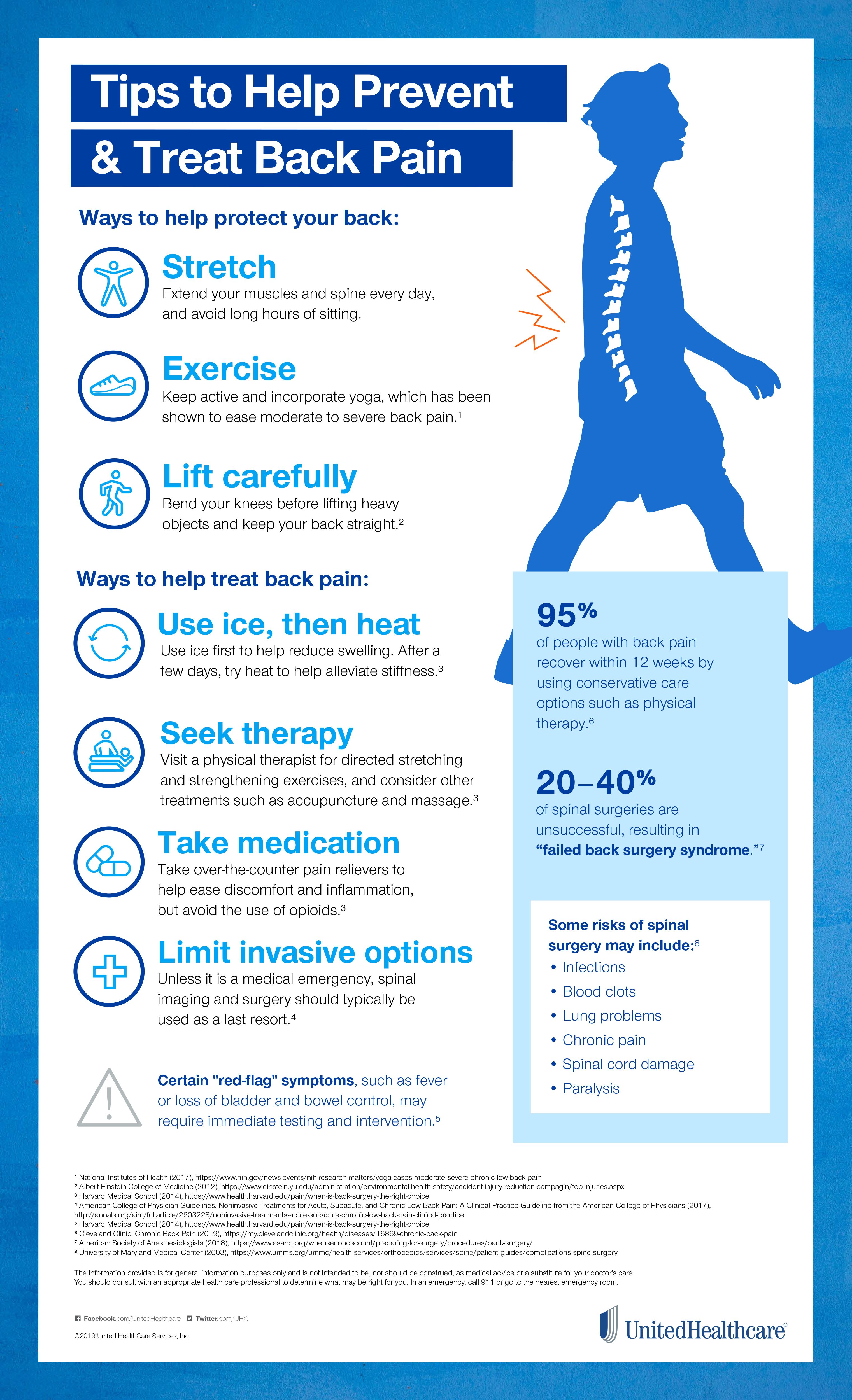
Nearly
70% of people will experience low back pain at least once during their
lifetime, so considering these tips may help prevent and treat this common
condition. (Graphic: Business Wire)
October
29, 2019 09:00 AM Eastern Daylight Time
MINNETONKA,
Minn.--(BUSINESS WIRE)--UnitedHealthcare
has introduced a new benefit for people with acute low back pain that makes it
more affordable to access physical therapy and chiropractic care, helping to
improve health outcomes, reduce costs and avoid often unnecessary invasive treatments
and opioid prescriptions.
“This new benefit design
may help encourage people with low back pain to get the right care at the right
time and in the right setting, helping expand access to evidence-based and more
affordable treatments”
With
this new benefit design, plan participants enrolled in certain
employer-sponsored health plans can pay $0 out of pocket (waived deductible or
copay) if they select physical therapy or chiropractic care for the treatment
of low back pain, helping encourage people to choose these noninvasive
options.*
Based
on a UnitedHealthcare analysis, by 2021 this benefit design has the potential
to reduce the number of spinal imaging tests by 22%, spinal surgeries by 21%,
opioid use by 19%, and lower the total cost of care for eligible plan
participants and employers.1
“This
new benefit design may help encourage people with low back pain to get the
right care at the right time and in the right setting, helping expand access to
evidence-based and more affordable treatments,” said Anne Docimo, M.D.,
UnitedHealthcare chief medical officer. “With millions of Americans
experiencing low back pain currently or at some point during their lifetimes,
we believe this benefit design will help make a meaningful difference by
improving health outcomes while reducing costs.”
The
benefit covers, at no additional out-of-pocket cost, three physical therapy or
chiropractic visits, along with additional visits normally covered under the
plan, to a qualified care provider. This design helps make it more affordable
for people with low back pain to obtain treatment from the over 75,000
chiropractors and physical therapists participating in UnitedHealthcare’s
national care provider network.
The
benefit design was informed by a recent study by OptumLabs and the Boston University
School of Public Health that showed higher out-of-pocket costs made it less
likely for patients with low back pain to choose clinically recommended
noninvasive treatments, such as physical therapy and chiropractic care. For
example, people with a copay of more than $30 were 29% less likely to see a
physical therapist than patients whose copay was $0. There was a similar
correlation between deductible and choice of physical therapy to treat low back
pain, according to the study in The American Journal of Managed Care.
Nearly
70% of people experience low back pain at least once in their lifetime, and
about one-quarter of adults in the United States report experiencing the
condition in the past three months.2 3 Despite
clinical recommendations against it, opioids are prescribed for nearly 9% of
new low back pain cases, with this condition ranking as the most common reason
for an opioid prescription.4
To
treat low back pain, the American College of Physicians (ACP) recommends
exercise and the use of non-pharmacologic and nonsurgical approaches including
physical therapy, chiropractic care, acupuncture and nonsteroidal
anti-inflammatory drugs.5 These noninvasive treatment options
help 95% of people with low back pain recover after 12 weeks.6 Muscle
relaxants and imaging, such as an X-ray or MRI, should be secondary options,
and spinal surgery should be a last resort. Opioids should be avoided.5 However,
certain "red-flag" symptoms, such as fever or loss of bladder and
bowel control, may require immediate testing and intervention.7
This
new UnitedHealthcare benefit change is available now for some new and renewing
employers with fully insured plans and 51 or more employees in Connecticut,
Florida, Georgia, New York** and North Carolina. Starting Jan.1, 2020, the
benefit will be expanded to new and renewing employers with self-funded plans
and organizations with two to 50 employees in the following states: Alabama,
Arkansas, Florida, Georgia, Louisiana, Mississippi, North Carolina, South
Carolina, Tennessee and Virginia. Broader expansion is planned throughout 2020
and 2021.
Eligible
employers with fully insured plans that include coverage for physical therapy
and chiropractic visits have this benefit at no additional cost.
More
information about strategies that may help treat low back pain and this benefit
is available here.
* Eligible plan participants must have remaining physical
therapy or chiropractic visits under their plan; the new benefit design does
not increase the maximum number of covered physical therapy or chiropractic
visits per year.
** Benefit design available to employers with more than 101
employees.
About
UnitedHealthcare
UnitedHealthcare is dedicated to helping people live healthier lives and making the health system work better for everyone by simplifying the health care experience, meeting consumer health and wellness needs, and sustaining trusted relationships with care providers. In the United States, UnitedHealthcare offers the full spectrum of health benefit programs for individuals, employers, and Medicare and Medicaid beneficiaries, and contracts directly with more than 1.3 million physicians and care professionals, and 6,500 hospitals and other care facilities nationwide. The company also provides health benefits and delivers care to people through owned and operated health care facilities in South America. UnitedHealthcare is one of the businesses of UnitedHealth Group (NYSE: UNH), a diversified health care company. For more information, visit UnitedHealthcare at www.uhc.com or follow @UHC on Twitter.
UnitedHealthcare is dedicated to helping people live healthier lives and making the health system work better for everyone by simplifying the health care experience, meeting consumer health and wellness needs, and sustaining trusted relationships with care providers. In the United States, UnitedHealthcare offers the full spectrum of health benefit programs for individuals, employers, and Medicare and Medicaid beneficiaries, and contracts directly with more than 1.3 million physicians and care professionals, and 6,500 hospitals and other care facilities nationwide. The company also provides health benefits and delivers care to people through owned and operated health care facilities in South America. UnitedHealthcare is one of the businesses of UnitedHealth Group (NYSE: UNH), a diversified health care company. For more information, visit UnitedHealthcare at www.uhc.com or follow @UHC on Twitter.
1 UnitedHealthcare
modeling, 2019.
2 Kassebaum NJ, Arora M, Barber RM, et al. Global, regional,
and national disability-adjusted life-years (DALYs) for 315 diseases and
injuries and healthy life expectancy (HALE), 1990–2015: a systematic analysis
for the Global Burden of Disease Study 2015. Lancet 2015;388:1603–1658.
3 Hoy D, March L, Brooks P, et al. The global burden of low
back pain: estimates from the Global Burden of Disease 2010 study. Ann Rheum
Dis. 2014; 73(6):968-74.
4 OptumLabs. 2018 Opioid KPI Metrics.
5 American College of Physician Guidelines. Noninvasive
Treatments for Acute, Subacute, and Chronic Low Back Pain: A Clinical Practice
Guideline from the American College of Physicians. http://annals.org/aim/fullarticle/2603228/noninvasive-treatments-acute-subacute-chronic-low-back-pain-clinical-practice.
April 4, 2017.
6 Cleveland Clinic. Chronic Back Pain. https://my.clevelandclinic.org/health/diseases/16869-chronic-back-pain.
Accessed July 2019.
7 Harvard Medical School, https://www.health.harvard.edu/pain/when-is-back-surgery-the-right-choice.add,
2014
Contacts
Will
Shanley
UnitedHealthcare
(714) 204-8005
will.shanley@uhc.com
https://www.businesswire.com/news/home/20191029005055/en/New-UnitedHealthcare-Benefit-Pain-Helps-Reduce-Invasive
UnitedHealthcare
(714) 204-8005
will.shanley@uhc.com

No comments:
Post a Comment