Christopher Holt May 11, 2018
Once again rising health
insurance premiums are in the news. Plan sponsors are beginning to submit their
rate requests for the 2019 Affordable Care Act (ACA) Marketplace, and
double-digit increases are once again the defining attribute of the requests. In
Maryland, the two insurers with a combined four plans in the state’s ACA
marketplace are requesting an average increase of 30 percent over 2018
premiums. In Virginia, the rate requests we’ve seen so far are all over the
map. Some plans are proposing to lower their rates slightly, but most are
seeking steep increases of between 15 and 66 percent. It’s quickly
becoming apparent that 2019 will bring more of the same when it comes to
rapidly rising health care costs in the ACA’s marketplaces.
Many factors drive
premium calculations, and Congress can only effect some of those directly.
Ironically, however, there is one policy action Congress could take immediately
to provide premium relief in 2019. Unfortunately, as I’ve written about previously, neither Republicans
nor Democrats seem willing to push to fund cost-sharing reduction (CSR)
payments to insurers at this point. Still, in light of the recent news on
premium trend lines, perhaps it’s worth noting a new analysis from the Center
for Health and Economy (H&E) on the effects of CSR payments
paired with a reinsurance program.
H&E finds that
resuming CSR payments in 2019, paired with a federal reinsurance program to
cover the costs of the most expensive plan beneficiaries, would reduce
insurance premiums in the individual market. Silver plans, which have born the
brunt of the recent increases, would see reductions of between 15 to 16 percent
relative to the H&E baseline projection for 2019. Over the 10-year window
H&E finds these policies could lead to roughly a million more insured individuals
than under current law. Most impressively, the two policies combined would
result in a net deficit reduction of $17 billion over 10
years. In other words, Congress could easily provide premium relief, increase
the number of insured Americans, and reduce the federal deficit starting as
soon as next year.
Chart Review
If the proposed
health insurance premiums seen to date are approved for the 2019 plan year,
they would build on the substantial premium increases from previous years in
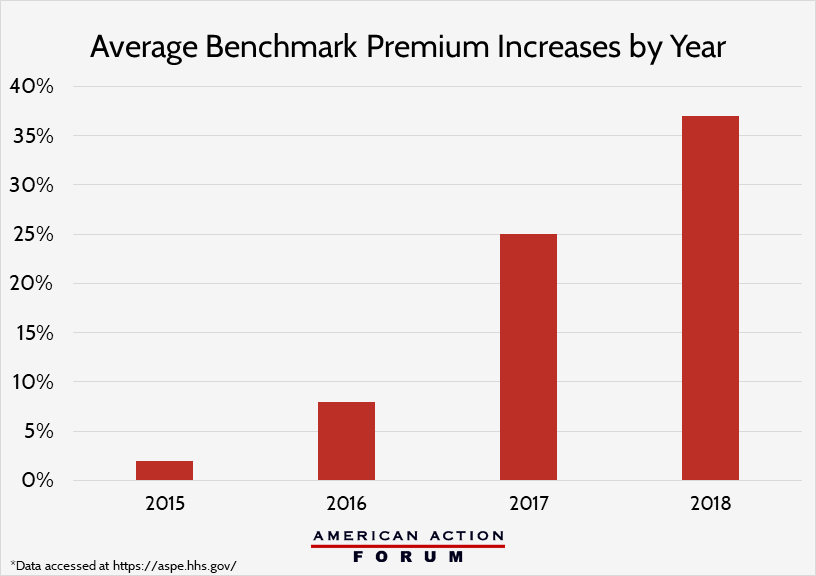
the Affordable Care Act exchanges. The chart below shows the average increase
in benchmark premiums for each year of the ACA exchanges.

No comments:
Post a Comment