 |
Just Released
|
|
|
Nearly 8 in 10 Immigrants Who Entered the
U.S. Without Legal Permanent Resident Status Have At Least One Characteristic
That Could Count Against Them under the New “Public Charge” Rule
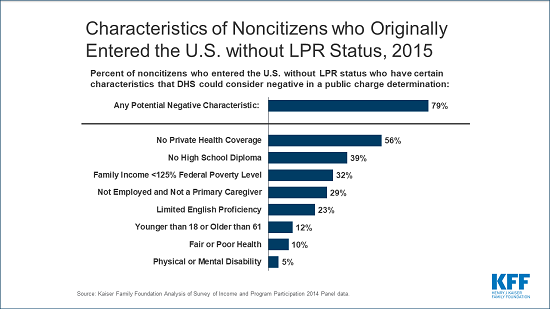
Seventy-nine
percent of noncitizen residents who originally entered the United States
without legal permanent resident status have at least one characteristic that
could count against them under the Trump Administration’s new “public charge”
rule, according to an updated KFF analysis.
Such
characteristics – including having an income below 125 percent of the federal
poverty level or lacking a high school diploma or private health insurance --
could make it harder for immigrants to obtain admission into the U.S. or get
a green card under the administration’s final rule to change “public charge”
inadmissibility policies scheduled to take effect on October 15. Under the
changes, federal officials will deny entry or green cards to people who they
determine are likely to rely on public programs such as Medicaid and certain
housing and nutrition programs that were previously excluded from this
“public charge” test. Many noncitizen residents have characteristics that
would be considered positive under the rule as well, though immigration officials
would have substantial discretion in assessing factors and applying the rule.
The
new rule also will likely lead to decreased enrollment in Medicaid and other
public programs among immigrant families beyond those directly affected by
the rule due to fear and confusion about the changes. An estimated 13.5
million Medicaid or CHIP enrollees are citizens or noncitizens living in a
household with a noncitizen. If the rule were to lead to disenrollment rates
ranging from 15 percent to 35 percent among these enrollees – based on prior
experience with welfare reform -- then between 2 million and 4.7 million
individuals could drop out of such programs, the analysis finds. Decreased
participation in Medicaid would increase the uninsured rate among immigrant
families and could decrease revenues and increase uncompensated care for
providers.
Filling
the need for trusted information on national health issues, the Kaiser Family Foundation is
a nonprofit organization based in San Francisco, California.
|
||
|
|
||
|
Connect with us:
    |
||
Wednesday, September 18, 2019
Many Immigrants Could Be Affected By the New “Public Charge” Rule

Subscribe to:
Post Comments (Atom)
No comments:
Post a Comment