Tara O'Neill Hayes, Carly McNeil September
9, 2019
Executive Summary
- The U.S. maternal mortality rate has
significantly increased from 7.2 deaths per 100,000 live births in 1987 to
16.7 deaths per 100,000 live births in 2016, and the data indicate that
more than half of these deaths are preventable.
- Unnecessary cesarean sections, limited receipt
of proper prenatal and postnatal care, and racial or ethnic disparities
are likely contributing to soaring mortality rates.
- State maternal mortality review committees are
increasingly considered necessary for collecting standardized data on
pregnancy-related deaths and providing recommendations and strategies for
effective interventions targeting quality and performance improvements.
Introduction
Maternal mortality,
as defined by the World Health Organization (WHO), refers to “the death of a
woman while pregnant or within forty-two days of termination of pregnancy,
irrespective of the duration and site of the pregnancy, from any cause related
to or aggravated by the pregnancy or its management but not from accidental or
incidental causes.”[1] While the number of reported
pregnancy-related deaths in most of the world
has been declining, the maternal mortality rate (MMR) in the United States has
more than doubled since 1987, from 7.2 deaths per 100,000 live births that year
to a peak of 17.6 in 2014 and dropping slightly to 16.7
deaths per 100,000 live births in 2016, according to the Centers for
Disease Control and Prevention (CDC).[2] Other studies reported figures as high as
23.8 in 2014.[3] These numbers indicate that the United
States has one of the highest MMRs in the world.
A recent report from
the CDC indicates that 60
percent of these deaths could have been prevented had the mothers better
understood the importance of and been able to access more easily quality
prenatal and postpartum care.[4] Further, for every maternal death, there
are 84 women who suffer from a severe complication.[5] As a result, the United States is
increasingly one of the most unsafe countries for women giving birth.
This overview
highlights the most prominent drivers of maternal mortality in the United
States and then examines several policy responses to the issue.
Why is the Maternal
Mortality Rate Increasing in the United States?
The United States has
one of the highest maternal mortality rates, if not the highest, in the
developed world, although the data tracking these deaths are not
straightforward.[6] The CDC defines pregnancy-related deaths
to include deaths occurring within one year of the end of a
pregnancy—significantly longer than the 42-day WHO standard noted above.
Comparing the numbers under the CDC definition to the figures in other
countries understandably puts the United States above every other developed
country. Nevertheless, only 11.7 percent of pregnancy-related deaths in the United
States occur more than 42 days after birth, which would account for roughly 2
deaths per 100,000 births, meaning the United States would still have a higher
MMR than every other developed country, except Mexico and Latvia.[7]
Among 2,990
pregnancy-related deaths observed in a recent CDC study, 31 percent occurred
during pregnancy, 36 percent occurred on the day of delivery or within six days
post-delivery, and 33 percent occurred one week to a year postpartum.[8] As these numbers imply, a range of
reasons contribute to maternal mortality in the United States.
Complications Linked
to Surgical Deliveries
One
in three American mothers delivers her baby via cesarean section
(c-section), a 500 percent increase since the 1970s, compared with roughly one
in five women worldwide.[9] A c-section is a surgical procedure to
deliver a baby by creating incisions in the woman’s abdomen and uterus.[10] Providers may choose this option for
their patients if the baby is demonstrating signs of potential distress, the
labor is perceived to be at a stalemate, or if there are other health concerns.
One study by a doctor
at Harvard found, however, that the hospital where the woman is delivering her
baby is the key determinant of whether or not she will undergo a surgical
delivery.[11] This finding undermines the claim that a
woman’s health or the health of the baby are the primary predictors of
c-sections. A 2015 study in Health Affairs corroborates this claim,
finding that c-section rates in U.S. hospitals varied from 7 percent to 70
percent.[12] C-sections put women at risk for
infection, postpartum hemorrhaging, blood clots, and surgical injury, and for
that reason they are not recommended as the primary option over vaginal
delivery.[13] A recent study found that women who had
c-sections were 80 percent more likely to have complications than those who
delivered vaginally, and for women aged 35 and older the risk for severe
complications was nearly three times greater.[14] Improper postpartum care can exacerbate
complications following surgery, and many complications left untreated can lead
to death.
Chronic Conditions
The number of
pregnant women with chronic health conditions such as hypertension, diabetes,
and chronic heart disease is rising, and these conditions put them at higher
risk for complications during their pregnancy and postpartum. A recent
University of Michigan study found that there was a nearly 40 percent higher
prevalence of chronic conditions (specifically those conditions which pose a
particular risk for mothers and babies) among pregnant women in 2014 than in
the decade prior, with the greatest increases occurring among low-income women
and women living in rural areas.[15] Further, the United States seems to have
much higher rates of chronic conditions than people in other developed
countries: A recent study
found that 60 percent of adults in the United States have a chronic condition,
while the European
Chronic Disease Alliance notes that roughly one-third of European adults
have a chronic disease.
For the first time,
pre-existing conditions, rather than complications with delivery, have become
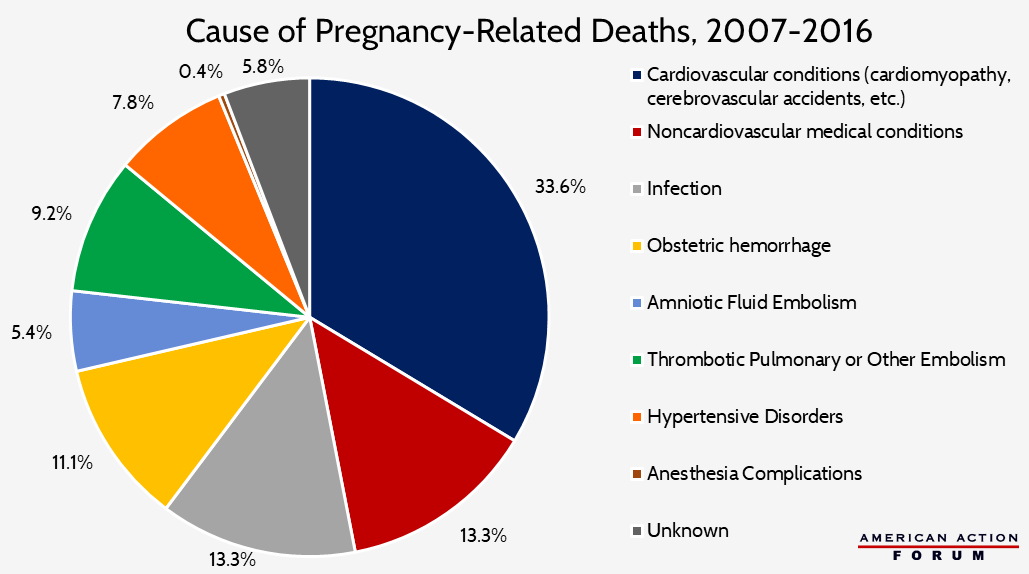
the leading cause of maternal morbidity and mortality.[16] Increases in cardiovascular conditions,
cerebrovascular accidents (i.e. strokes), and other medical conditions were
responsible for over one-third
of pregnancy-related deaths from 2011 to 2015, according to CDC data. Other
causes of death include hemorrhaging or amniotic fluid embolism, which were the
leading causes of death at delivery. High blood pressure issues (which could be
chronic or not), hemorrhaging, and infections were the most common causes of
death within six days post-delivery.[17]
Source: Centers for
Disease Control and Prevention. “Racial/Ethnic
Disparities in Pregnancy-Related Deaths—United States, 2007-2016.”
September 6, 2019.
Insurance Coverage
A woman’s insurance
status is also likely to impact her health and the care she receives before,
during, and after pregnancy, which affects her likelihood of having a healthy
pregnancy and delivery and of receiving necessary care after birth. Women receiving
no prenatal care are three to four times more likely to have a
pregnancy-related death than women who receive prenatal care.[18] Studies have shown that uninsured women
and women covered by Medicaid are much less likely to receive adequate prenatal
and postnatal care: According to the Medicaid and CHIP Payment Advisory
Commission (MACPAC), only 64.2 percent of women covered by Medicaid and 35.7
percent of uninsured women received adequate prenatal care, compared with 84.1
percent of privately insured women between 2012 and 2014.[19] This disparity results from both a
difficulty in finding Medicaid providers who will accept new patients and
low-income women being less likely to understand the importance of pre- and
post-natal care.
Over time, Medicaid
has covered a growing share of births in the country, covering more than 47
percent of all births in 2017.[20] This rise is partially due to changes to
Medicaid law in the 1980s that require state Medicaid programs to cover
pregnant women with income up to 133 percent of the federal poverty level
during their pregnancy and up to 60 days following the end of the pregnancy.[21] Further, while only 3 percent of women
were uninsured during pregnancy and delivery, 18.8 percent of women were
uninsured in the month prior to pregnancy—meaning they were likely not
addressing all of their medical needs before becoming pregnant—and 14 percent
of women became uninsured again following delivery, which is when most maternal
deaths occur.[22]
Insurance coverage
and reimbursement rates may also influence whether a woman has a c-section, and
perhaps unsurprisingly those with Medicaid or without any insurance at all are
less likely to have a c-section. Between 2012 and 2014, 28.4 percent of
pregnant women covered by Medicaid delivered via c-section; 14.4 percent of
uninsured pregnant women had c-sections. Based on an overall c-section rate of
33 percent, privately insured women must have a c-section rate of more than 37
percent. One study found that women with non-HMO commercial insurance coverage
were statistically more likely to have an elective c-section than women covered
by Medicaid, an HMO plan, or uninsured, although the rate was still just 0.9
percent in 2007 among women without any indication for pre-labor cesarean
delivery.[23] Reimbursement rates could drive this
trend: The average charge for a c-section without complications and newborn
care is $51,125 in 2013 before insurance, compared to $32,093 for an
uncomplicated vaginal delivery and newborn care also before insurance.[24]
Age of Pregnant Women
A woman’s age is
another strong indicator of a woman’s risk for complication and death resulting
from pregnancy, and age is also related to the other factors discussed above.
Most countries show a J-shaped pattern of maternal-mortality risk, with
adolescents having a greater risk of maternal mortality than women in their
twenties but women over 35 having the greatest risk.[25]
There are a multitude
of factors contributing to higher risks for younger women, including an
individual’s income, insurance status, and awareness regarding healthy
behaviors during pregnancy, which is likely the cause for the increased MMR
among adolescents. Women who were uninsured or covered by Medicaid when they
gave birth were much more likely, relative to privately insured women, to be
low-income, have less education, and be younger than 19.
The higher MMR for
older women is likely more related to biological factors. It is well-documented
that women over 30 have a greater risk of complications during pregnancy, and
women over 35 have the highest MMR.[26] The data have also consistently shown
that older women are also more likely to have c-sections, and in 2017, 40.2
percent of deliveries among women aged 35-39 occurred via c-section, while the
share for women aged 20-24 was 25.9 percent.[27]
The rising age of
mothers is likely contributing to rising MMR, as the risk of complications and
death associated with c-sections, as well as the prevalence of chronic
conditions, increases with a mother’s age. Between 2007 and 2017, the average
age of mothers at first birth rose by 1.3 years to 24.5 in rural areas and by
1.8 years to 27.7 in large metropolitan areas.[28] Further, the birth rate for all age
groups younger than 35 declined between 2017 and 2018, while the birth rate for
all age groups 35 and older increased.[29] In general, however, increasing age of
pregnant women is not a factor that is unique to the United States compared to OECD
countries.
Racial/Ethnic
Disparities
Racial disparities
are driving greater maternal mortality and morbidity prevalence among certain
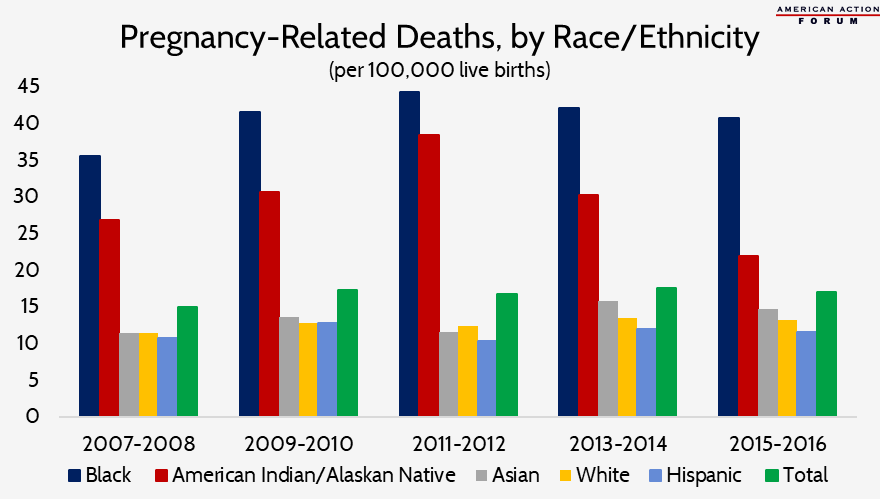
populations relative to others. African American and Native American/Alaskan
Native women are three to four times more likely to die from pregnancy-related
issues than both Hispanic and white non-Hispanic women.[30] The graph below emphasizes the notable
differences in mortality rates across different racial/ethnic groups, which
persist at all ages—and actually worsen—as education level increases, even in
states with the lowest MMR.[31]
Source: Centers for
Disease Control and Prevention. “Racial/Ethnic
Disparities in Pregnancy-Related Deaths—United States, 2007-2016.”
September 6, 2019.
Limited access to
quality hospitals and poor or nonexistent prenatal and postnatal care is
resulting in poor outcomes. A 2010 Healthy People report found that
approximately 25 percent of all pregnant women in the United States do not
receive the recommended number of prenatal visits, though, the rates are much
higher for minority women: 32 percent of African American women and 41 percent
of American Indian/Alaskan Native women do not receive proper prenatal care.[32] This lack of access to early care may be
particularly problematic for black women, as African Americans have a higher
prevalence of high blood pressure, heart disease, and diabetes, all of which,
as mentioned earlier, can cause complications during pregnancy, and may even be
fatal if not addressed early or left untreated.[33]
Further, black women
giving birth at hospitals predominantly serving minorities are at a higher
risk. A study published in 2017 found that 74 percent of black babies were born
at the 25 percent of hospitals serving the highest proportion of black
individuals, and women delivering at these hospitals were significantly more
likely to suffer severe complications than women delivering at lower black-serving
hospitals, even after adjusting for patient characteristics and comorbidities.[34] The study author concludes that delivery
hospital accounts for nearly half of the difference between black and white
maternal mortality rates.
Various other factors
likely are contributing to rising MMR among black women. Social
determinants of health are likely contributing to the mortality rates
experienced by these populations, though the data shows the MMR is higher for
black women than white women at every education level. In fact, black women
with a college degree were still 2.4 times more likely to suffer severe
maternal morbidity and 1.6 times more likely to die from a pregnancy-related
complication than a white woman with less than a high school education.[35] For women with a college degree or
higher, the disparity ratio is 5.2.[36] The rural-urban divide may also be
contributing to the racial disparities. Women in rural areas are at increased
risk of lacking access to proper care. A study in 2017 found that more than
half of all rural counties in the United States, with 2.4 million women of reproductive
age, have no hospital obstetric services and also face primary-care physician
shortages.[37] The study
found these counties were more likely to have a higher percentage of
non-Hispanic black women, to have lower median household incomes, and to be in
states with more restrictive Medicaid eligibility. Closing the gaps on these
factors is going to be a necessary step in ameliorating the overall maternal
mortality rate.
Policy Solutions
A good place to start
for improving maternal mortality would be to increase monitoring of and
adherence to safety recommendations and best practices developed by the Joint Commission or the Alliance
for Innovation on Maternal Health Program, which the American College of
Obstetrics and Gynecologists and other provider groups created. A recent investigation
found a severe lack of attention to even basic safety protocols for mothers;
for instance, fewer than 15 percent of pregnant women at risk of a stroke due
to high blood pressure were treated according to recommendations.[38] Interventions such as coordinated care,
home visits particularly for at-risk women, health education, prenatal care
consultations, and specialized-care referrals can also benefit expecting and
postpartum mothers.[39] Increasing insurance coverage, reducing
cost restrictions, and pursuing proven provider collaboration models will
likely expand access to prenatal and postnatal care. For the uninsured, the
average cost of prenatal care is roughly $2,000 in aggregate.[40] Delivery and postnatal care can cost
upwards of $15,000,
depending on insurance coverage, although this figure does not account for the additional
costs associated with bringing a baby home, highlighting the cost burden
that is particularly felt by low-income and uninsured.
The Preventing
Maternal Deaths Act, signed into law in December 2018, provides federal
grants to states for investigating the deaths of women who die within a year of
pregnancy.[41] This legislation establishes and
supports new and existing state maternal mortality review committees (MMRCs),
which are entities that collect and report standardized data on maternal deaths
to inform quality improvement interventions, most notably, among other
responsibilities.[42] MMRCs also evaluate factors such
as social determinants, including racism, economic status, and nutrition to
paint a bigger picture of the issues influencing maternal deaths. Drawing from
the data, MMRCs develop recommendations and strategies to reduce problematic
behaviors and better support women. Various public-private partnerships between
state agencies and private stakeholders (payers, providers, hospitals, etc.)
focus on realizing these strategic actions. A
recent study in Health
Affairs found that 38 states currently have active MMRCs
recognized by the CDC, with more states in the process of authorizing and
establishing additional MMRCs. The funding and supplementary resources provided
to the states by the Preventing Maternal Deaths Act allows states to further
develop comprehensive data reporting and reduce variability across MMRCs.
Case Study:
California
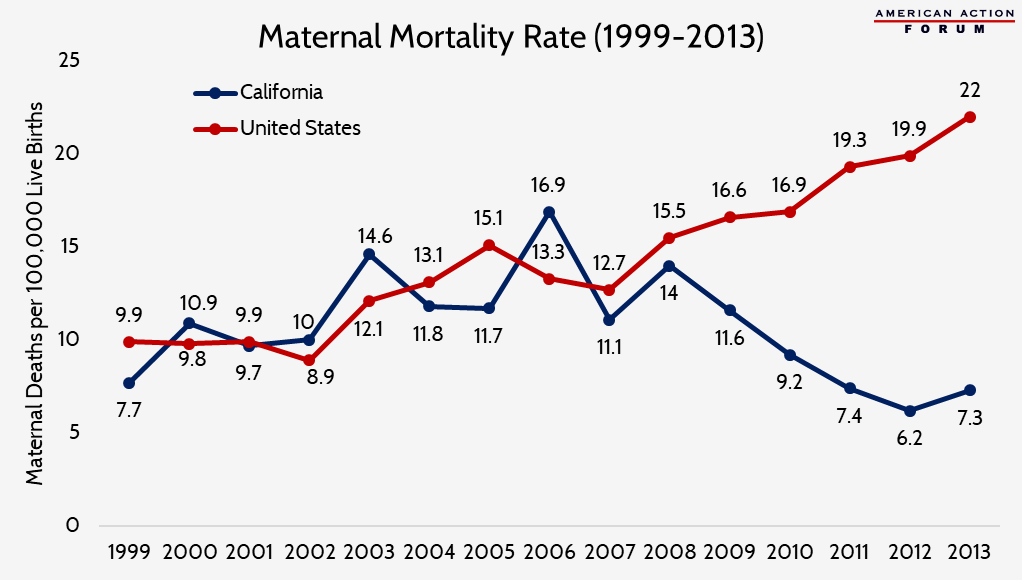
California has been a
pioneer in reducing maternal mortality for over a decade following the
implementation of the California Maternal
Quality Care Collaborative (CMQCC) in 2006. By 2013, the state’s maternal
mortality rate was reduced by half to an average of 7 deaths per 100,000 live
births.[43] This trend diverges greatly from the
national average, which, according to the CMQCC, rose from 13.3 to 22 deaths
per 100,000 during the same time period.[44] Notably, most of the reduction was
driven by reduced mortality rates among black women, and while a disparity
between blacks and other races still exists in the state, the difference has
significantly declined since the program’s creation.[45]
This collaboration
between hospitals, clinicians, state agencies, insurers, patient and public
groups, and other stakeholders requires four key components: linking public health
surveillance and proactive action; mobilizing collaborative public and private
partnerships; creating a data system with low administrative burden to support
improvements; and establishing multi-stakeholder interventions that connect
providers with relevant health services.[46]
Source: State of
California, Department of Public Health, California Birth and Death Statistical
Master Files, 1999-2013. https://www.cmqcc.org/research/ca-pamr-maternal-mortality-review
The CMQCC and the
California Department of Public Health hold annual maternal mortality review
committee meetings to assess maternal mortality in the state, including causes
of death and demographic characteristics, to determine potential interventions
to eliminate mortality among various populations.[47] Recommendations are then used to develop
free evidence-based toolkits
for stakeholders to implement effective quality improvement strategies.[48] These toolkits inform providers of what
to do when complications arise and how to be more equitable and efficient in
care delivery.
The most notable
difference between California and other states is the success of its Maternal Data Center (MDC),
which was created to generate rapid-cycle performance metrics on the maternity
care services that patients receive at participating hospitals in order to
provide insight and aid in quality improvement efforts. Launched in 2012, over
200 California hospitals representing more than 95 percent of births are
monitored by the MDC, with expansions in Oregon (2014) and Washington state
(2015).[49] This tool has allowed these hospitals to
use real-time data to generate perinatal quality metrics and evaluate
performance to meet and exceed established benchmarks while reducing data
quality issues and discrepancies in performance reporting.[50]
The combination of
mortality reviews, stakeholder engagement, and data has provided a blueprint
for improvements targeting performance and quality metrics. The implementation
of these large-scale interventions is likely the driving force behind
California’s improvements in maternal mortality rates and could potentially
have similar effects if administered at the national level across various
states to aid in maternal mortality rate reductions. Of course, there are
potential limitations and challenges to applying this model, including its
reliance upon multi-stakeholder engagement. Under-resourced states may find it
difficult to finance data collection and reporting if the infrastructure does
not already exist. Rural areas, and especially states that are not receiving
enhanced federal funding from expanding their Medicaid programs, may also be
unable to support the types of performance initiatives implemented under CMQCC
due to more limited access to maternal care services among their uninsured
populations (whose rates are higher than in states that have expanded Medicaid)
and provider shortages. The Washington Post
reports that the cost of California’s efforts to the state Department of
Public Health is approximately $950,000 annually, with additional resources
from grants and foundations provided.
Case Study: North
Carolina
North Carolina also implemented
some statewide initiatives to address maternal mortality over the past decade
and has seen some improvements. In 2009, North Carolina implemented the Perinatal Quality Collaborative, working with
65 hospitals across the state to improve quality by changing care practices,
such as reducing the number of early elective deliveries. In 2011, the state
created a new Medicaid
Pregnancy Medical Home, which sought to improve care coordination,
particularly among low-income individuals, similar to what California did.
Medicaid providers are financially incentivized to screen for conditions that might
put a woman at higher risk for complications during pregnancy; if risk is
found, she is referred to a case manager who can help monitor her care and make
sure she understands not just what she needs to be doing, but also why. The
case manager will also visit their patients at home and assist in overcoming
nonmedical challenges that may affect the health of mom and baby, such as food
insecurity or housing issues.
These efforts seem to
be contributing to improved outcomes and reduced MMR for black women in the
state, so much so that the disparity between black and white women was
virtually eliminated in 2013. Though, the elimination of that gap was not
achieved as a result of the MMR for black women falling compared to the MMR for
white women when these interventions began.[51] Rather, unlike in California, the MMR
for white women in North Carolina has been increasing, similar to the overall
national rate. It is unclear why black women are seeing such a benefit, but not
white women. White women comprise a greater share of North Carolina’s Medicaid
population than black women: 43 percent, compared with 37 percent, according to
the most recent figures.[52]
Conclusion
Addressing maternal
mortality in the United States will require more than infrastructural
improvements to better track the causes of deaths. Policymakers and providers
need to recognize the influence of social determinants and health inequities to
create more far-reaching policies to target the most vulnerable populations.
The last year has seen an uptick in legislation intending to tackle these
crucial issues, but the work is certainly not done. Fortunately, California has
provided a model for other states to follow, though each state will likely need
to adapt its strategy to their population’s specific needs.
[2] https://www.cdc.gov/reproductivehealth/maternalinfanthealth/pregnancy-mortality-surveillance-system.htm
[3] https://www.cmqcc.org/research/ca-pamr-maternal-mortality-review,
https://www.ncbi.nlm.nih.gov/pmc/articles/PMC5001799/
[6] https://www.smithsonianmag.com/smart-news/cdc-says-more-half-us-pregnancy-related-deaths-are-preventable-180972140/
[7] https://www.cdc.gov/mmwr/volumes/68/wr/mm6818e1.htm?s_cid=mm6818e1_w,
https://apps.who.int/iris/bitstream/handle/10665/194254/9789241565141_eng.pdf;jsessionid=A5BCC05853070F3E0AAADCC3FB3CB6EB?sequence=1,
https://stats.oecd.org/index.aspx?queryid=30116
[8] https://www.usnews.com/news/healthiest-communities/articles/2019-05-07/most-pregnancy-related-deaths-preventable-cdc-says
[14] https://www.reuters.com/article/us-health-cesarean/c-section-complication-risk-rises-with-mothers-age-idUSKCN1RN2SN
[17] https://www.usnews.com/news/healthiest-communities/articles/2019-05-07/most-pregnancy-related-deaths-preventable-cdc-says
[22] https://www.macpac.gov/wp-content/uploads/2018/11/Pregnant-Women-and-Medicaid.pdf,
https://docs.house.gov/meetings/WM/WM00/20190516/109496/HHRG-116-WM00-Wstate-HarrisP-20190516.pdf
[24] https://www.theguardian.com/us-news/2018/jan/16/why-does-it-cost-32093-just-to-give-birth-in-america
[26] https://www.urmc.rochester.edu/encyclopedia/content.aspx?contenttypeid=90&contentid=P02481,
https://www.thelancet.com/journals/langlo/article/PIIS2214-109X(14)70007-5/fulltext
[30] https://www.smithsonianmag.com/smart-news/cdc-says-more-half-us-pregnancy-related-deaths-are-preventable-180972140/
[35] https://www.ucsfcme.com/2018/MOB18003/SLIDES/13_HOWELL_Racial_Ethnic_Disparities_Maternal_Mortality.pdf,
https://www.cdc.gov/mmwr/volumes/68/wr/mm6835a3.htm
[44] https://www.washingtonpost.com/national/health-science/a-shocking-number-of-us-women-still-die-from-childbirth-california-is-doing-something-about-that/2018/11/02/11042036-d7af-11e8-a10f-b51546b10756_story.html?utm_term=.30aea82465de
[52] https://www.kff.org/medicaid/state-indicator/medicaid-enrollment-by-raceethnicity/?currentTimeframe=0&selectedRows=%7B%22states%22:%7B%22north-carolina%22:%7B%7D%7D%7D&sortModel=%7B%22colId%22:%22Location%22,%22sort%22:%22asc%22%7D
https://www.americanactionforum.org/insight/maternal-mortality-in-the-united-states/#ixzz606vEJq3H
Follow @AAF on Twitter

No comments:
Post a Comment