 |
News Release
|
||
|
As Unemployment Skyrockets, KFF Estimates More than 20 Million People
Losing Job-Based Health Coverage Will Become Eligible for ACA Coverage
through Medicaid or Marketplace Tax Credits
Nearly Six Million Are Not Eligible and
Will Have to Pay the Full Cost of Coverage, and Many Could End Up Uninsured
Coverage Losses Will Affect At Least a
Million Residents in Each of Eight States: California, Texas, Pennsylvania,
New York, Georgia, Florida, Michigan and Ohio
With
more than 31 million workers filing unemployment claims between March 1 and
May 2 as the coronavirus crisis hit the nation’s economy, a new KFF analysis estimates 26.8 million people across
the country would become uninsured due to loss of job-based health coverage
if they don't sign up for other coverage.
While
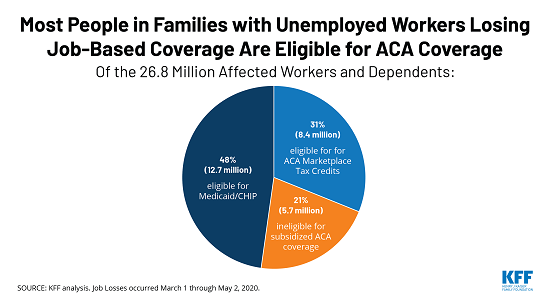
most are eligible for coverage under the Affordable Care Act (ACA), not all
will take it up. In addition, 5.7 million are not eligible for help under the
ACA and would have to pay the full cost of their coverage, and many of them
will likely remain uninsured.
The
analysis estimates that, based on their incomes and other factors, most (79%)
who lost employer coverage and became uninsured are likely eligible for
subsidized coverage, either through Medicaid (12.7 million) or through the
ACA’s marketplaces (8.4 million).
Overall,
nearly 78 million people live in a family experiencing job loss since March
1. Some already have coverage from a source besides the previous employer,
which they would retain, or could switch to coverage offered by their
spouse’s employer or, for young adults, through parents.
At
first, a small number (150,000) who live in states that have not expanded
their Medicaid programs to cover low-income childless adults would fall into
a “coverage gap,” ineligible for Medicaid but with incomes too low to qualify
for tax credits to help with marketplace premiums. The analysis projects that
this group would grow to 1.9 million by January 2021 when workers’
unemployment benefits expire, dropping their incomes below the threshold to
qualify for tax credits.
“Unlike
in past recessions, most of those who lose their job-based coverage will be
eligible for health coverage because of the Affordable Care Act, though some
may find coverage unaffordable even with subsidies,” Executive Vice President
for Health Policy Larry Levitt said. “As unemployment benefits expire,
however, about two million more people in states that did not expand their
Medicaid programs under the ACA will move into the Medicaid coverage gap and
have no affordable option.”
Eight
states have at least a million affected residents and account for nearly half
of all people losing employer coverage and becoming uninsured: California
(3.4 million), Texas (1.6 million), Pennsylvania (1.5 million), New York (1.5
million), Georgia (1.4 million), Florida (1.4 million), Michigan (1.2
million) and Ohio (1 million). These are all large states with many workers
in hard-hit industries that often provide health benefits.
The
analysis reflects workers’ incomes while working and while employed, family
status, and state of residence. It takes into account workers’ expected
unemployment benefits, including the $600 per week additional federal
supplement available through the end of July.
Other
findings include:
Filling the need for trusted
information on national health issues, the Kaiser Family Foundation is a nonprofit organization
based in San Francisco, California.
|
|||
|
|||
|
Connect with us:
    |
|||
|
|||
Wednesday, May 13, 2020
Analysis: More than 20 Million People Losing Job-Based Coverage Will Become Eligible for ACA Coverage


Subscribe to:
Post Comments (Atom)
No comments:
Post a Comment