Payers are
not working quickly enough to address significant burdens associated with prior
authorizations, the AMA asserts.
March 14,
2019 - Physicians are still frustrated by problematic prior
authorization (PA) procedures and believe that health payers are moving too
slowly on necessary solutions, finds a new survey by the American Medical
Association (AMA).
Building on
data released earlier in 2019, which
showed near-universal dissatisfaction with PA protocols, the AMA is again
urging health plans to reduce the administrative burdens associated with the
pre-approval process.
“While health plans
and benefit managers contend that PA programs are important to control costs,
providers often find these programs to be burdensome and barriers to the
delivery of necessary patient care,” the professional organization wrote.
To combat perceptions
of burden while maintaining the benefits of PA for controlling costs, the AMA
collaborated with other major industry groups to develop a framework for using
PAs effectively.
The American Hospital
Association, AHIP, Blue Cross Blue Shield Association, MGMA, and the American
Pharmacists Association all signed off on the 2018 Consensus Statement on Improving the Prior
Authorization Process.
Yet the AMA believes
that industry stakeholders are not moving quickly enough to address the shared
areas of concern, such as targeting PAs to specific situations, embracing
automation, and improving transparency and communication around the PA process.
A survey of 1000
practicing physicians confirms the group’s concerns, the AMA contends.
For example, payers
signing the industry consensus statement agreed to address communication
barriers and encourage the adoption of automated, digital techniques for
sending and receiving PA information.
“Moving toward
industry-wide adoption of electronic prior authorization transactions based on
existing national standards has the potential to streamline and improve the
process for all stakeholders,” the statement says.
“Additionally, making
prior authorization requirements and other formulary information electronically
accessible to health care providers at the point-of-care in EHRs and pharmacy
systems will improve process efficiencies, reduce time to treatment, and
potentially result in fewer prior authorization requests because health care
providers will have the coverage information they need when making treatment
decisions.”
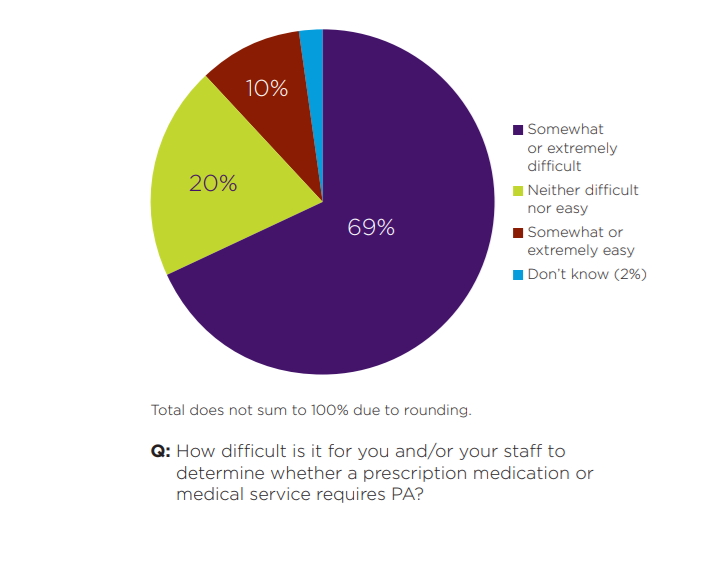
However, 69 percent
of survey participants said that it is still somewhat or extremely difficult to
communicate with payers around prior authorizations. Physicians find it
challenging to determine what services or prescriptions require a PA and what
criteria support the decision.
Source:
AMA
In addition, few
physicians are able to conduct PA transactions through modern digital
means. Only 21 percent of providers reported that their electronic health
record (EHR) systems are able to support electronic PA for prescription drugs.
About 60 percent of
physicians commonly use the phone for PAs related to prescriptions and medical
services. Nearly half of physicians routinely use fax machines for the
process.
As a result of slow
and unwieldy communication processes, physicians report that the continuity of
care for their patients is frequently interrupted.
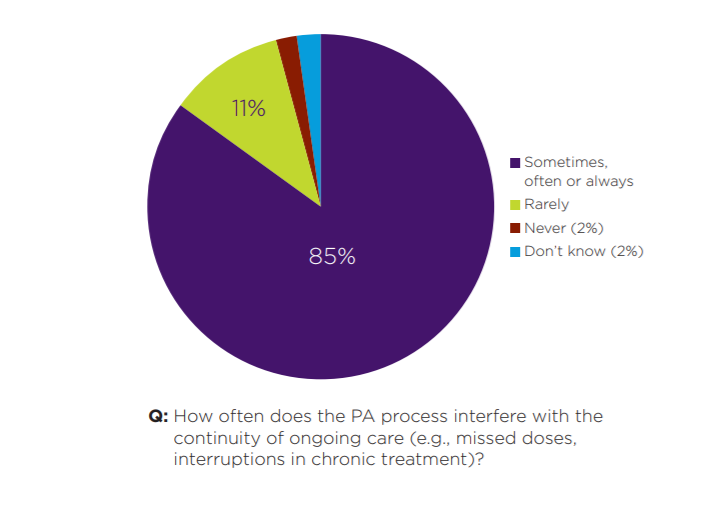
Eighty-five percent
of respondents said that PAs sometimes, often, or always interfere with the
continuity of care by introducing delays or detours in treatment.
In the earlier
survey, 91 percent of physicians also stated that prior authorizations actively
contribute to worse outcomes for patients. Patients are more likely to
abandon treatment or experience delays in necessary care when PAs are involved,
they asserted.
About two-thirds of
physicians wait at least one business day for a response to a PA request.
A quarter routinely wait more than three days.
The industry has also
pledged to address these inefficiencies by
developing more selective PA criteria.
“Differentiating the
application of prior authorization based on provider performance on quality
measures and adherence to evidence-based medicine or other contractual
agreements (i.e., risk-sharing arrangements) can be helpful in targeting prior
authorization requirements where they are needed most and reducing the
administrative burden on health care providers,” the consensus statement says.
“Criteria for
selective application of prior authorization requirements may include, for
example, ordering/prescribing patterns that align with evidence-based
guidelines and historically high prior authorization approval rates.”
But only 8 percent of
physicians reported contracting with health plans that allow exemptions for
providers, the AMA says.
Source:
AMA
Instead of narrowing
the focus and reducing the number of required PAs, payers are actually on the
opposite path, the survey indicates.
Eighty-six percent of
respondents have seen increases in PAs for medical services and 88 have seen
more prescription PAs over the past five years, the poll found.
However, since the
industry consensus statement was only signed in 2018, this statistic may not be
a useful assessment of progress since the agreement.
Nevertheless,
physicians are united in their view that the prior authorization process is
ripe for change, and the AMA is clearly strongly invested in pushing speedier
progress.
The society has
published an extensive list of reports,
recommendations, and principles related to member concerns about PAs, and
offers providers a number of resources to help physicians
understand and navigate the process.
“The AMA is committed
to attacking the dysfunction in health care by removing the obstacles and
burdens that interfere with patient care,” saidAMA Board of Trustees Chair Jack
Resneck Jr., MD, after the release of the first survey data in February.
“To make the
patient-physician relationship more valued than paperwork, the AMA has taken a
leading role by creating collaborative solutions to right-size and streamline
prior authorization and help patients access safe, timely and affordable
care, while reducing administrative burdens that pull physicians away from
patient care.”
“The time is now for
insurance companies to work with physicians, not against us, to improve and
streamline the prior authorization process so that patients are ensured timely
access to the evidence-based, quality health care they need.”
https://healthpayerintelligence.com/news/ama-payers-moving-too-slowly-on-prior-authorization-fixes?eid=CXTEL000000460294&elqCampaignId=8956&elqTrackId=bce15b779a4f4149b01fac063ba75f9a&elq=a1d6f6dec6894030ba8c51769738148e&elqaid=9414&elqat=1&elqCampaignId=8956

No comments:
Post a Comment