|
Poll: Most Democrats Prefer a Presidential Candidate Who Wants to
Build on the Affordable Care Act
53%
of Public View the ACA Favorably as Democratic Support for the 2010 Law
Reaches All-Time High
Poll Also Finds Strong Bipartisan Support for Surprise Billing Legislation
Most
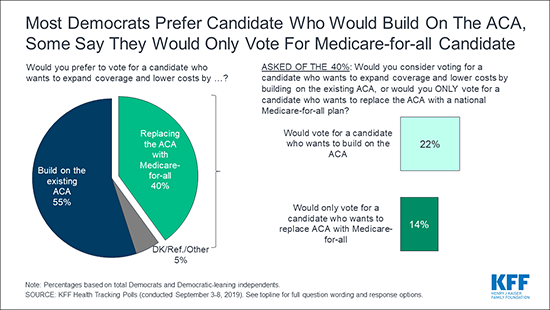
Democrats and Democratic-leaning independents (55%) say they prefer a
candidate who would build on the Affordable Care Act to achieve those goals.
Fewer (40%) prefer a candidate who would replace the ACA with a
Medicare-for-all plan.
Even among those who prefer a
candidate who would replace the ACA with a national Medicare-for-all plan,
most say they would vote for a candidate who wants to build on the ACA (22%
of all Democrats and Democratic-leaning independents). On the other hand, 14%
of all Democrats and Democratic-leaning independents say they would only vote
for a candidate who wants to replace the ACA with a Medicare-for-all plan.
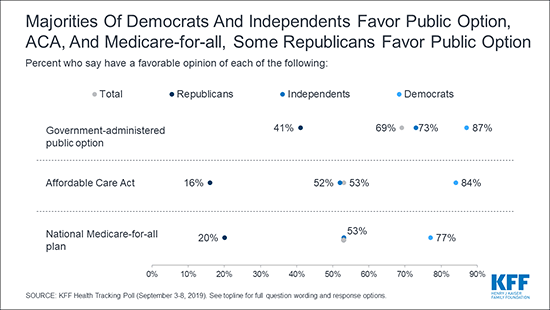
Among the public overall, a
majority (53%) now view the ACA favorably, a slight increase since July (48%)
and up significantly since before President Trump took office. Among
Democrats, 84% now view the 2010 law favorably – an all-time high in nine
years of KFF polling. The share of Democrats who hold favorable views of the
ACA has increased 11 percentage points during President Trump’s term, up from
73% in February 2017.
Opinions
towards both a government-administered public option that would compete with
private health insurance plans and a national Medicare-for-all plan in which
all Americans would get their insurance from a single government plan hold
steady this month, yet large shares express some uncertainty about the
differences between the two proposals.
Nearly
seven in 10 Americans (69%) favor having a government-administered public
option and about half (53%) favor a Medicare-for-all plan. Most Democrats and
independents favor the ACA, and the proposed public option and
Medicare-for-all. Four in ten (41%) Republicans favor a
government-administered public option.
The
public is divided in their perceptions of the similarities between a national
health plan in which all Americans would get their coverage from a single
government plan and a government-administered public option that would
compete with private health insurance.
About
half (47%) say that the two approaches are “very” or “somewhat” similar. In
spite of the debate about the approaches in Democratic presidential
nominating race, Democrats are no more aware that the two approaches are
different than the overall public is.
Large
shares of the public say they have heard either “a little” or “nothing” about
either a government-administered public option (64%) or a national
Medicare-for-all plan (48%).
Out-of-Pocket
Costs and Pre-Existing Conditions Are Public’s Top Health Priorities for
Congress
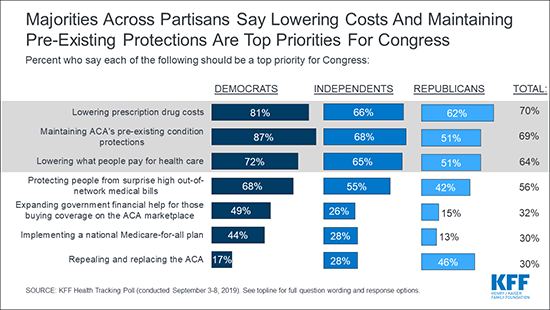
With
Congress back from its August recess, the new poll finds majorities across
party lines consider action on lowering prescription drug costs (70%),
maintaining the Affordable Care Act’s pre-existing condition protections
(69%), and lowering the amount people pay for care (64%) as Congress’ “top”
health-care priorities.
Congress
is currently considering bi-partisan legislation to address surprise bills,
which can occur when people with insurance inadvertently receive care from an
out-of-network provider. The poll finds 78% of the public, and majorities of
Democrats (84%), independents (78%), and Republicans (71%), support
legislation to protect patients from paying the cost of such surprise bills.
A
majority (57%) continue to support such legislation even after hearing
opponents’ argument that it would lead to doctors and hospitals being paid
less, though about one-fifth (17%) switch to oppose it after hearing the
argument, increasing total opposition to 37%.
Designed
and analyzed by public opinion researchers at KFF, the poll was conducted
Sept. 3-8 among a nationally representative random digit dial telephone
sample of 1,205 adults. Interviews were conducted in English and Spanish by
landline (305) and cell phone (900). The margin of sampling error is plus or
minus 3 percentage points for the full sample. For results based on
subgroups, the margin of sampling error may be higher.
Filling
the need for trusted information on national health issues, the Kaiser Family Foundation is
a nonprofit organization based in San Francisco, California.
|




No comments:
Post a Comment